Leather Sectional Sofas on Sale: A Buyer’s Guide


A leather sectional often starts as a feeling before it becomes a purchase. A homeowner wants one inviting corner of the house that handles movie nights, holidays, quiet mornings, and the occasional nap without looking tired after a year. Then the search begins, and the phrase leather sectional sofas on sale starts appearing everywhere.
That's usually where the confusion sets in. A lower price can signal a smart opportunity, but it can also hide compromises in leather quality, frame construction, scale, or delivery fit. For a long-lived piece like a sectional, the better question isn't “How much is it off?” It's “Will it still feel like a good decision years from now?”
That investment mindset matters because leather is not a fringe category. It has represented 34% of all upholstery sales at retail in a recent year, according to Furniture Today's leather category report. In plain terms, shoppers aren't hunting a rare bargain when they look for leather seating on sale. They're shopping within a large, established furniture category where promotions, floor samples, and clearance opportunities appear regularly.
For homeowners visiting Easton Town Center, that's also why a showroom visit still matters. A sectional isn't just seen. It's sat in, measured, compared, and evaluated as part of the room it will anchor.
Table of Contents
- The Savvy Shopper's Guide to Leather Sectionals
- Measure Twice Buy Once A Practical Planning Guide
- Decoding Leather Quality and Frame Construction
- Customizing Your Sectional for a Perfect Fit
- How to Find Genuine Value and Great Savings
- Delivery Day and Long-Term Leather Care
The Savvy Shopper's Guide to Leather Sectionals
A common scene plays out like this. A family has outgrown the old sofa. One seat sags, the fabric shows wear, and nobody really fits comfortably anymore. They start looking for a leather sectional because it feels substantial, polished, and easy to live with. Then they see a markdown and wonder if they should move quickly before it's gone.
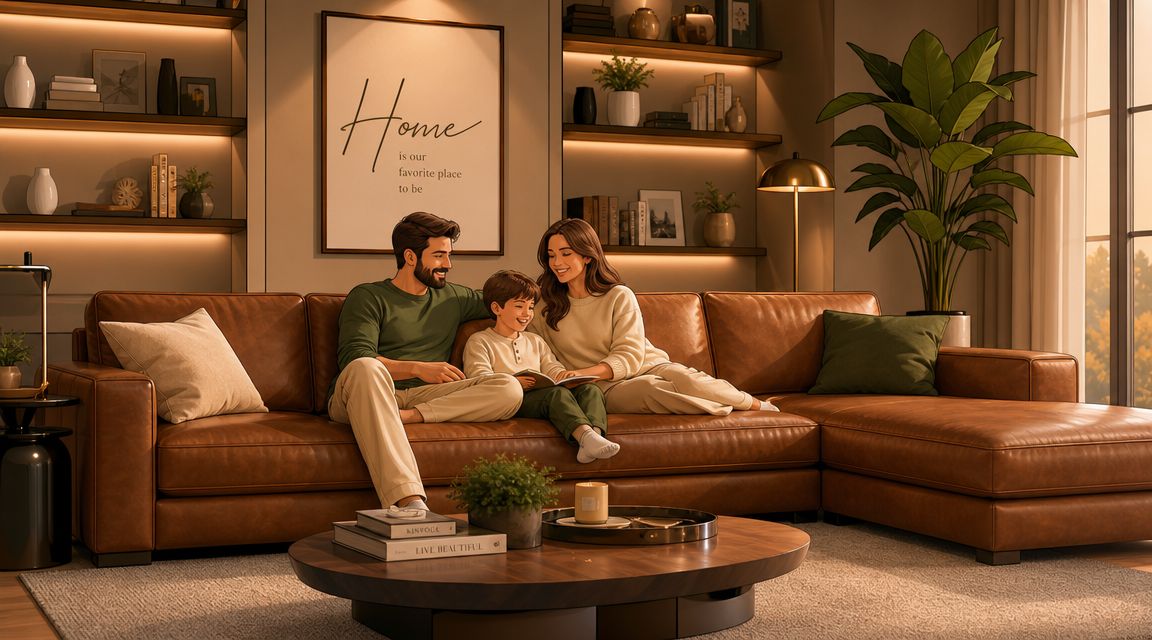
That moment is where savvy shopping begins. A strong sale purchase isn't just a lower number on a tag. It's a piece that fits the room, supports the body well, wears gracefully, and still feels appropriate when the home evolves around it.
What shoppers often get wrong
Many buyers compare only shape and discount. That's understandable, because sale tags are easy to read and construction details usually aren't. But sectionals are large, tactile pieces. They ask more from a room than a chair or ottoman does. They affect traffic flow, conversation layout, and the overall feel of a space.
Practical rule: A sectional should be evaluated like a long-term household fixture, not like an impulse décor purchase.
This is why many homeowners benefit from slowing the process down. Looking at one sectional in isolation can make almost any sale seem attractive. Looking at it in context changes the decision. The room size, the seat depth, the leather finish, and the delivery path all matter before the price can be judged fairly.
A useful starting point is a buying framework like this sectional planning guide from Vinson Fine Furniture, which helps shoppers sort through scale, layout, and everyday use before they commit.
The investment mindset
An investment homeowner usually isn't looking for the lowest possible spend. That buyer wants value, which is different. Value means the sectional serves the house well for a long time. It also means the piece still looks intentional after the novelty of the sale has worn off.
That's especially true in a market such as Columbus, where homeowners often want spaces that feel finished and durable, not temporary. In a well-edited room, the leather sectional becomes the visual anchor. It carries weight, both physically and stylistically.
The best leather sectional sofas on sale tend to be the ones that still make sense after the initial excitement passes. If the room works better, the seating feels better, and the construction supports years of use, the discount is a benefit. If not, it's only a short-term thrill.
Measure Twice Buy Once A Practical Planning Guide
Before anyone compares leather grades or cushion fills, the first job is simple. Measure everything the sectional has to pass through and everything it has to live within. This step prevents one of the most frustrating furniture mistakes a buyer can make.
A common but critical problem is failing to measure the delivery path. Sectionals are among the most-returned furniture categories due to size and access issues, according to this delivery-fit guidance on sectionals. Room dimensions alone don't protect against a sectional that can't get through the front door, turn a stair landing, or fit inside an elevator.
What needs to be measured
A sectional has two dimensions to plan for. One is the finished footprint in the room. The other is the travel path from outside the home to the exact spot where the piece will be placed.
A clear checklist helps:
Measure the seating wall and open floor area.
Record the maximum width and depth the sectional can occupy without blocking walkways, vents, or sightlines.Measure every doorway on the route.
Include exterior doors, interior doors, and any narrow transitions.Check stairwells and landings.
Tight turns are often harder than straight runs.Measure elevator interiors if applicable.
Apartment and condo buyers should check door opening and cabin depth, not just one or the other.Note ceiling height and light fixtures near corners.
Tall backs and awkward angles can create surprises during carry-in.
The most useful measuring habit
Many shoppers measure the room while forgetting circulation. A sectional may fit on paper and still make the room feel cramped once people need to move around it. That's why the best plans include walking space between the sectional and nearby pieces such as coffee tables, media consoles, and side chairs.
Measure the path people take through the room, not just the patch of floor where the sectional will sit.
Professional space planning can save money and stress. For homeowners who want help visualizing scale, this furniture measuring resource is a practical place to start before stepping into a showroom.
A simple planning example
Consider a homeowner choosing between a long chaise sectional and a modular corner sectional. Both may technically fit in the room. But if the chaise projects into the main traffic lane from the hallway to the kitchen, the room won't function well. The modular version may feel larger in a better way because it preserves movement.
That distinction matters more during sale shopping. A discounted sectional can feel urgent, which pushes buyers to decide before they've tested the room plan properly. The smarter move is to sketch the footprint with painter's tape on the floor first. That gives the household a chance to live with the shape for a day or two.
In situations with unusual layouts, split-level homes, or apartment access concerns, a design consultation can be especially useful because the problem isn't only style. It's logistics.
Decoding Leather Quality and Frame Construction
Price tags rarely explain why one leather sectional feels steady and refined while another feels loose or thin. The difference usually comes from what the buyer can't see at a glance. Leather grade, frame build, joints, cushion density, and suspension all shape how a sectional performs over time.
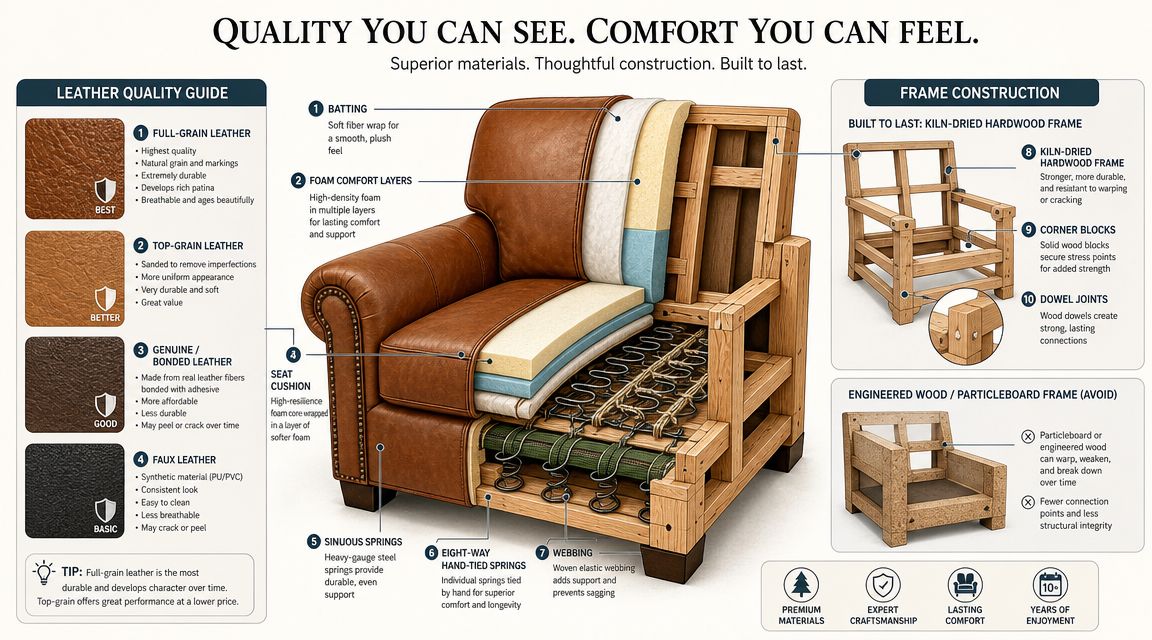
The most reliable way to evaluate a leather sectional on sale is to verify the leather grade, inspect the frame for solid hardwood with corner-blocked joints, and check for high-density foam cushions. A practical benchmark used in upholstery is 1.8 lb/ft³ or higher for high-density polyurethane seat foam, as noted in this leather sectional buying guide.
How to read leather labels
Shoppers often see several leather terms and assume they all mean roughly the same thing. They don't. The label tells a story about surface character, consistency, and long-term wear.
Top-grain leather is generally the strongest and most consistent option discussed in upholstery standards because the outer grain layer remains intact. It usually offers a cleaner, more dependable balance of durability and appearance.
Split leather comes from lower layers of the hide. It can still be used in furniture, but it doesn't offer the same surface integrity as top-grain.
Bonded leather contains leather content but isn't the same as full leather surface material. It's usually the wrong place to compromise if the goal is longevity.
| Leather Type | Description | Best For |
|---|---|---|
| Top-grain | Outer grain layer remains intact, offering strong durability and a more consistent finish | Long-term everyday seating |
| Split | Lower layer of the hide, usually less durable and less consistent in feel | Lower-priority use where budget matters more than longevity |
| Bonded | Material that contains leather content but isn't a full leather surface in the same way as top-grain | Shorter-term or lower-investment purchases |
A shopper can learn more about material differences through this leather furniture selection guide.
What sits under the leather matters just as much
A handsome hide won't rescue a weak frame. If the base shifts, creaks, or twists, the upholstery above it will show that strain over time. For long-term use, solid hardwood or engineered hardwood frames with corner-blocked, glued, and screwed joints are preferred over softwood-only construction held mainly with staples.
A good sit-test reveals a lot. The sectional should feel planted when someone sits down on one end. It shouldn't wobble when weight shifts to the corner. Arms should feel firm, not hollow or loose.
Suspension changes comfort too. Eight-way hand-tied and sinuous-spring systems can create different ride feels and repair considerations. One may feel more buoyant, the other more controlled. Neither should feel flat or unstable.
What a sale tag doesn't tell the buyer
Deep discounts can mean many things. A sectional may be a floor model, a discontinued configuration, or a piece with light cosmetic wear. None of those possibilities automatically make it a bad purchase. They mean the buyer has to inspect more carefully.
If a discount looks dramatic, the construction details deserve even more attention.
Showroom testing is particularly important. The leather should feel appropriate to the intended use. The seat should support the body without collapsing. The frame should feel quiet and solid. For shoppers interested in solid wood furniture Ohio craftsmanship and long-lived upholstery, those tactile clues are often more revealing than any promotional sign.
Customizing Your Sectional for a Perfect Fit
Many homeowners start with sale shopping because they assume custom ordering belongs in a different price category. In practice, customization often solves problems that clearance shopping can't. It helps a buyer get the right size, the right orientation, and the right visual weight for the room.
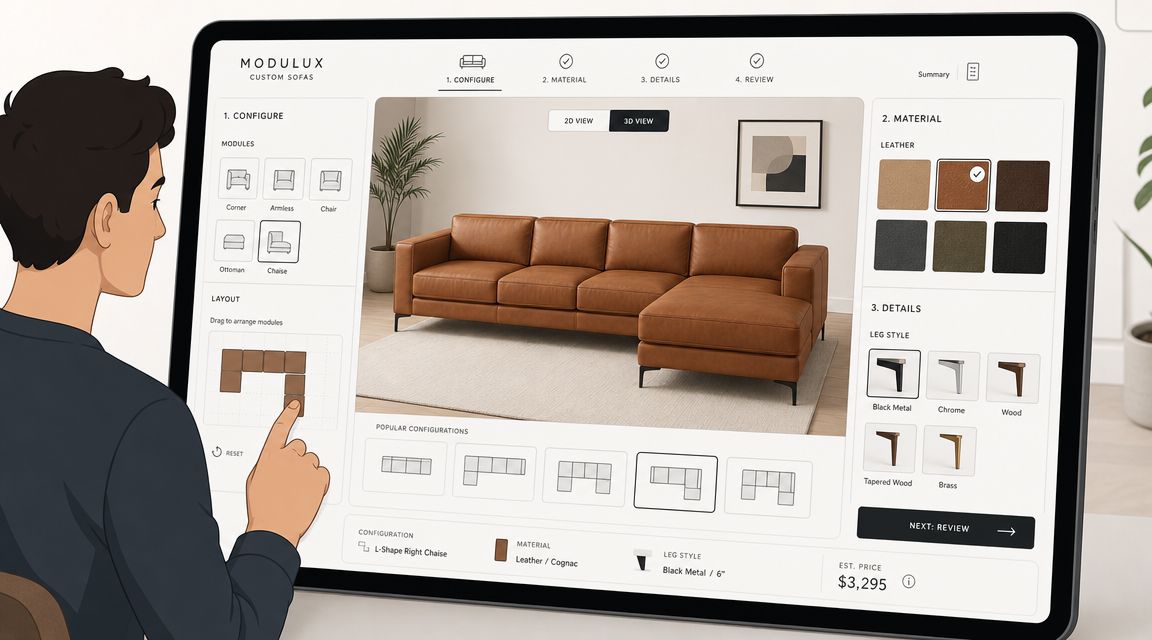
A sectional doesn't need to be extravagant to be custom. It needs to reflect the actual room and the actual household. A left-arm chaise instead of a right-arm chaise can completely change circulation. A narrower arm can recover valuable inches. A different leg finish can help the piece connect with nearby wood tones.
Customization solves more than color
Color is the most obvious choice, but it's rarely the most important one. The better questions are usually about form and function.
- Configuration: Should the chaise face left or right based on the room entry and traffic flow?
- Scale: Would a lower back or slimmer arm keep the room from feeling crowded?
- Use pattern: Does the household need lounging depth, upright support, or a balance of both?
- Visual language: Should the sectional feel crisp and structured, or relaxed and soft-edged?
One helpful tool for sorting that out is a digital visualizer. Seeing modules assembled to room dimensions reduces guesswork. It also helps couples or families make decisions from the same reference point instead of speaking in vague terms like “too big” or “a little boxy.”
What to decide before ordering
Customization works best when the buyer already knows a few essential criteria. Those usually include room size, preferred seat depth, desired orientation, and the overall mood of the space.
A practical decision list looks like this:
- Lead with lifestyle: If the sectional is the primary evening seat, comfort needs to come before sculptural appearance.
- Choose the corner experience: Some sectionals create a true shared lounge zone. Others prioritize cleaner lines and separate seat positions.
- Match the home's architecture: A lofty open-plan room can handle more visual mass than a smaller enclosed living room.
- Think beyond today: A modular or reconfigurable layout can be useful if the homeowner expects to move or remodel.
For buyers exploring personalized layouts, this guide to designing a sectional shows how digital planning can help narrow decisions before an order is placed.
For homeowners furnishing multiple rooms, this kind of planning often connects with broader design decisions too. A family investing in custom dining sets, Amish-made furniture, or other enduring pieces usually benefits from viewing the living room as part of a whole-house plan rather than a stand-alone purchase.
How to Find Genuine Value and Great Savings
Not all sale prices mean the same thing. A markdown can reflect a seasonal promotion, a floor sample, a discontinued layout, or a closeout in a specific leather color. A shopper who understands those differences usually makes calmer, better decisions.
Seasonality can play a role too. Consumer search interest for white leather furniture has shown a late-summer pattern, with interest peaking especially in August and September, according to this trend analysis using Google Trends data. Retailers often align promotions and inventory movement with periods of stronger shopper attention, which makes late summer a useful time to watch for leather sectional sofas on sale.
Not every sale means the same thing
A buyer can think of sale shopping in categories rather than as one giant “discount” bucket.
Seasonal promotions usually offer broader selection because they apply across active assortments. These can be helpful for shoppers who want choices in size, color, or configuration.
Floor samples can offer strong value when the frame and leather remain in good condition. They deserve close inspection at seams, corners, arm tops, and seat cushions.
Discontinued configurations can be excellent if the layout happens to fit the room. The risk is forcing the room to adapt to the sectional instead of the sectional fitting the room.
Clearance pieces can be ideal for decisive buyers who have already done their planning. They're less forgiving for shoppers still figuring out dimensions.
A genuine value purchase happens when the piece, the room, and the timing all line up. Price alone doesn't create that alignment.
A smart shopping rhythm
The strongest approach is to prepare before the sale appears. Measurements should already be in hand. Preferred seat feel should already be understood. Leather expectations should already be clear. Then, when a promising sectional becomes available, the decision is based on fit and construction rather than urgency.
That's one reason some shoppers use showroom visits to narrow their preferences first and purchase later when the right opportunity appears. Others prefer to compare custom-order pricing alongside clearance options, because a made-for-room sectional sometimes delivers better value than a discounted compromise.
For timing ideas and sale patterns, this furniture sale timing guide can help shoppers plan their search more intentionally.
In a Furniture store Columbus Ohio setting, value shopping also tends to be more successful when buyers ask practical questions instead of chasing the biggest markdown. Is the leather grade clearly identified? Is the sectional a floor model? Are replacement cushions available? Can the layout be adjusted later? Those questions reveal value faster than a percentage sign does.
Delivery Day and Long-Term Leather Care
The buying decision doesn't end at checkout. A sectional only becomes a successful purchase when it arrives properly, fits as intended, and stays comfortable and attractive through daily life.

A smart final check is repairability. The total cost of a sectional includes more than the sticker price. It also includes whether cushions or covers can be replaced later, which strongly affects lifetime value, as noted in this guidance on sectional repairability and long-term value.
What to ask before delivery is scheduled
Delivery day goes more smoothly when the buyer confirms a few details in advance.
- Ask about piece count: A sectional that arrives in smaller components is often easier to maneuver than a large fixed unit.
- Confirm room placement: The exact wall, corner, and orientation should be decided before the truck arrives.
- Check assembly expectations: Some sectionals only need connectors aligned. Others involve more setup.
- Clarify service level: In-home placement and packaging removal can make a major difference with oversized furniture.
This is also where financing and service can shape the experience. Some shoppers prefer to spread out a major furniture investment rather than delay the purchase. Others care most about in-home setup because they don't want to manage heavy modules and packing materials themselves.
A high-service showroom can help with both. Vinson Fine Furniture offers flexible financing through Synchrony HOME, White-Glove In-Home Delivery, a Custom Order Program with 3D visualizers, an In-Store Design Studio with complimentary design consultations, a Low Price Guarantee with a 110% refund of the local price difference, and a Clearance Gallery with savings up to 70%.
Simple habits that protect leather
Leather doesn't need complicated care, but it does need consistent care. Small habits prevent avoidable wear.
- Blot spills promptly: Don't rub aggressively. Gentle blotting protects the surface.
- Keep it out of harsh sun: Direct sunlight can dry and fade leather over time.
- Give it breathing room from heat: Vents, radiators, and fireplaces can stress the material.
- Clean with appropriate products: Harsh household cleaners can do more harm than the spill itself.
- Ask about replacement parts early: If cushions, covers, or components are available, that supports long-term ownership.
For ongoing maintenance basics, this leather protection guide is a useful reference.
A well-chosen sectional should age with the home, not fight against it. That's why the sale price is only one part of the story. Delivery planning, service, and care habits are what help the purchase keep its value.
A homeowner shopping for leather sectional sofas on sale usually isn't just buying seating. The purchase shapes daily comfort, room flow, and the long-term look of the home. For those ready to compare layouts, test seat comfort, or explore customization options in person, Vinson Fine Furniture offers a practical next step at Easton Town Center.