Find Your Sectional Couch Most Comfortable


A sectional search often starts the same way. A homeowner opens a dozen tabs, saves a handful of favorites, visits a showroom, sits down for a minute or two, and still leaves unsure. One sectional feels soft but too deep. Another looks refined but sits stiffly. A third seems perfect until the back cushions slide or the seat feels tired after a longer sit.
That confusion makes sense because comfort isn't a finish, a color, or a trendy silhouette. Comfort is a personal fit. The sectional couch most comfortable for one household may feel awkward in another home with different heights, habits, and room layouts.
A better way to shop is to stop asking which sectional is most comfortable in general and start asking which one supports the body well, fits the room, and stays pleasant to use over time. That shift changes everything. It turns the process from guessing into testing.
The guide below treats comfort the way a seasoned furniture designer would in a showroom at Easton Town Center. It focuses on what a shopper can feel, measure, and compare in person, along with the hidden construction details that matter later. Readers who want an early primer on layouts and planning can also review what to know before buying a sectional.
Table of Contents
- Your Search for the Most Comfortable Sectional
- The Anatomy of Lasting Comfort
- Finding Your Perfect Fit with Seat Dimensions
- Choosing Upholstery for Touch and Durability
- The Ultimate In-Store Sit-Test Checklist
- Designing for Your Lifestyle
- Your Partner in Finding Perfect Comfort
Your Search for the Most Comfortable Sectional

Most shoppers don't struggle because they lack taste. They struggle because the word comfortable gets used too loosely. One brand uses it to mean sink-in soft. Another means supportive. A third means oversized and casual. Those are not the same experience.
That matters most with a sectional because it does more than provide a seat. It anchors family movie nights, visiting guests, quiet reading, afternoon naps, and everyday conversation. A piece that looks relaxed in a photo can feel tiring in real life if the seat is too deep, the back too low, or the cushions too loose.
Comfort has to match the household
A taller person may love an expansive lounge seat. A shorter sitter may perch at the front edge of that same cushion and lose back support. A household with children and pets may care just as much about cleanability and cushion recovery as softness on day one.
A sectional earns its place when it supports the way the room is actually lived in, not just the way it photographs.
Shoppers often get stuck comparing arm styles, fabric swatches, and room scenes before learning how the seat should support the body. Once those fundamentals are clear, choices become easier. The shape makes more sense. The material makes more sense. Even the price starts to make more sense because the value is tied to construction, fit, and longevity.
Looking past the trend cycle
Extra-deep and cloud-like sectionals have appeal. So do clean-lined structured pieces. Neither is automatically right or wrong. The sectional couch most comfortable is usually the one that balances support, scale, and use.
That is why an in-person visit still matters. A good showroom visit isn't about browsing aimlessly. It's about learning what the body responds to and what details to inspect before making a long-term investment.
The Anatomy of Lasting Comfort
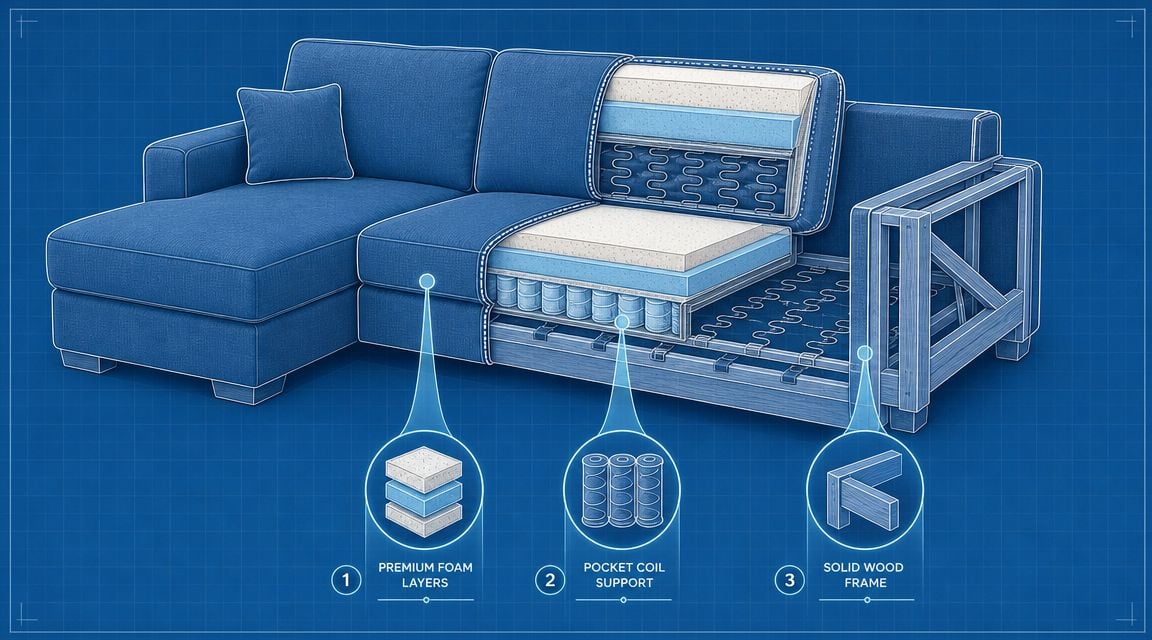
A sectional can feel pleasant for a few minutes and still disappoint after daily use. That usually comes down to what sits underneath the upholstery. According to buyer guidance on sectional construction, the core construction elements are frame integrity, spring system, and cushion design, because those parts control immediate feel and long-term sag resistance.
What supports the body under the fabric
The frame is the skeleton. If it flexes too easily, the seat can develop uneven pressure points and the sectional may creak or feel unstable at the corners where modules meet. A solid, well-built frame helps the seat feel composed instead of wobbly.
The spring system handles weight distribution. It spreads body weight across the seat rather than letting a sitter drop into one concentrated spot. That affects how supported the thighs and hips feel, especially during longer stretches of sitting.
A shopper doesn't need to become a furniture engineer to judge this. A few simple checks reveal plenty:
- Press across the seat: Support should feel consistent, not hollow in the middle and hard at the edges.
- Sit in the corner seat: Corners often expose weak construction faster than straight seats.
- Shift side to side: The sectional shouldn't feel like separate pieces fighting each other.
- Lean on the arm: A stable frame holds steady when someone sits down or stands up.
How cushion design changes the feel over time
The cushion decides the first impression and the long game. Some cushions feel luxurious at first contact but lose resilience during a longer sit. Others feel firmer at first and become more comfortable as the body settles in.
Practical rule: A good seat cushion should compress enough to feel inviting, then push back enough to keep the body supported.
That balance matters most in homes where the sectional is used every day. The same construction guidance notes that a durable spring-and-cushion system generally preserves comfort and posture support longer. That doesn't mean every household needs the same firmness. It means shoppers should ask whether the sectional will still hold the body well after repeated use.
A useful showroom question is simple: what is inside the seat cushion, and how is it wrapped? That question often tells more about lasting comfort than the surface fabric ever will.
Finding Your Perfect Fit with Seat Dimensions
The fastest way to understand comfort is to study the seat, not the silhouette. Seat depth and seat height shape how the body lands, how the pelvis tilts, and whether the lower back stays in contact with the back cushion.
A widely cited benchmark places comfortable usable seat depth at about 22 to 24 inches, with 21 to 22 inches often recommended for people roughly 5'4" to 5'10". The same guidance notes that deeper seating often suits taller users, while deeper seats can also feel more lounge-like than supportive for upright sitting. That benchmark appears in this seating comfort discussion.
Why depth and height have to work together
Seat depth is easy to misunderstand because a deep sectional can feel impressive at first touch. There is room to curl up, stretch out, and sink in. But if the sitter can't comfortably use the back cushion without reaching for extra pillows, the seat may be too deep for regular upright use.
Seat height changes that experience further. A deeper seat often works better when the seat is somewhat lower. If the seat is both deep and high, shorter sitters may feel suspended rather than supported. Their feet may not rest naturally, and their body may slide forward to find a stable position.
That is why comfort isn't a single number. It is the relationship between dimensions.
A simple way to read the numbers
A shopper comparing sectionals in a showroom can use a simple lens.
| Use case | What usually feels better | What to watch for |
|---|---|---|
| Upright conversation | Moderate depth with supportive back contact | Knees too high or no thigh support |
| Reading or working from the sofa | A balanced seat that allows feet to rest naturally | Sliding forward to sit upright |
| Lounging or curling up | Deeper seating or a chaise | Losing back support in standard sitting |
| Mixed-height household | Middle-ground geometry with adaptable pillows | One person loves it while another can't settle |
For room planning, dimensions on paper matter too. A sectional that seems ideal in the showroom may overwhelm a room if the chaise blocks circulation or the corner pushes too far into a walkway. Before a visit, many homeowners benefit from reviewing how to measure furniture for the home.
The most comfortable sectional is rarely the deepest one. It is the one whose proportions let the body relax without fighting the seat.
Choosing Upholstery for Touch and Durability
A sectional is experienced through the skin as much as through posture. Upholstery affects temperature, texture, maintenance, and how welcoming the seat feels at different times of day. A beautiful frame with the wrong cover can still become a disappointing purchase.
How material changes everyday comfort
Leather often appeals to buyers who want a refined, neat look and a surface that wipes clean easily. Its hand feel depends heavily on the finish and grain, but in general it offers a smooth, structured sit.
Performance fabrics suit busy homes because they tend to handle frequent use more gracefully. They can feel soft and relaxed while still standing up well to spills and routine wear.
Natural fibers such as cotton and linen usually offer softness and a casual look. They can be lovely in the right room, though the household's habits matter. A formal sitting room and a family room don't ask the same things of upholstery.
Velvet and textured weaves change the sensory experience the most. They can add warmth, depth, and softness to the hand, but texture also changes how lint, pet hair, and daily brushing show on the surface.
Shoppers deciding between these categories often benefit from seeing larger swatches and considering how the sectional will be used at breakfast, after work, during movie night, and when guests stay late. A broader material primer appears in this upholstery guide.
First-touch softness matters. Long-term comfort also depends on whether the cover stays pleasant to live with and easy to maintain.
Recent design coverage has highlighted washable covers and slipcovered builds, but often focuses on first-day softness more than how the couch feels after 1 to 3 years. The more useful question is how cushion construction and cover maintenance affect longevity, as noted in this discussion of sectional buying considerations.
Comparing Common Sectional Cushion Fills
| Fill Type | Initial Feel | Longevity & Support | Best For |
|---|---|---|---|
| All-foam | Structured and supportive | Often holds a cleaner shape | Homes that prefer a tailored sit |
| Foam with fiber wrap | Soft surface with supportive core | Balances comfort and shape retention | Everyday family rooms |
| Down blend | Plush and relaxed | May need more frequent smoothing and care | Buyers who want a sink-in feel |
| Down alternative blend | Soft with a tidier appearance | Often easier to maintain than a looser plush fill | Mixed-use spaces |
The right combination is often a material plus fill decision, not one or the other. A resilient cushion inside an easy-living cover usually outperforms a soft cover wrapped around a weak seat core.
The Ultimate In-Store Sit-Test Checklist
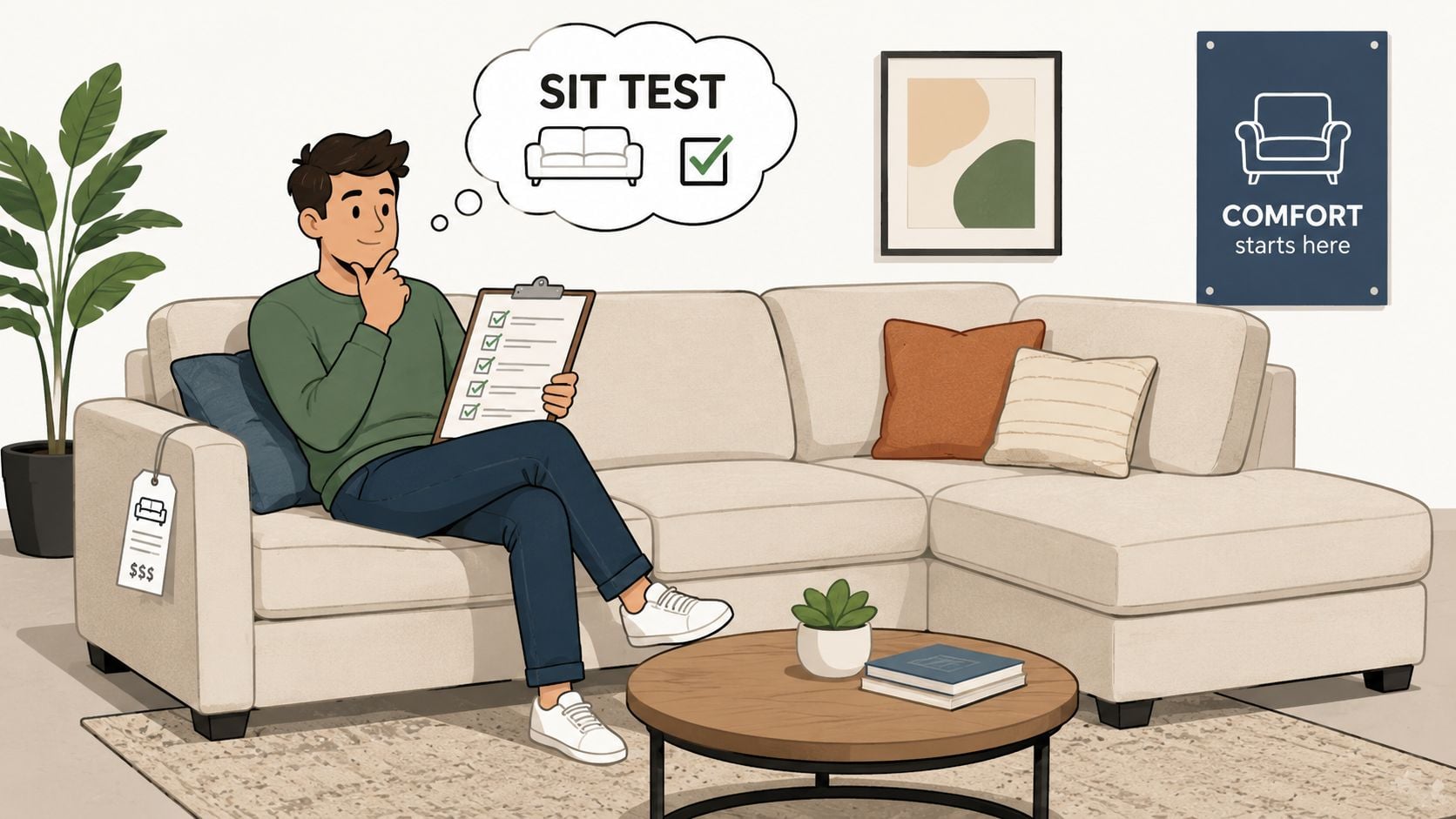
A showroom visit becomes useful when the shopper tests the sectional the way it will be used at home. Style alone won't answer whether the back supports reading posture, whether the corner seat pinches, or whether standing up feels graceful.
Guidance on sectional comfort often misses that point. As noted in this article on comfortable sectionals, seat geometry strongly affects comfort, and matching seat height, depth, and back support to a real body type requires an in-person test.
How to test a sectional like it will be used at home
A useful sit-test is slower than most shoppers expect. It should include more than one posture and more than one seat.
- Start upright: Sit all the way back. Notice whether the lower back meets the cushion comfortably or needs a pillow.
- Place both feet naturally: If the body has to slide forward to plant the feet, the proportions may be off.
- Try the corner and chaise: These seats can feel very different from the center cushion.
- Lean on the arm: An arm should feel supportive, not decorative only.
- Stand up without momentum: This reveals whether the seat is too soft, too low, or awkward in daily use.
What to notice before saying yes
A thoughtful shopper also watches what happens after the first soft impression fades.
- Cushion recovery: Does the seat bounce back neatly after someone stands?
- Back pillow behavior: Do the pillows hold position or collapse too quickly?
- Module stability: Does the sectional feel settled and aligned as weight shifts?
- Body response: After a few minutes, does the neck tighten, do the hips roll back, or does the body stay at ease?
Sit long enough to forget the showroom. That's when the body starts giving honest feedback.
For households sharing one sectional, each main user should repeat the same test. The right piece usually reveals itself when no one has to negotiate with it.
Designing for Your Lifestyle
The best sectional shape is the one that supports the room's habits. A chaise may suit a couple who spends evenings stretched out with a book or a film. A more balanced sectional may work better in a living room built for conversation. The shape changes the social behavior of the room.
Matching the shape to the room
An L-shape often works well when the room needs a defined seating zone without feeling overfilled. It can anchor a corner and still leave open circulation on one side.
A chaise sectional creates a clear lounging seat. That can be ideal in a media room or for a household that prefers legs-up comfort. It is less ideal when every seat needs to function equally for guests.
A U-shape encourages gathering. It gives multiple people a strong sightline to one another, which can make a large family room feel welcoming. But it asks for space and careful planning so the room doesn't become all sofa and no breathing room.
A smart way to sort these options is to think in scenes:
- Movie-focused room: A chaise or deeper lounging corner may serve best.
- Conversation-focused room: More upright seating positions often work better.
- Small open-plan room: An L-shape usually preserves circulation more gracefully.
- Frequent overnight guests: A sleeper or modular arrangement may earn its footprint.
Features that help and features that distract
Power recline, hidden storage, sleeper mechanisms, and movable modules can all add usefulness. They can also complicate the design if they solve a problem the household doesn't really have.
Comfort experts often advise filtering by seat comfort, depth, and height because those dimensions materially change the seating experience. A very deep sectional can feel plush at first, but if someone can't place both feet flat on the floor, lower-back support often suffers during a longer sit, as discussed in this sectional comfort guide.
For active family rooms, material choice matters just as much as shape. Households balancing durability with comfort often explore kid-friendly and pet-friendly furniture ideas.
A good sectional doesn't force the room to adapt to it. It supports the room's daily rhythm.
Your Partner in Finding Perfect Comfort
Finding the sectional couch most comfortable usually comes down to three decisions. The shopper needs the right construction inside, the right dimensions for the body, and the right materials for the household. When those align, style becomes the finishing touch instead of the deciding factor.
What a guided buying process should include
A good buying experience should help the homeowner answer practical questions, not just choose a color.
- Configuration help: The room should be planned around circulation, scale, and how the seating zone functions.
- Material guidance: Fabrics, leathers, and cushion builds should be matched to daily habits.
- Customization options: The buyer should be able to adjust configuration, covering, and details where appropriate.
- Clear value: Pricing, delivery, and service should be easy to understand before the order is placed.
For homeowners in Central Ohio, Vinson Fine Furniture offers a relevant example of that process through its showroom and design services. Shoppers can use the complimentary design consultation to review room layout, compare materials, and explore custom-order possibilities with fabric, finish, and configuration choices through digital visualizers.
Why the showroom still matters
This category is tactile. That is why a serious sit-test still belongs at the center of the process. A showroom visit lets a buyer compare structured seats against lounge seats, test arm height while reading, and feel the difference between cushion constructions that may look nearly identical online.
The strongest furniture stores in Columbus Ohio don't just display product. They help decode it. That matters for investment homeowners shopping for solid wood furniture Ohio craftsmanship, custom dining sets, Amish-made furniture, or even the best mattresses Easton Town Center shoppers compare in the same visit. The buying mindset is similar across categories. The piece should fit the body, fit the home, and hold up well over time.
That same full-service approach matters after the order as well. Helpful policies such as a low price guarantee, access to clearance savings, flexible financing through Synchrony HOME, and white-glove in-home delivery all reduce friction around a major purchase. For many households, those details are part of comfort too. They make the path to a lasting piece feel settled from the beginning.
A homeowner ready to stop guessing can explore custom options, room planning help, and in-person sit-testing at Vinson Fine Furniture. The Easton Town Center showroom gives shoppers a practical way to compare construction, dimensions, upholstery, and configuration before choosing a sectional built for lasting comfort.