Top Grain Leather Upholstery Fabric Guide


Top-grain leather upholstery fabric is a surface-selected portion of a hide whose outer layer is lightly corrected for a more uniform finish, and it commonly lasts 7 to 10 years or longer when finish, care, sunlight, and household use are favorable. Its performance depends on far more than the “top grain” label, including thickness, coating, flex resistance, construction, and maintenance.
A homeowner standing in the Vinson Fine Furniture showroom at Easton Town Center may hear “top grain leather” while comparing a solid hardwood sectional, a power recliner, or a custom sofa. The label sounds reassuring, but reasonable questions follow. Is top grain the same as genuine leather? Does it resist pets and daily reclining? Is a smoother finish always more durable?
The useful answer isn't found in the grade name alone. Investment furniture deserves a specification that connects the hide, finish, frame, motion hardware, and intended room to the way a household lives day to day.
Understanding the Leather Label
A homeowner may first encounter the terminology while comparing two handsome sectionals. One description says “top grain,” another says “genuine leather,” and a third mentions leather match. The surfaces may look similar under showroom lighting, yet the materials can differ substantially in natural hide content, finish, and expected care.
Top grain identifies the selected upper portion of a bovine hide. It doesn't guarantee one universal level of durability, thickness, or finish. The surface may be lightly sanded, buffed, or embossed to reduce visible scars and create consistency across cushions, arms, and adjoining pieces.
Why the terminology causes confusion
“Genuine leather” generally communicates that natural hide is present, but it doesn't by itself describe the hide's exact layer or finishing system. Bonded leather and leather-match products can contain substantially less natural hide on visible surfaces, so a buyer should ask which areas are covered with leather and which use a matching substitute.
The difference matters on a large sectional. Natural variation may be beautiful on a single chair, but a homeowner furnishing an open living room may prefer consistent color and grain across several cushions. Light correction can create that visual harmony while retaining the substantial fiber structure beneath the surface.
Practical rule: Treat “top grain” as a starting label, not a complete performance specification.
A sofa's suitability also depends on tanning, thickness, finishing, flexing performance, seam construction, and exposure to sunlight. The leather quality grades guide can help buyers organize those terms before they compare swatches or sit-test furniture.
What the label means for an investment home
Top grain sits within a broader leather hierarchy. Full grain preserves more of the natural outer surface, while corrected grain receives more surface preparation for uniformity. Neither choice automatically fits every household. A family with pets, children, or frequent reclining may value a protective finish, while a quieter room may justify a more expressive natural surface.
The right question at the showroom is therefore specific: What is the finish, how thick is the leather, which surfaces are leather, and what testing supports the intended use? That question moves the purchase away from marketing language and toward a durable, documented material choice.
What Is Top Grain Leather Exactly
Top grain leather starts with the hide's upper layer, the part with the tightest fiber structure and the most usable strength for upholstery. That upper section is then refined with light surface correction, such as sanding, buffing, or embossing, to reduce visible scars and create a more even look. For a homeowner, that matters because the label describes only the starting point. The finish applied over that surface, the cut thickness, and the way the leather is tested usually have more to do with how a sofa will wear in daily life.
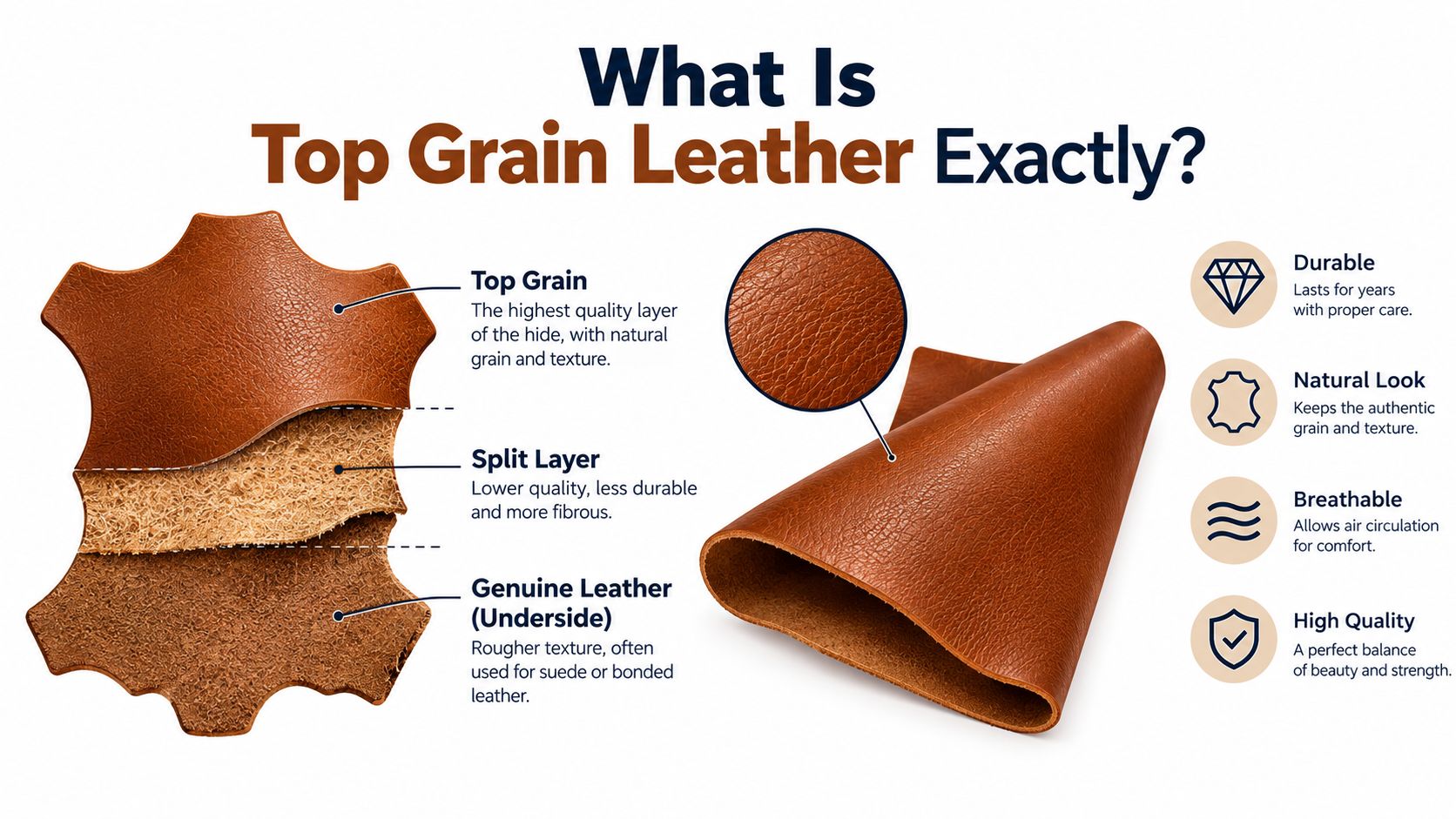
A useful comparison is hardwood flooring. The wood species matters, but so do the stain, the topcoat, and the thickness of the wear layer. Top grain upholstery works much the same way. The hide keeps much of its dense fiber network, while surface preparation and coating make the color and grain more consistent across a sofa, sectional, or dining chair set.
Top grain, full grain, and corrected grain
Full-grain leather keeps the natural outer surface with very little correction. It shows more scars, grain shifts, and natural variation, which many buyers value because the hide looks less processed and develops more visible character over time.
Top-grain leather comes from that same general upper portion but receives lighter correction for a cleaner, more uniform appearance. It often suits larger upholstered pieces, where strong natural markings can look mismatched from cushion to cushion. If you want a clearer explanation of top grain versus full grain leather, that distinction is worth reviewing before you compare samples.
Corrected-grain leather goes through more extensive surface preparation and usually a heavier finish. It can deliver a very controlled look, but the question is not only how it looks in the showroom. Buyers should also ask what coating sits on top, how thick the hide is, and how that construction is expected to flex and age.
Why the distinction matters on furniture
The outer layer is only one part of performance. Tanning, finish chemistry, thickness, seam design, cushion build, and repeated flexing all shape how the furniture feels and holds up. The FAO review of leather applications discusses upholstery leather thickness and service life, while also making clear that real-world durability depends heavily on use conditions and material preparation.
On a large sectional, those hidden variables become easier to see. A more uniform top grain leather can keep the overall design cohesive across multiple seats, but the smarter purchase question is still specific: what finish is on the leather, how thick is it, and what supports its intended use.
Comparing Leather Grades and Alternatives
A leather choice should reflect the household's priorities. Full grain emphasizes natural surface character, top grain balances character with consistency, and bonded material prioritizes a manufactured surface rather than the same continuous hide structure. Performance fabric can also make sense when softness, color range, or a particular cleaning requirement matters more than leather's tactile qualities.
| Leather Type | Durability | Appearance | Maintenance | Cost |
|---|---|---|---|---|
| Full grain | Strong natural fiber structure, but surface markings remain visible | Most natural, with variation and developing patina | Requires attentive placement and care | Typically positioned as a premium material |
| Top grain | Depends heavily on correction, finish, thickness, and construction | More uniform than full grain while retaining hide character | Ranges from moderate to easier care, depending on finish | Varies by hide and finishing system |
| Corrected grain | Can gain practical protection from added finish, though heavier correction changes the surface | Highly consistent, embossed, or pigmented appearance | Often easier to wipe and maintain | Varies with finish and construction |
| Bonded leather | Composite surface with less natural hide content, so long-term behavior differs from upholstery leather | Uniform manufactured appearance | Follow the maker's specific care instructions | Often selected for initial affordability |
| Performance fabric | Depends on fiber, weave, coating, and verified testing | Broad range of colors and textures | Cleaning code and fiber content determine the routine | Varies widely by construction |
The table makes one point clear: a grade doesn't establish a universal cost or lifespan. A heavily protected top-grain leather may be more practical for daily family use than a lightly finished hide, while a carefully chosen performance fabric may suit a room where softness and color flexibility lead the decision.
Matching the surface to the household
For pets, frequent meals, or daily reclining, buyers should inspect seat edges and arm fronts because those areas receive repeated contact. Leather doesn't eliminate claw marks or damage, but a suitable finish can make routine wiping easier. Fabric may offer a warmer initial hand and greater pattern choice, while tightly woven performance options can serve households that prefer a textile surface.
A performance fabric sectional offers a useful alternative for buyers comparing tactile comfort, cleanability, and visual character. The right comparison isn't leather versus fabric in the abstract. It is which tested surface suits the room, occupants, maintenance habits, and desired aging pattern.
Look beyond the showroom color
Two swatches with the same color can behave differently because pigment, coating thickness, embossing, and hide selection alter the finished surface. A homeowner should request a sample, feel both the face and reverse where possible, and ask whether every contact surface is leather or a matching material.
That level of scrutiny helps distinguish a coherent material specification from a broad promotional phrase. The goal is not to find a universally superior surface. It is to select one whose trade-offs remain comfortable years after delivery.
Evaluating Durability and Performance Specs
A reliable leather assessment begins with the finished material, not the grade printed on a hangtag. Upholstery leather is evaluated through separate tests for abrasion, flex resistance, colorfastness, tear strength, seam strength, and ultraviolet exposure. A strong result in one category doesn't prove that the leather will resist cracking at a seat edge or arm front.
Four questions to ask before ordering
What is the thickness? Common top-grain upholstery is reported around 0.9 to 1.1 millimeters, although thickness alone doesn't establish quality or comfort. The exact hide, backing, finish, and construction still matter. FIRA's upholstery-leather guidance explains why the finished specification deserves attention.
Which finish is applied? Aniline finishes preserve more visible natural character and generally require greater care. Semi-aniline finishes add some protection while retaining a relatively natural appearance. Pigmented finishes use a protective polymer layer that generally improves stain and abrasion resistance, making them a sensible option for many active households.
What abrasion test was used? One upholstery source reports ranges of 25,000 to 40,000 Martindale cycles for residential-to-contract applications and 50,000 or more for heavier-duty protected leathers. Those values come from the upholstery testing guide, and the test method, specimen, finish, and pass criteria still need confirmation.
How does the finish handle flexing? ASTM D2097 evaluates visible finish change during controlled repeated flexing, including cracking and crazing. A technical benchmark describes 5,000 cycles for light residential use, 10,000 for residential or contract use, and 20,000 or more for heavy commercial use. These are procurement benchmarks, not universal legal thresholds. ASTM D2097 information provides context for the method.

Read the report, not just the number
A supplier report should identify the standard, cycle count, loading or test conditions, exact finished leather, and observed failure mode. That detail matters because coating thickness, pigment, embossing, and corrective sanding can materially change performance.
The most useful specification is the one tested on the exact leather selected for the exact furniture application.
A homeowner should also ask about warranty exclusions, especially those involving sunlight, pets, chemical cleaners, and normal wear. A custom leather sectional with power motion, swivel seating, or rocker and glider components deserves the same scrutiny as a stationary sofa because movement increases flexing at seams, cushions, and contact points.
Long-Term Care and Maintenance Tips
Top-grain leather rewards simple, consistent habits. Dust and grit can collect in seams, while repeated friction at seat cushions and armrests can wear through a protective topcoat. Ultraviolet exposure can also break down the finish and draw out leather oils and moisture, so placement matters as much as cleaning.
In a Columbus home, a sectional near large windows may face different stresses from a recliner in a shaded family room. A thoughtful care routine should account for traffic, pets, reclining motion, heat sources, and the amount of direct sunlight reaching the upholstery.
A practical care rhythm
- Remove surface grit: Dust seams and crevices regularly with a soft attachment so particles don't act like fine abrasive material during sitting and reclining.
- Address spills promptly: Blot liquid with a soft, clean cloth. Avoid aggressive rubbing, which can spread the spill or alter the finish.
- Use approved products: Follow the furniture maker's instructions and avoid household detergents, abrasive cleaners, waxes, and heat.
- Protect the placement: Limit prolonged direct sunlight and keep furniture away from intense heat that can dry or distort the surface.
- Condition selectively: Use a compatible leather conditioner when the manufacturer's care guidance calls for it, rather than applying an untested product by habit.
For additional guidance on cleaning leather interiors and handling routine surface care, homeowners can consult these care tips from Nanak Car Wash. The principles are transferable, but furniture leather still requires the specific recommendations supplied with the piece.
Care should follow the finish
A pigmented surface usually tolerates more routine contact than a lightly finished aniline surface, but neither is maintenance-free. A natural-looking finish may show variation, marks, and changes in tone as part of its character. A protective coating may simplify spill management while making scratches or wear appear differently.
The top-grain leather care guide provides a useful reference for building a consistent routine. The most important habit is restraint. Strong chemicals, improvised solvents, and heat can create damage that ordinary dusting and prompt blotting would have prevented.
Longevity includes repairability
A long-term furniture decision should include questions about cushion service, seam repair, replacement components, and warranty coverage. Leather can remain attractive for years, but a damaged cushion or stressed seam shouldn't automatically mean replacing the entire piece.
That is especially relevant for motion furniture. Power recliners and reclining sectionals contain moving parts that deserve correct operation and periodic inspection. Care preserves the upholstery, while sound construction and service support help preserve the furniture investment as a whole.
Customizing Your Leather Furniture at Vinson
Material selection becomes more useful when it is connected to the room's dimensions, seating habits, wood finish, and movement requirements. A leather swatch that looks balanced beside solid maple may feel too cool beside solid cherry, while a highly protected surface may be more practical than an expressive aniline finish in a household with children or pets.
Vinson Fine Furniture's Custom Order Program supports that decision process with choices in fabrics, finishes, and 3D visualizers for brands such as Smith Brothers, Canadel, and Mavin. Smith Brothers of Berne is made in Indiana, Mavin is Amish-made in Ohio, and Canadel is handcrafted in Quebec, Canada. Together, these lines support North American-crafted furniture planning without treating one finish or origin as a substitute for examining the actual specification.
Design the whole room, not just the upholstery
The In-Store Design Studio and Complimentary Design Consultations give Columbus-area homeowners a place to coordinate leather, solid hardwood, scale, and movement before placing an order. A consultant can help compare a top-grain leather sectional with performance fabric, select a finish that suits the room's light, and determine whether motorized reclining, swivel chairs, rockers, or gliders fit the household's daily rhythm.
Digital visualization can also support the approval process. Designers can upload CAD specifications, apply digital material shaders and finishes, and present photorealistic previews before manufacturing. That process can shorten feedback cycles from weeks to days, giving buyers a clearer way to compare upholstery, wood finishes, and proportions before production.
A practical specification may include:
- Living room seating: A top-grain leather sectional with power motion for frequent reclining and clear walkways.
- Occasional seating: A swivel chair, accent chair, rocker, or glider selected for posture, movement, and visual balance.
- Hardwood coordination: Solid cherry, oak, maple, or walnut chosen to complement the leather's undertone.
- Service documentation: Finish type, thickness, test reports, warranty exclusions, and contact-surface details.
Buyers who want to understand the small construction details behind upholstery work can also review this upholstery thread and needle guide. The resource reinforces why seam design and repair knowledge belong in a serious furniture conversation.
Value and delivery belong in the specification
Vinson's Low Price Guarantee provides a 110% refund of the difference when its conditions are met, while the Clearance Gallery offers savings of up to 70% on qualifying floor samples, overstocks, and closeouts. Those options can help a homeowner compare custom ordering with immediate availability without lowering the standards for leather, hardwood, or construction.
The custom upholstery services connect those choices to a finished order. White-Glove Delivery completes the process by placing, assembling, and clearing packaging from the home, which is particularly useful for substantial sectionals and motion furniture.
Visit Vinson Fine Furniture at Easton Town Center for a sit-test of top-grain leather sectionals, reclining pieces, swivel chairs, rockers, and gliders. The In-Store Design Studio can help compare finishes, solid hardwoods, motion options, and documented leather specifications through a Complimentary Design Consultation.