American Heirloom Furniture Traditions Worth Preserving


A homeowner in Columbus stands in a half-empty dining room with a tape measure, a paint sample, and a question that doesn't fit on a price tag. The table chosen now could host homework, holidays, and eventually a grandchild's first Thanksgiving, or it could wobble, chip, and head for the curb in a few years. That gap between a purchase and a keepsake is where American heirloom furniture traditions still earn their name. The term isn't about a curved leg or a dark stain. It's about solid wood, honest joinery, and construction a future owner can repair, refinish, and continue using.
What Heirloom Furniture Actually Means Today
Most shoppers first meet the word heirloom as a style label. That's the first point of confusion. A piece can look traditional and still fail early, while a clean-lined, bench-made table can serve for decades. Heirloom is a working standard, not a look.
A standard built from four parts
A practical definition rests on materials, construction, provenance, and serviceability. The frame and primary surfaces use solid hardwood rather than thin surface layers over a less durable core. Joints lock mechanically, drawers and doors can be adjusted, and hardware can be replaced without tearing the piece apart. The maker or workshop is identifiable, which helps a later owner source a matching finish, a leaf, or a repair.
Documentation matters more than many buyers expect. A simple record of the maker, wood species, finish, purchase date, and any repairs turns a good table into transferable property. Without that record, the next generation guesses at care products and finish compatibility, and small mistakes accumulate.
- Durable material: Solid cherry, oak, maple, or walnut forms the structure, not just the visible surface.
- Repairable construction: Joints, panels, and hardware allow a craftsperson to tighten, reglue, or replace a part.
- Identifiable origin: A named workshop or brand tradition gives the piece provenance and a parts path.
- Usable scale: Proportions fit ordinary rooms and doorways, so the piece can move with a family.
Why the distinction matters in Central Ohio
Columbus homeowners who plan to stay put feel the cost of replacement differently. A dining set that's refinished once and reupholstered once can outlast several style cycles in paint, lighting, and rugs. The wood gains depth, small marks can be addressed locally, and the room keeps its anchor.
An heirloom isn't furniture that's too precious to use. It's furniture that's built well enough to be used daily and still be worth repairing.
Four decisions determine whether a purchase meets that standard. The homeowner chooses a wood species suited to the room, reads the construction details, selects a maker tradition with a service record, and protects the piece after delivery. Each decision is learnable in a showroom, and none requires specialist tools.
From Colonial Workshops to Ohio-Made Hardwood
American heirloom furniture didn't begin as a national style. It began in port cities, in small workshops where a cabinetmaker's reputation traveled by word of mouth and a signed piece carried accountability.
Boston, Newport, and Philadelphia set the pattern
The Metropolitan Museum of Art identifies Boston as the dominant urban center for furniture design in the early eighteenth century, while Newport, Rhode Island became a leading center during the second half of the century. The Met's documentation on Newport cabinetmaker John Townsend identifies John Townsend and the Goddard family as makers who helped establish a distinctive regional style characterized by simplified forms and increased use of solid mahogany, with surviving Townsend pieces dated from 1765 to 1792 demonstrating that a refined design could be repeated with little change for nearly three decades.
That repetition is instructive. A workshop didn't chase novelty each season. It refined a form until the proportions, joinery, and material choices worked reliably, then repeated it for clients who expected the piece to hold value. Museum records also document American armchairs made between 1725 and 1745 in both Boston and Philadelphia, showing that regional production networks existed well before the Revolution. A signed expandable dining table from 1796 points to another lasting idea, flexibility for larger gatherings.
From regional workshops to a national industry
The workshop model later scaled. North Carolina illustrates the shift, growing from a small base in 1900 to a major producing state by the mid twentieth century, and national shipments eventually reached a scale that small shops couldn't have imagined. That growth created a tension that still shapes buying decisions. Distribution got easier, but the authority of a piece still came from material quality, identifiable making, and regional skill.
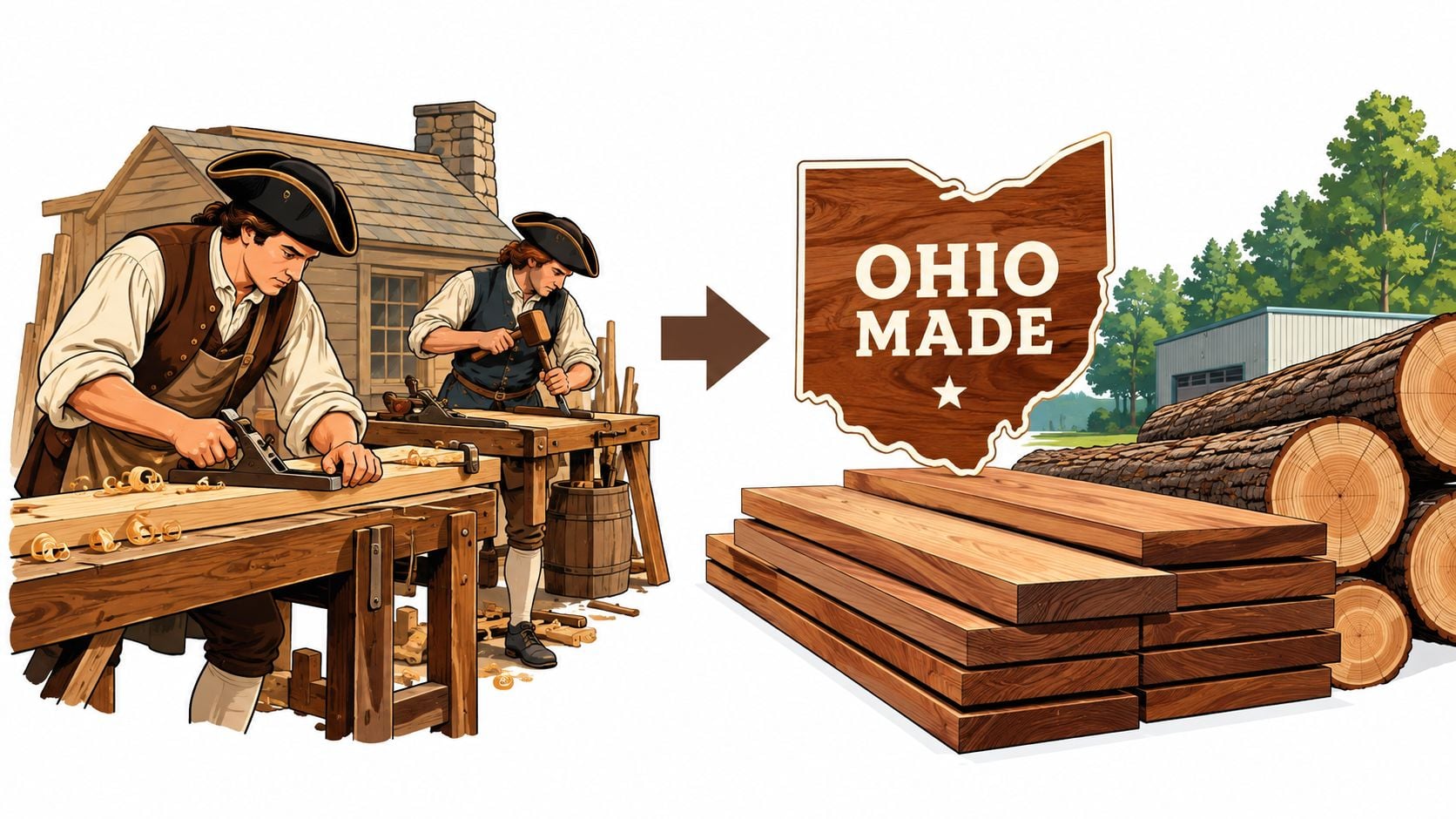
Central Ohio fits naturally into that lineage. Amish and other hardwood workshops in the state continue the older pattern on a modern footing, small to mid-sized shops, solid wood as the starting point, and forms repeated and refined rather than reinvented. Interest in reclaimed material tells a related story, and readers curious about that Ohio thread can explore furniture made from reclaimed Ohio barn wood as one example of regional material finding a second life.
For a buyer today, the history isn't decoration. It explains what to look for, a named maker, a regional material tradition, and a design stable enough to remain useful when tastes around it change.
Choosing the Right Hardwood for the Room
Wood species is the first buying decision because finish can be changed more easily than the board underneath. Shoppers often start with color, then discover that grain, hardness, and aging behavior matter more over twenty years of daily use.
Solid Hardwood Comparison for Heirloom Furniture
| Species | Hardness (Janka) | Aging Character | Best Room Fit |
|---|---|---|---|
| Solid cherry | Moderate, dents more readily than maple | Deepens and warms noticeably with light exposure | Dining rooms and bedrooms with steady, even light |
| Solid oak | Hard, with pronounced open grain | Holds its tone, grain hides everyday wear | Family dining and living rooms with heavy traffic |
| Solid maple | Very hard and dense, fine closed grain | Stays light and even, takes paint and pale stains well | Kitchens, busy dining areas, and kids' bedrooms |
| Solid walnut | Hard, with rich natural color variation | Mellows slightly, keeps a deep, quiet presence | Primary bedrooms, studies, and calmer living spaces |
The comparison prevents a common mistake. A homeowner who loves cherry's first-day color may be surprised as it deepens, while a family that chooses maple for a kitchen table gains a dense surface that tolerates homework, crafts, and hot dishes on trivets without showing every mark. Oak's visible grain forgives the scuffs of a household with pets. Walnut suits a Mavin bedroom furniture set or a quieter case piece where its natural color does the work that stain does elsewhere.
Match the wood to light and traffic
Sunlight changes cherry unevenly if a runner or centerpiece never moves, so rotating objects during the first year helps the top age as one surface. Maple and oak handle the abrasion of an Amish-made dining set used three times a day. Walnut rewards a room where it won't be dragged or knocked by vacuum cleaners each week.
Climate matters as much as species. Conservation guidance on temperature and humidity for wooden furniture recommends maintaining indoor relative humidity near 45–55%, with 50% plus or minus 5% as a useful benchmark for most regions. Relative humidity shouldn't exceed 65%, while levels below 30% can desiccate glue, loosen joints, and embrittle finishes. In a Columbus winter with forced-air heat, that lower bound is the one to watch.
A deeper walk-through of species behavior is available in this guide to choosing the right hardwood for longevity and style, which pairs well with handling actual samples under showroom light. The stated hardwood standard behind that guidance, solid cherry, oak, maple, or walnut, deliberately keeps the conversation within woods that can be sanded, repaired, and refinished as solid material.
Reading Joinery and Construction Like a Maker
A showroom floor is a classroom if a shopper knows where to put a hand. The most revealing details sit at the interfaces, where a leg meets an apron, where a drawer front meets its sides, and where an edge meets a palm every day.
The joints that carry the load
Mortise-and-tenon joinery locks a projecting tongue into a matching cavity, so the joint resists racking even before glue is considered. Dovetailed drawers use interlocking fan-shaped cuts that hold a drawer front against years of pulling. Both can be inspected without tools. A shopper opens the drawer, looks at the corner, and runs a thumb along the seam.
Solid wood also moves with the seasons. Floating panels sit in a frame with room to expand and contract, and properly oriented grain keeps that movement predictable rather than destructive. A wide top that's rigidly restrained on all sides is more likely to split than a thinner top that's allowed to move. Thickness alone isn't the standard. The movement strategy is.
The Arts and Crafts lesson in hand finishing
The American Arts and Crafts tradition associated with Gustav Stickley combined machine-assisted preparation with hand finishing, fitting, and final joinery, producing furniture that emphasized structural honesty, repairability, and visible material quality rather than concealment through ornament. That division of labor still describes good making. Machines bring repeatability, skilled hands control the fit and the surfaces a person touches.
Readers who want a broader grounding in how fitted joinery is planned and executed in a home setting will find useful context in this carpentry guide for Dublin homeowners, which treats bespoke fitting as measured, on-site problem solving rather than guesswork. A complementary overview of common wood joints and how they work helps connect those principles to furniture specifically.
- Tight, clean seams: Joints close without visible gaps or filler.
- Consistent grain selection: Adjacent boards relate in color and direction.
- Eased hand-contact edges: Chair arms, table edges, and drawer pulls feel smooth, not sharp.
- Accessible hardware: Hinges, glides, and leaf mechanisms can be serviced or replaced.
Showroom test: A buyer who can't see how a piece comes apart for repair should ask. A good maker has an answer.
Serviceability is the point of all of it. A joint that can be reglued and a finish that can be renewed locally keep a piece in the family. A sealed, inaccessible assembly turns a small failure into a full replacement.
Three Named Traditions Worth Your Investment
Abstract standards get easier to judge when they're attached to named makers. Three partner traditions available in Columbus express heirloom values in different rooms of the house, and the geography matters for buyers who care about origin.

Smith Brothers of Berne, Indiana
Smith Brothers furniture at Easton represents the upholstered side of the heirloom idea. Made in Indiana, USA, the line is known for bench-made seating, solid frames, and custom upholstery in fabric and top-grain leather. For living rooms, that includes custom leather sectionals in Columbus homes, reclining and motorized power motion seating, swivel chairs, rockers, and gliders. The heirloom logic is the same as a wood table, a frame worth keeping, upholstery that can eventually be renewed, and motion hardware chosen for daily cycles rather than occasional use.
Mavin, Amish-made in Ohio
Mavin is Amish-made in Ohio, USA, with a focus on solid-wood dining and bedroom pieces. An Amish-made dining set or a solid-maple bedroom suite from an Ohio workshop carries the regional workshop tradition forward in a direct line, small-shop making, solid hardwood, and hand finishing at the edges and surfaces. A shopper examining a mission-style dining chair built for long service can see the Arts and Crafts influence in the exposed structure and restrained form.
Canadel, handcrafted in Quebec
Canadel is handcrafted in Quebec, Canada, and specializes in configurable dining furniture. Its strength is dimensional and finish flexibility, table shapes, edge profiles, leg styles, and chair pairings built to order. Geography should be stated plainly for buyers building an American-only list. Smith Brothers and Mavin are American-made. Canadel is Canadian craftsmanship, properly grouped under North American made rather than USA-only roundups.
All three sit inside a single ordering framework. Vinson's Custom Order Program covering Smith Brothers, Canadel, and Mavin allows customers to tailor details such as upholstery, finishes, and dimensions rather than selecting only from fixed showroom inventory, with described materials including solid cherry, oak, maple, and walnut. For solid wood furniture in Ohio, that combination of an Ohio maker, an Indiana upholstery bench, and a Quebec dining specialist gives a homeowner comparable options without leaving one showroom.
Customization That Protects the Heirloom Promise
Customization is often treated as decoration. For longevity, it's protection. A table that's six inches too wide gets bumped, squeezed through doorways, and eventually replaced, while a table sized to the room stays.
Through the Custom Order Program, a buyer specifies dimensions, finish, edge and leg details, and upholstery, then reviews the result with 3D visualizers before production. Fabric and leather choices carry practical weight. Performance fabrics suit households with children and pets, while top-grain and performance leathers suit daily reclining and sectional use where a surface must flex without cracking. Finish selection works the same way, and homeowners researching how professional finishing changes a surface's durability and sheen can learn from Dublin furniture finishing experts who describe spray application as a controlled, even coating process.
Those decisions are easier in person. The In-Store Design Studio at Easton offers complimentary design consultations where proportions, fabric coordination, and finish samples are tested together under real light, with a sit-test for cushion depth and motion seating. That service sits inside a longer local history. Vinson Fine Furniture's family-owned history in Columbus since 1979 records a family-owned and operated business serving customers since 1979 from its Easton Town Center showroom at 4070 Morse Road in Columbus, Ohio, emphasizing North American manufacturing in Ohio, the United States, and Canada. A piece ordered to fit a room, a body, and a household's habits is less likely to be discarded when life changes.
Owning a Heirloom for the Long Run
Buying well is half the system. Keeping a piece heirloom-ready depends on placement, humidity, and timely small repairs rather than occasional dramatic restoration.
Homeowners place solid-wood pieces away from heat vents, radiators, and direct sun, track conditions with an inexpensive hygrometer, and avoid abrupt swings between heated, air-conditioned, and humidified air. Bulky pieces get lifted from sturdy structural areas by more than one person rather than dragged. At the five-year mark, the sensible checklist is modest, tighten hardware, inspect glides and hinges, address a localized finish worn spot, and consider reupholstery before a frame is ever questioned. Guidance on how to care for wood furniture at home turns those habits into a routine, and readers weighing intervention on an older piece will benefit from a clear explanation of restore vs conserve antique furniture finishes before stripping anything.
Delivery and pricing protections belong to the same ownership picture. White-glove delivery with inspection, placement, assembly, and packaging removal reduces the handling damage that often occurs on day one. On value, Vinson's Low Price Guarantee and Clearance Gallery terms allow 30 days to identify the same product at a lower published price from a local Central Ohio authorized dealer, with a refund of 110% of the price difference if conditions are satisfied, while the Clearance Gallery advertises savings of up to 70% on selected floor samples, overstocks, and seasonal closeouts.
Visit the Easton Town Center showroom to handle solid cherry, oak, maple, and walnut samples, sit-test Smith Brothers motion seating, and plan a Mavin or Canadel piece with a complimentary design consultation. The team at Vinson Fine Furniture can help match wood, joinery, and customization to the way a Columbus household lives, so the next purchase is built to be inherited.