Should I Finance a Mattress: A Practical Guide

A mattress should be financed only when the offer is true 0% APR and the buyer can clear the full balance before the promotional deadline. If the plan uses deferred interest, missing that deadline can turn an apparently interest-free purchase into high-cost debt.
A shopper may walk into a showroom exhausted, test a premium mattress, and feel relieved when the payment sounds manageable. The monthly figure is only the first question. The important questions are whether the rate is interest-free, how much must be paid each month to reach a zero balance, and whether that payment remains realistic after an unexpected expense.
Financing is already familiar in furnishings. A 2013 GE Capital Retail Bank shopper study found that 72% of furnishings shoppers said financing made larger purchases more affordable, while 68% said it influenced their choice of retailer. That popularity makes careful reading more important, not less.
The Mattress Financing Decision Most Buyers Skip
A shopper stands beside a queen mattress marked at $2,800. After a few minutes of testing, the salesperson slides over a payment pad showing a long installment option at roughly $79 a month. The number feels comfortable, especially when the household is also paying for moving costs, renovations, or other necessities.
That shopper shouldn't reject the mattress automatically. But accepting the payment without examining the agreement is a mistake. The decision isn't just whether the household can absorb the monthly charge. It is whether the rate is true 0% APR and whether the balance can reach zero before the promotional period ends.
A long payment term can make a premium sleep system appear accessible while leaving the buyer exposed to a large balance later. A deferred-interest agreement may accrue interest from the purchase date and add that interest retroactively if the promotional balance isn't fully paid by the deadline, as the Consumer Financial Protection Bureau explains in its promotional-financing guidance.
The showroom question that matters
Before discussing comfort layers, firmness, or delivery, the buyer should ask:
- What type of promotion is this? Is it true 0% APR, or does interest accrue in the background?
- What is the exact payoff date? The calendar date matters more than the broad phrase “no interest.”
- What payment clears the balance in time? The required payoff amount can be higher than the advertised minimum.
- What happens after the promotion? The standard APR and any retroactive interest determine the risk.
Industry guidance shows a wide market range, from genuine 0% promotional plans to variable APRs as high as 36%, while store-card standard rates are often around 29% to 34% after promotions end. Those figures are documented in Furniture Today's financing coverage.
Practical rule: A monthly payment is affordable only if it also retires the balance before the promotion expires.
The purchase may be a high-consideration decision because sleep, comfort, durability, and household cash flow all matter. Vinson's perspective on why furniture purchases are high-consideration decisions applies especially well to a mattress. A lower payment isn't automatically better value if the financing structure creates a costly deadline.
How Mattress Financing Actually Works
Mattress financing generally falls into two structures. The first is true 0% APR, where no interest accrues during the stated promotional period as long as the account remains compliant. The second is deferred interest, where interest accrues from the purchase date but the lender postpones charging it until the promotion ends.
The application process can look similar for both. A shopper submits an application, receives a soft-check prequalification or hard credit inquiry, gets an approval decision and credit limit, then selects an available payment schedule. The payment schedule may be designed to clear the balance within the promotion, or it may satisfy a lower minimum while leaving a residual balance.
That distinction is where many buyers get caught. The displayed payment often reflects the selected term or minimum requirement, not necessarily the amount needed to eliminate the promotional balance. A buyer who pays only the minimum can reach the deadline with money still owed.
Two structures, different consequences
True 0% APR behaves like a scheduled repayment arrangement with no interest during the promotional window. The buyer still needs to make every required payment, but the agreement doesn't normally add backdated interest merely because a balance remains after the promotion.
Deferred interest is less forgiving. Synchrony's retail financing guidance explains that interest accrues from the purchase date and is deferred until the promotional period ends. If the balance isn't paid in full, the accumulated interest can become payable, alongside the remaining principal. Synchrony's retail financing material also illustrates how a standard APR can apply when a promotion fails.
The phrase “no interest if paid in full” should therefore trigger a closer reading. It doesn't necessarily mean the account is operating at a 0% APR.
Common Mattress Financing Providers at a Glance
| Provider | Typical Retailers | Promo Structure | Credit Pull |
|---|---|---|---|
| Store-branded credit line | Mattress and furniture showrooms | True 0% APR or deferred interest | Soft prequalification or hard application |
| Retail financing partner | Participating home-furnishing retailers | Promotional window or fixed installment plan | Depends on the application stage |
| Online installment service | Direct-to-consumer mattress sellers | Fixed payments, sometimes interest-bearing | May involve a soft check or hard inquiry |
| Credit union or bank lender | Retail and medical-financing programs | Fixed APR or promotional offer | Usually confirmed during application |
Vinson Fine Furniture's Synchrony HOME Credit Card information should be read alongside the actual account agreement. Promotional language on a showroom sign is not enough. The contract controls the interest method, deadline, payment obligation, and post-promotion rate.
Deferred Interest Versus True Zero Percent
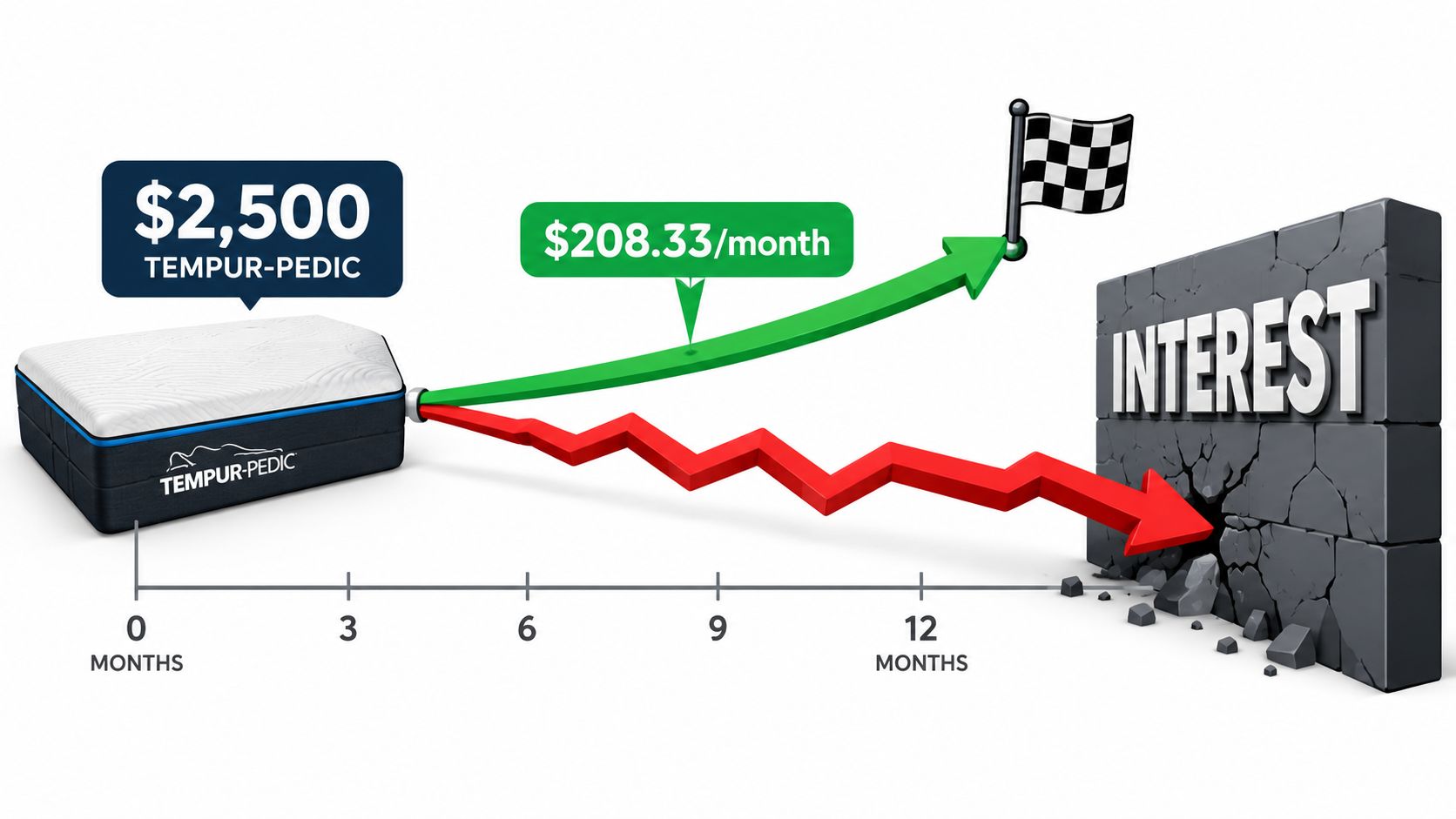
A worked example makes the difference clear. Suppose a shopper buys a Tempur-Pedic mattress for $2,500 and receives a 12-month no-interest promotion.
Under a straightforward payoff plan, the buyer divides the balance across the promotional months:
$2,500 ÷ 12 = $208.33 per month
If the buyer pays $208.33 a month and clears the balance by month 12, the total paid is $2,500. No financing premium is added.
The balance that survives the deadline
Now consider the same payment plan under deferred interest. The buyer makes the same payment for 11 months, then stops because of a job change or major household expense. The remaining balance is about $208 at the deadline.
With true 0% APR, that remaining balance would continue under the account's post-promotion terms, without retroactive promotional interest. With deferred interest, interest calculated from the original transaction date can be added to the account. At an advertised rate of roughly 29.99%, the resulting lump-sum charge could be roughly $180 to $200, based on the example assumptions.
The exact charge depends on the agreement and account calculation. The main point is structural: deferred interest can make the buyer pay interest on the original purchase period even though the account statements previously showed no interest charge.
Fixed installment plans work differently
A fixed installment plan generally charges its stated interest from the beginning rather than holding it back for a deadline. That can make the total cost easier to forecast. If a buyer already suspects that full payoff before a promotional date will be difficult, a transparent fixed-rate plan may be safer than a deferred-interest offer, even when its headline payment looks less attractive.
A buyer comparing options can review Vinson's mattress financing options and then request the full written terms for the specific purchase. The useful comparison isn't “Which payment is smallest?” It is “Which agreement gives the clearest path to a debt-free balance at the lowest total cost?”
How to Compare a Mattress Financing Offer
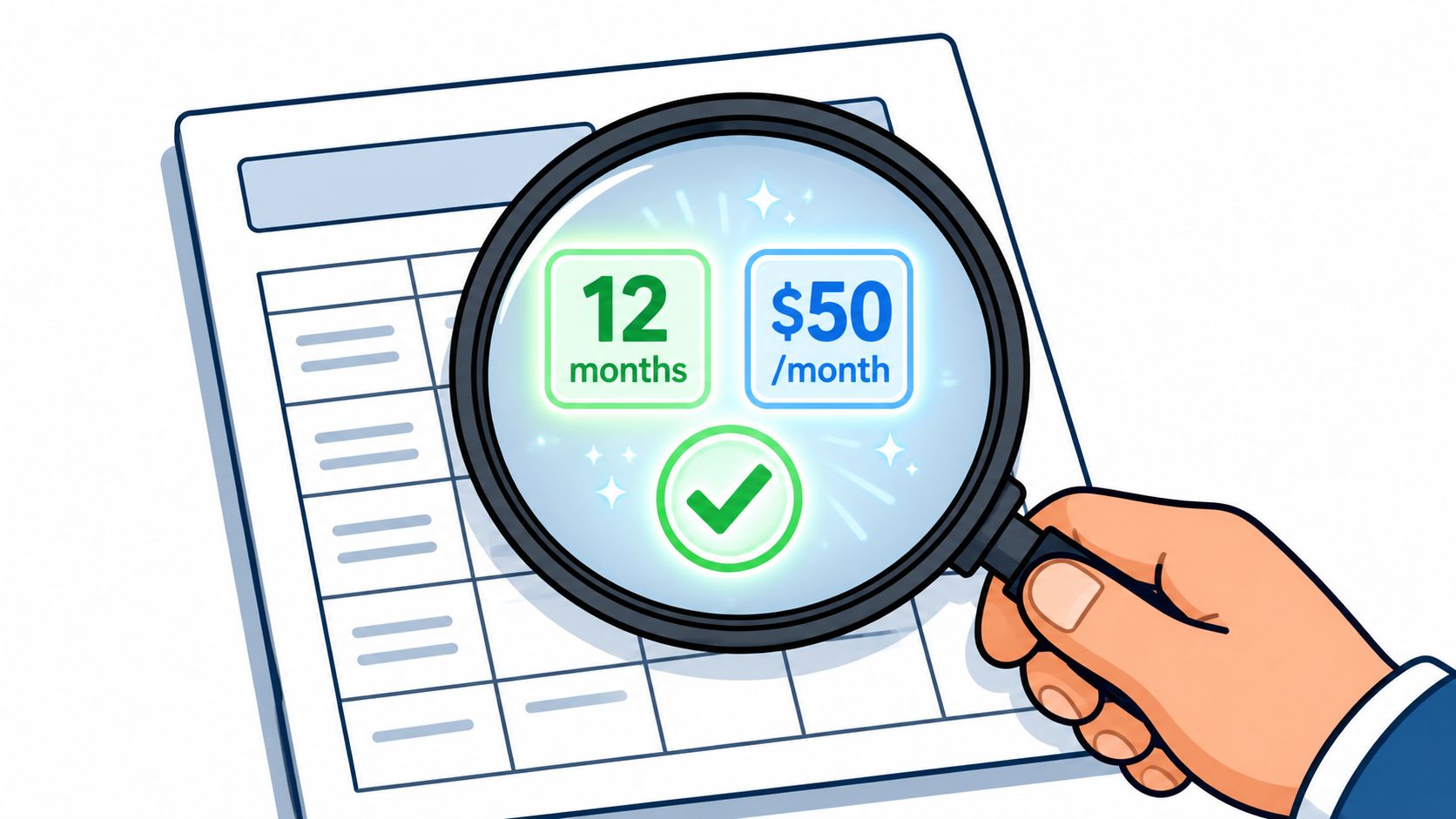
Before signing, the buyer needs three answers in writing: the promotional window, the monthly amount required to clear the balance, and the type of credit inquiry used for the application.
First, identify the promotional window
A financing offer may advertise a long repayment term while attaching a much shorter interest-free period. The buyer should find the exact end date, not rely on a general phrase such as “12-month financing.” Then the deadline should be placed on a personal calendar with enough time for the final payment to post.
Second, calculate the real monthly payoff
The basic calculation is direct:
Promotional balance ÷ promotional months = minimum monthly payoff target
That target is the practical floor for staying interest-free. If the mattress balance is $2,500 and the promotion lasts 12 months, the buyer needs to plan around $208.33 per month, not whatever smaller minimum appears on the statement.
The calculation should then be stress-tested. A payment that works only when every month goes perfectly isn't a safe payment. If the household couldn't maintain it after a job transition, repair, or medical bill, the offer is too aggressive.
Third, verify the credit-pull language
Some lenders offer soft-check prequalification before the full application. Others use a hard inquiry when the buyer submits the funding application. The retailer should explain which step affects the credit file and whether approval guarantees the advertised promotion.
The agreement should also answer these practical questions:
- Purchase requirements: Does the offer require a minimum transaction amount?
- Down payment: Is any upfront payment required?
- Early payoff: Can the buyer repay early without a fee?
- Interest method: Does interest accrue from the transaction date?
- Post-promotion rate: What APR applies after the offer ends?
A 0% offer can be sensible when the buyer controls the payoff schedule. A low payment that leaves a balance at the deadline is a different product, regardless of how attractive the signage looks.
Financing Against Cash and Other Payment Options
A $2,500 mattress purchase can be paid several ways, and the best choice depends on total cost, available cash, credit profile, and confidence in the payoff plan. Monthly payment size alone doesn't reveal the strongest option.
| Payment Method | Total Cost on $2,500 | Flexibility | Credit Impact | Best Fit |
|---|---|---|---|---|
| Cash | $2,500, unless a cash discount applies | High after purchase, lower cash reserves | None from financing | Buyer with a healthy reserve |
| True 0% APR promotion | $2,500 if fully paid by the deadline | Moderate | Application and account activity may matter | Buyer with reliable monthly cash flow |
| Low-interest credit card | Depends on the card's APR and payoff timing | High | Can affect utilization and payment history | Buyer with available credit and a clear payoff plan |
| Short-term installment or BNPL plan | Stated purchase amount if genuinely interest-free, otherwise more | Usually limited by the plan | May affect thin credit files or involve an inquiry | Buyer who can handle frequent scheduled payments |
| Saving before purchase | Purchase price after saving, with no financing charge | Highest after purchase | None from financing | Buyer who can safely delay the purchase |
Cash is the cleanest option if paying upfront won't damage the household emergency reserve. A low-interest card with a genuine introductory 0% period can also work, especially when it offers rewards, but the regular APR after the introductory period still matters.
Short-term buy-now-pay-later plans can divide a purchase into several scheduled payments. Protect-A-Bed's explanation of BNPL risks is useful reading because installment convenience can obscure return complications, affordability pressure, and the consequences of missed payments.
The overlooked option is waiting
Saving for a few months and buying outright removes the promotional deadline and backdated-interest risk. It may also give the buyer time to compare firmness, materials, trial terms, and delivery charges rather than making a rushed decision because the monthly payment appears manageable.
That broader approach matches the principles in Vinson's guide to shopping for furniture smartly. A buyer should preserve flexibility where possible, especially when the purchase isn't urgent.
When Tightening Credit Changes the Math
Financing terms can change between shopping trips. The European Central Bank reported moderate net tightening of consumer-credit standards in both Q3 2025 and Q4 2025, with banks also reporting slightly worse access to some funding channels, as shown in its 2025 Bank Lending Survey.
That doesn't mean every mattress buyer will receive worse terms. It does mean approval, credit limits, promotional duration, and APR shouldn't be treated as permanent features of a retailer's signage.
The offer can change quietly
A shopper who waits may encounter:
- A lower credit limit: The approved amount may no longer cover the preferred mattress and delivery.
- A shorter promotion: A longer deferred-interest window may be replaced by a shorter one.
- A higher back-end APR: The standard rate may become more expensive after the promotion.
- A larger required payment: Shorter payoff windows can increase the monthly target.
- A different approval result: Prequalification may not produce the same result as a full application.
Current BNPL offerings also span from short-term 0% plans to longer financing at 9.99% to 35.99% APR, according to the verified market guidance provided for this article. The range reinforces the central lesson: buyers need the exact total cost for the exact offer, not a general assumption that installment financing is interest-free.
Financing a mattress is also financing a depreciating household purchase. If a larger model requires an aggressive payment schedule, the rational move may be to save longer or choose a model that meets the household's sleep needs without putting the budget under deadline pressure.
When Financing a Mattress Makes Sense
Financing makes sense under strict conditions. The offer should be true 0% APR, the buyer should be able to repay the entire balance before the promotional window closes, and the cash retained should serve a clear priority such as an emergency reserve or higher-interest debt repayment.
It can also be reasonable when a premium mattress addresses a real sleep need and the fixed obligation remains comfortable after ordinary household expenses. A better mattress may justify a higher purchase price when the buyer has tested it properly and understands the return terms. The purchase still needs discipline, because comfort doesn't change the financing contract.
A direct go-or-skip standard
The buyer should finance when all of these statements are true:
- The agreement is interest-free: The paperwork says 0% APR, not merely “no interest if paid in full.”
- The payoff target is manageable: The balance divided by the promotional months fits comfortably within the budget.
- The deadline is visible: The final payoff date is recorded and monitored.
- Cash has a job: Retained savings protect the household or pay down more expensive debt.
- The mattress has been tested: The buyer has assessed support, pressure relief, firmness, and motion response in person where possible.
The buyer should skip financing when the long term exists mainly to shrink the payment, when the payoff target would require perfect financial conditions, or when a less expensive mattress would meet the same needs. A buyer still researching sleep surfaces can review new mattress technology from Jack Dellaccio before treating a financing offer as a reason to purchase immediately.

Decision test: If the buyer can't explain the payoff date and required monthly amount without reopening the agreement, the purchase isn't ready to finance.
Returns, Trials, and Delivery Details That Affect Your Choice
A financing decision doesn't end at checkout. The buyer should confirm the mattress return process, trial requirements, refund timing, and whether the lender receives the refund directly. A return may reverse the original payment method rather than place cash back in the buyer's hands, which can complicate an account that has already been paid down.
Trial periods deserve special attention. A deferred-interest plan may continue accruing interest during the trial even if the mattress is eventually returned. The retailer should explain when the refund is processed, when the lender posts it, and who remains responsible for payments while those transactions are pending. Vinson's mattress return policy should be reviewed before an application is submitted.
Comfort, warranty, and delivery are separate issues
A trial protects against a comfort mismatch, while a warranty generally addresses defects under its own terms. A buyer shouldn't assume that a warranty covers dissatisfaction with firmness or feel.
Delivery can change the financed balance too. White-glove delivery usually means in-home placement, assembly or installation, and removal of packaging or debris instead of curbside drop-off, according to Freightcom's explanation of white-glove delivery. Industry guidance places this premium service at about $150 to $500 or more, depending on location, stairs, and assembly complexity, as described by Secursus in its white-glove delivery guide.
Before financing, the buyer should ask:
- Is old-mattress removal included?
- Does stair access change the charge?
- Does delivery post as part of the financed transaction?
- When does the promotional clock begin?
- What happens if delivery is delayed or the order is returned?
Vinson Fine Furniture serves Columbus and Central Ohio from its Easton Town Center showroom, with an In-Store Design Studio, Complimentary Design Consultations, and a Custom Order Program for fabrics, finishes, and 3D visualizers across Smith Brothers of Berne, Mavin, and Canadel. Its solid hardwood focus includes cherry, oak, maple, and walnut, while its showroom also offers top-grain and performance leather, power motion sectionals, reclining seating, swivel chairs, rockers, and gliders. Buyers can compare the Low Price Guarantee, which provides a 110% refund of the difference under its terms, with Clearance Gallery savings of up to 70%, then arrange White-Glove Delivery for the broader bedroom purchase.
The right next step is a sit-test at Vinson Fine Furniture, where Columbus-area shoppers can review premium mattresses, financing paperwork, delivery charges, return terms, and the payoff amount before signing. Bring the household budget and calendar, ask for the exact total cost in writing, and choose financing only if the balance can be cleared comfortably before the promotional deadline.