Synchrony HOME Credit Card Guide for Furniture Buyers

A shopper has selected a dining set, approved the finish, and is standing at the Easton showroom register with the invoice in hand. The sales consultant mentions a Synchrony HOME offer, and the decision suddenly shifts from wood species and chair comfort to payment deadlines, promotional terms, and the consequences of missing a payoff target.
That moment deserves a clear explanation. The synchrony home credit card can make a substantial furniture purchase easier to manage, but it isn't a general-purpose rewards card and its “no interest if paid in full” language demands discipline. The right question isn't just whether the application is approved. It's whether the purchase, promotional term, household budget, and payoff date fit together without strain.
Standing at the Register With a Furniture Purchase
The shopper at the counter has several practical questions, even if none gets asked aloud. What does the Synchrony HOME Credit Card cover? Does the advertised offer mean genuine 0% financing, or does interest build in the background? Is a longer term available for the dining set, and what happens if an unexpected repair, delayed bonus, or household expense interferes with the plan?
Those questions matter more than a polished sign beside the register. Showroom financing can feel compressed into a few minutes, while a furniture purchase may remain part of a household budget for months. A responsible consultant should help the buyer understand the offer before the account is opened, including the required monthly payment, the exact expiration date, and the standard rate that applies afterward.
At Vinson, the decision also sits alongside the quality of the furniture itself. A solid cherry, oak, maple, or walnut dining set, built for long service and finished to suit the room, represents a different buying decision from a short-term household purchase. The same applies to a bench-made sectional, a premium leather recliner, or Mavin bedroom furniture selected for a long-term home.
The questions worth answering before signing
A shopper should leave the register knowing:
- What the offer means: The promotional language should identify whether the plan uses deferred interest, equal payments, or another structure.
- What must be paid each month: Minimum payments may be lower than the amount needed to eliminate the promotional balance.
- When the deadline falls: The payoff date belongs on the household calendar immediately.
- Where the card works: The account is tied to participating home-furnishings merchants rather than broad everyday spending.
- What happens after the promotion: Any remaining balance can become expensive under the regular purchase APR.
A buyer researching room layouts may also benefit from a practical guide to styling rustic side tables at home, especially when coordinating a new dining or living room purchase with existing pieces. For account access and payment management, the Vinson checkout page provides a useful starting point, but the financing agreement itself remains the controlling document.
How the Synchrony HOME Credit Card Works
The Synchrony HOME Credit Card is a closed-loop retail card. It isn't a Visa or Mastercard, so it isn't accepted at grocery stores, gas stations, or unrelated retailers. Use is limited to participating Synchrony HOME merchants and locations in the home-furnishings ecosystem, which makes the account more specialized than a general-purpose card.
The product launched on February 4, 2019, with a headline offer of 2% cash back on purchases under $299 and promotional financing on home-related purchases, as described by Synchrony's card information. The practical value today, however, usually comes from the financing offer attached to a particular furniture transaction, not from everyday rewards.
Deferred interest in plain English
A deferred-interest promotion doesn't mean interest disappears. It means interest can be withheld during the promotional period if the buyer pays the full promotional balance by the deadline. If a balance remains, interest can be charged retroactively from the purchase date.
Consider a $3,200 bedroom set placed on a 12-month promotion. The buyer must still make every required minimum payment, but the minimum may not be enough to clear the full balance by the deadline. If even a small balance remains when the promotion expires, the account can add accumulated interest calculated from the original purchase date, subject to the agreement's terms.
Synchrony's published materials list a 29.99% purchase APR for new accounts as of February 1, 2024, and a common example offers 0% interest for 24 months on qualifying purchases of $500 or more, with equal monthly payments required. The same Synchrony HOME locations information explains the importance of reading the offer details, because the terms can vary by participating location.
Practical rule: Treat every deferred-interest plan as a race to a zero balance, not as permission to make low minimum payments indefinitely.
After the promotional period, any remaining balance can move to the standard purchase terms. Buyers who want broader context on lowering borrowing costs can review this guide to reduce credit card APR. Vinson's furniture financing information can help shoppers identify the financing options available for qualifying purchases, while the signed offer determines the actual terms.
Promotional Financing Options for Furniture Buyers
Promotional terms should be matched to the purchase, not selected because the longest number looks attractive. Synchrony materials show that participating locations may offer terms from 12 to 60 months, while standard offers can include shorter periods such as 6 or 12 months. Some promotions use deferred interest, while others use equal-payment structures or a stated promotional fee.
The table below shows the principal-only monthly amount if a buyer divides the purchase evenly across the stated term and pays it in full within that window. These are planning illustrations, not quoted account terms. A store promotion may impose a purchase threshold, add a promotional fee, or use a different payment formula.
Synchrony HOME Promo Lengths vs. Furniture Purchase Sizes
| Promo Length | $1,500 Purchase | $3,000 Purchase | $5,000 Purchase | $8,000 Purchase |
|---|---|---|---|---|
| 6 months | $250 per month, $1,500 total | $500 per month, $3,000 total | $833.33 per month, $5,000 total | $1,333.33 per month, $8,000 total |
| 12 months | $125 per month, $1,500 total | $250 per month, $3,000 total | $416.67 per month, $5,000 total | $666.67 per month, $8,000 total |
| 24 months | $62.50 per month, $1,500 total | $125 per month, $3,000 total | $208.33 per month, $5,000 total | $333.33 per month, $8,000 total |
| 36 months | $41.67 per month, $1,500 total | $83.33 per month, $3,000 total | $138.89 per month, $5,000 total | $222.22 per month, $8,000 total |
| 60 months | $25 per month, $1,500 total | $50 per month, $3,000 total | $83.33 per month, $5,000 total | $133.33 per month, $8,000 total |
The figures make the central issue visible. A six-month term may suit a smaller purchase when the household has ample monthly capacity. A 24-month term can make a sectional or dining set more manageable, while a 36- or 60-month offer may fit a larger room project if the buyer has a dependable payoff plan and the retailer makes that term available.
A concrete Synchrony rate sheet also shows a 36-month “No Interest for 36 Months Until Paid in Full” option, with a 2.78% promotional fee and a listed 16.45% APR. That example demonstrates why the offer type matters. A fixed-payment structure can differ materially from deferred interest, so the buyer should read whether the agreement requires equal payments, includes a fee, or backdates interest if the balance isn't cleared.
The safe calculation is simple. Divide the promotional balance, plus any stated fee, by the number of months in the offer, then round the payment upward and finish early. If the budget can't support that amount, the purchase should be reduced, delayed, or paid through another method. The no-interest furniture financing details should support the conversation, but the retailer's current offer controls.
Applying and Getting Approved at the Showroom
A showroom application usually begins at the sales desk, after the shopper has chosen the furniture and reviewed the available promotion. The staff member can explain the current offer and help the applicant begin the process, but approval, credit limit, and account terms come from Synchrony.
The application requires personal and financial information such as the applicant's name, address, Social Security number, income, and housing payment. Applicants should have those details ready and should review every screen before submitting. The financing algorithm evaluates the application and determines whether the account receives approval and what credit line is available for the transaction.
What the process can look like
- Pre-qualification: A preliminary check may indicate whether an application is likely to be accepted without affecting the credit score, according to Synchrony's promotional-financing background information.
- Formal application: The buyer submits the requested information through the showroom process or an available online route.
- Decision: Some applications receive a quick response, while others require additional review.
- Purchase completion: If approved, the buyer may receive account details that allow the transaction to proceed before the physical card arrives, subject to the retailer and issuer's process.
A pre-qualification result isn't a guarantee of approval. The formal application can produce a different outcome, credit limit, or promotional eligibility. A manual review also means the shopper shouldn't assume the purchase can be completed immediately or that the full invoice will fit within the eventual limit.
The in-house furniture financing process can help Columbus shoppers prepare for the showroom conversation. The useful approach is to establish a comfortable monthly ceiling before arriving, then select furniture that remains sensible even if the approval amount is lower than expected.
Comparing the Card to Other Ways to Pay
For a $3,000 to $8,000 furniture purchase, the payment method should match the buyer's use case. The Synchrony HOME Card is purpose-built for qualifying purchases at participating home-furnishings merchants. A general rewards card offers broader acceptance, while a loan can provide a more predictable repayment structure.
| Feature | Synchrony HOME Card | General Rewards Card | Store Card | Personal or Home-Equity Loan |
|---|---|---|---|---|
| Promotional window | May offer retailer-specific terms from short promotions through 12 to 60 months at participating locations, according to Synchrony's launch materials | Terms vary by issuer and offer | Terms depend on the retailer | Usually structured around the loan agreement rather than a retail promotion |
| Standard purchase APR | Published materials list 29.99% for new accounts as of February 1, 2024 | Varies by account | Varies by account | Fixed or variable according to the loan |
| Minimum payment structure | Minimum payments remain required during promotions | Issuer-defined minimum | Retailer-card agreement | Scheduled installment payment |
| Annual fee | Must be checked in the account agreement | Must be checked in the account agreement | Must be checked in the account agreement | Loan fees and costs depend on the agreement |
| Merchant acceptance | Participating Synchrony HOME merchants and locations | Broad network | Usually limited to the issuing retailer or network | Funds can generally be used for the qualifying project |
| Credit impact | Application and account activity can affect the buyer's credit profile | Application and account activity can affect the buyer's credit profile | Application and account activity can affect the buyer's credit profile | Application and repayment can affect the buyer's credit profile |
The HOME card's strongest case is a single large furniture purchase paired with a promotional term the household can complete. Its weakness is equally clear, limited acceptance and an expensive standard APR if the balance survives the promotion.
A general rewards card makes more sense for ongoing household spending when its terms are favorable and the buyer values broad acceptance. A store card may provide a purchase incentive, but buyers shouldn't assume it offers the same extended financing available through a particular Synchrony HOME merchant. A personal or home-equity loan can be more predictable, yet it introduces a separate application, credit review, and repayment process.
The Deferred-Interest Trap and Account Risks
The phrase “no interest if paid in full” places the condition at the end of the sentence, where shoppers often overlook it. The benefit applies only when the promotional balance reaches zero by the deadline. Synchrony's deferred-interest explanation states that minimum monthly payments don't guarantee payoff before expiration and that retroactive interest can apply from the purchase date if money remains.
Take a $5,000 sofa on a 24-month promotion, with $500 still unpaid at month 24. The buyer hasn't merely incurred interest on the remaining $500 under the promotional structure. Backdated interest calculated at the regular purchase APR can be added according to the account terms, potentially turning a manageable furniture payment into a much larger revolving balance.
Why minimum payments create trouble
The minimum payment protects the account from immediate delinquency, but it may not amortize the promotional balance within the offer window. A buyer who follows only the minimum can reach the deadline with a balance still open, even after making payments consistently.
A second risk involves account administration. Synchrony's dispute materials require written disputes through secure message, fax, or mail, and credit-reporting errors may require separate contact with a credit-bureau unit plus supporting documentation. Consumer-facing discussions continue to raise concerns about account-status and reporting issues, while Synchrony published updated credit-report correction instructions in 2026, as reflected in its dispute documentation.
Account safeguard: Save the original financing receipt, each statement showing the promotional balance, and every dispute confirmation until the account reports correctly.
A missed due date can also trigger fees or other consequences under the card agreement. Buyers should set automatic payments for more than the minimum, calendar the final payoff well before the expiration date, and inspect statements for the correct promotional code and balance. If a charge, payment allocation, or reporting entry doesn't match the written offer, Synchrony should be contacted promptly and the paperwork retained.
Smart Ways to Use the Card at Vinson Fine Furniture
The card works best as a disciplined financing tool for one substantial purchase. A sectional, dining set, or bedroom suite can have a clear balance, one promotional term, and one payoff date. Splitting small accessory purchases across separate promotions makes tracking harder and weakens the value of a carefully planned repayment schedule.
Vinson Fine Furniture's Easton showroom gives Columbus shoppers a place to test the sit, reach, movement, and scale of a piece before choosing a payment method. Its selection centers on solid hardwood furniture, including Amish-made dining sets and bedroom pieces, along with top-grain and performance leather seating. Shoppers can explore motorized power sectionals, reclining furniture, swivel chairs, rockers, and gliders, then discuss whether the purchase fits a promotion.
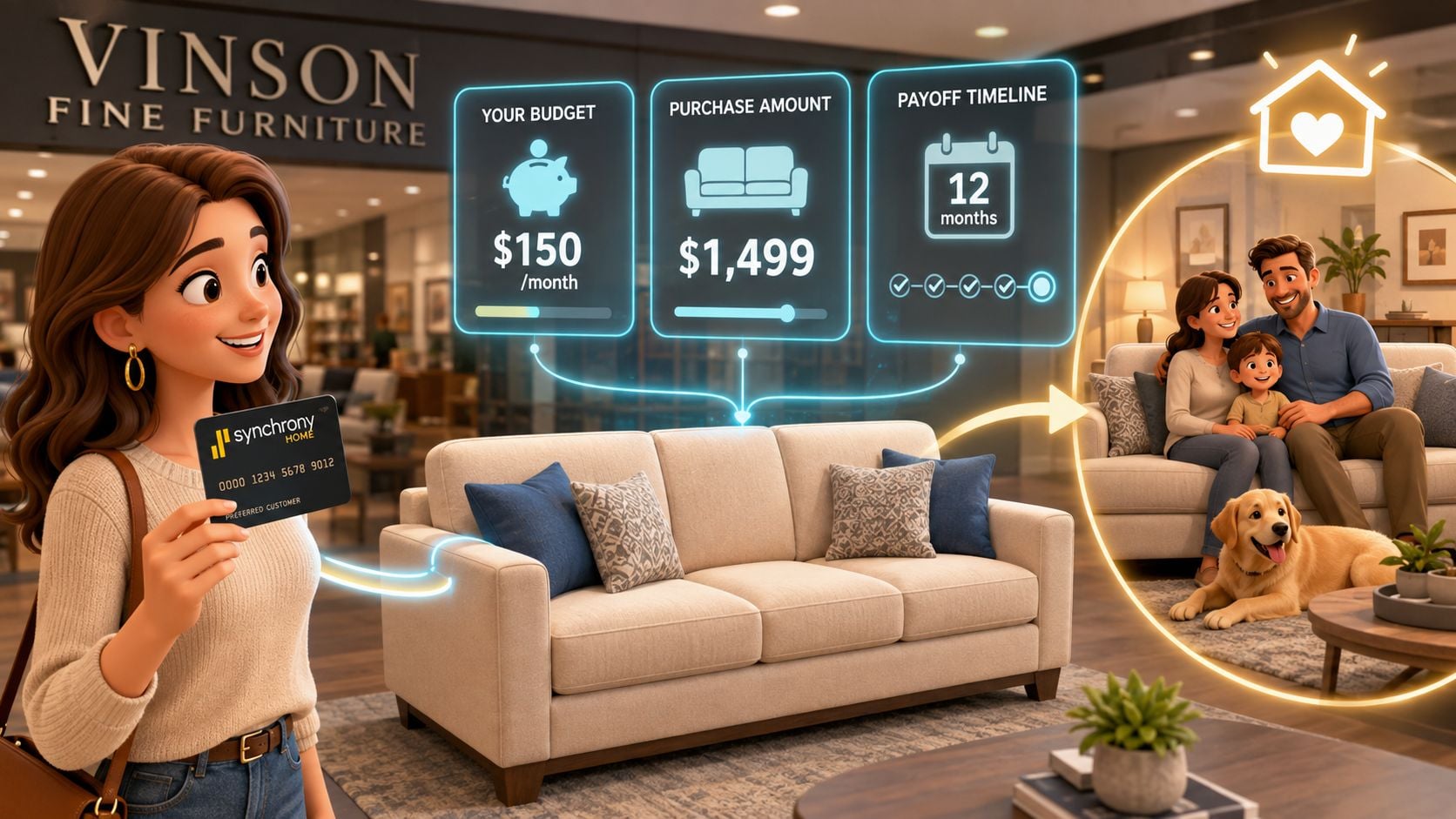
A practical showroom decision rule
- Use the card for one high-ticket item: A single sectional, dining group, or bedroom suite is easier to monitor than scattered purchases.
- Pay above the minimum: The target is the full promotional balance, not merely an account in good standing.
- Choose the term conservatively: A longer term only helps when the household can maintain payments and finish before the deadline.
- Check alternatives first: The Low Price Guarantee provides a 110% refund of the difference when its conditions are met, while the Clearance Gallery offers savings of up to 70%, according to Vinson's publisher information.
- Ask about protection separately: Coverage terms and exclusions should be reviewed through the furniture protection plans information before the purchase is finalized.
For purchases under $500, cash or a general-purpose card may be simpler when the promotion doesn't create meaningful payment flexibility. For a larger purchase, the shopper should compare the available term with a written payoff amount and a specific calendar date, then visit the Easton showroom on Marlborough Avenue for the sit-test and financing discussion.
Vinson Fine Furniture offers complimentary design consultations, a Custom Order Program for Smith Brothers, Canadel, and Mavin, solid hardwood construction, premium motion and leather seating, White-Glove Delivery, and showroom-based financing conversations. Visit Vinson Fine Furniture in Columbus to compare the furniture in person, review the Synchrony HOME offer, and leave with a payoff plan that fits the household budget.