TV Stands Mission Style: The Complete Buyer’s Guide

You're standing in the living room, the TV is already mounted or waiting for a console, and the current stand looks undersized, flimsy, or plain wrong. That's where tv stands mission style earns its place. It brings the weight, visual honesty, and practical storage that a large flat panel deserves, instead of pretending a screen can rest on a decorative box.
Mission style is not nostalgia for its own sake. It's a durable furniture language built for real use, and that's exactly why it still makes sense in homes with 55-inch, 65-inch, and larger displays. If the goal is a piece that looks deliberate, handles electronics cleanly, and still feels worthy of a long-term home, mission style is a serious answer.
Why Mission Style Works for Today's Living Room
A homeowner shopping for a TV stand usually wants the same three things at once. The piece has to look substantial, fit a modern screen, and survive daily use without looking tired in two years. Mission style answers that brief because it was never meant to be disposable furniture.
The style took shape in the United States in the late 19th century and became closely tied to the Arts and Crafts movement, which valued honest construction, visible joinery, and simple forms. Those ideas still show up in mission-style TV stands through straight lines, flat panels, and strong vertical and horizontal framing. The result is furniture that feels grounded instead of lightweight and temporary.
A style built for honest use
Mission furniture reads as architectural, not decorative. The eye sees square framing, broad surfaces, and a calm silhouette, and the hand feels the difference when the piece is opened, lifted, or moved. That matters in a media room, where the stand is expected to hold electronics, hide cables, and still look deliberate beside a large screen.
Practical rule: If a TV stand looks delicate, it will usually behave that way too.
A mission-style stand avoids that problem because its visual language matches its structural logic. The form is direct, the proportions are steady, and the material presence is obvious. For a homeowner who wants furniture that feels like it belongs in the room for decades, that combination is hard to beat.
Mission style also works with other pieces in the room because it does not fight for attention. It gives you a strong anchor, which makes it easier to blend in softer upholstery, open shelving, or accent pieces without turning the room into a theme. For a useful approach to that balance, this guide to mixing furniture styles lays out practical ways to combine mission furniture with other looks.
The Design Language That Defines Mission Style
Mission style is easy to recognize once the eye knows what to look for. The silhouette is usually upright and squared, with flat panel doors, clean rails, and very little ornament. Instead of hiding the material, the design lets the wood grain do the work.
What to look for in the showroom
A true mission piece tends to show a few clear traits:
- Straight, squared edges. These give the stand its sturdy, architectural feel.
- Flat panels and simple faces. The doors and sides look calm rather than fussy.
- Visible joinery. Through-tenons, pegs, or other exposed connections signal structure, not costume.
- Vertical and horizontal rhythm. Slats or framing lines create balance without visual clutter.
- Warm wood tone. The finish should support the grain, not bury it.
The original Arts and Crafts era also made good use of quarter-sawn oak, which produces a ray-flecked figure that feels unmistakably authentic. That grain pattern isn't decorative noise, it reinforces the whole point of the style, which is to show what the wood is doing rather than disguise it.
Why the look and the function match
Mission style is often described as simple, but simple doesn't mean basic. The square framing helps the piece resist racking, which is useful when a large TV sits on top and components move in and out of the cabinet. Flat surfaces also keep the cabinet from looking busy in a room already occupied by a screen, speakers, and remotes.
The best mission-style TV stands feel calm from across the room and serious up close. That's the standard worth holding to. If the piece looks like it is trying too hard, it's drifting away from the style's real logic.
Solid Hardwood Construction and Why It Matters for AV Furniture
Mission style only works when the material matches the look. That means solid cherry, oak, maple, or walnut, or at minimum a true wood-frame build that behaves like furniture meant to last. The style's strength comes from structure first, appearance second.
A mission-style TV stand should be built like a serious cabinet, not a lightweight shell. Solid wood or a strong wood-frame structure gives the piece the stiffness it needs for daily use, visible joinery keeps the construction honest, and the whole cabinet reads as furniture instead of a thin facade. That matters in a media room because electronics create real stress, from vibration and heat cycling to constant opening and closing. A clear guide for mounting a TV helps homeowners think through wall placement, but the stand still has to perform as furniture underneath the screen.
What separates real hardwood from compromise construction
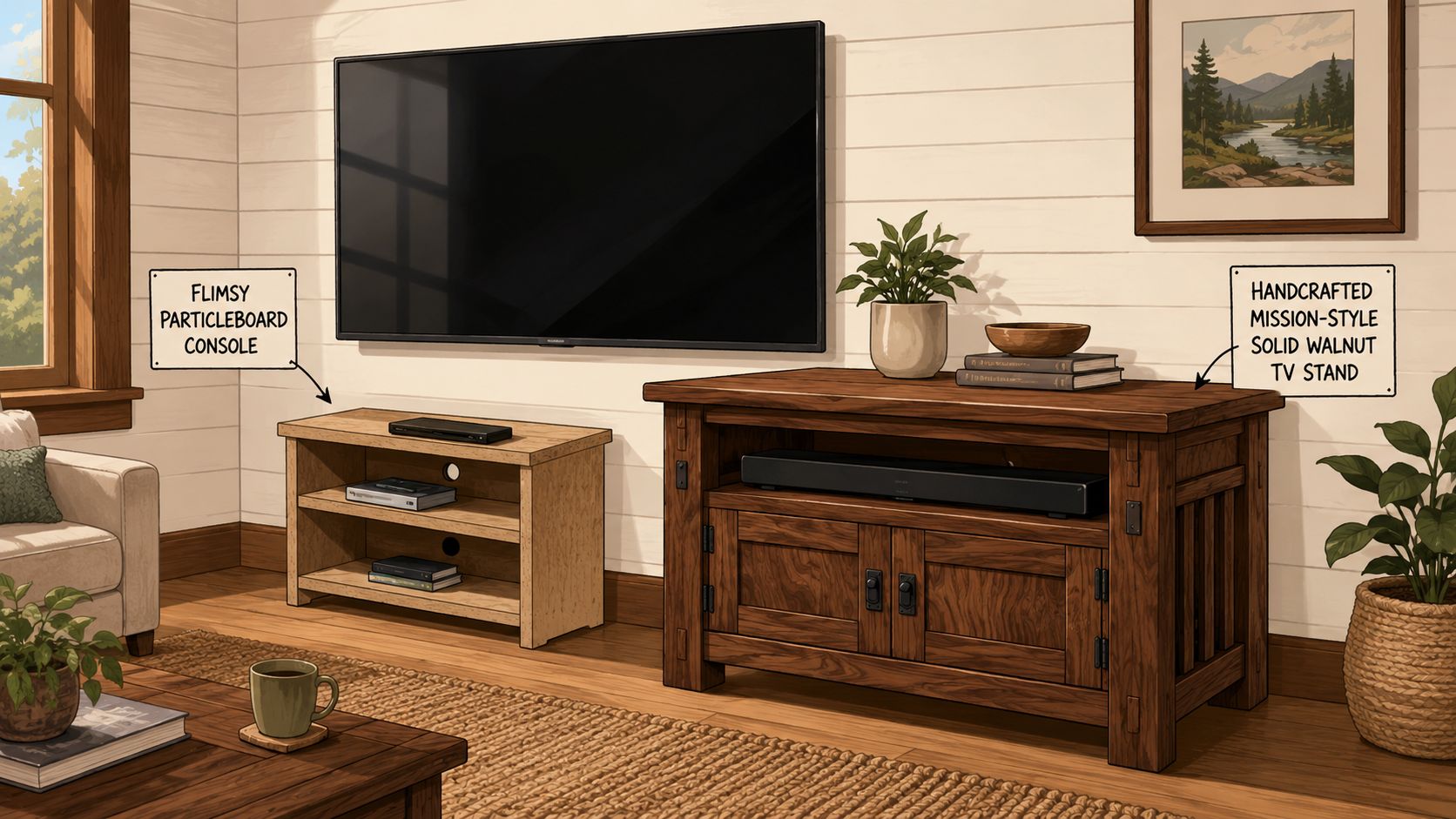
The difference shows up fast in use. Solid hardwood holds fasteners better, resists sagging better, and can be repaired when something loosens. Lower-grade panel construction tends to reveal itself through tired shelves, swollen edges, and joints that never quite feel tight again.
A heavy stand isn't automatically a good stand, but a properly built hardwood stand usually earns its weight.
That extra mass lowers the center of gravity, which is exactly what a TV base needs beneath it. A large flat panel does not forgive instability, and a stand that rocks, flexes, or twists under load is already failing its job. Visible joinery, solid rails, and sturdy drawer boxes all matter because they keep the piece serviceable over time instead of disposable.
Mission furniture also rewards careful wood selection. A well-chosen hardwood brings durability, stable movement, and a finish that ages with character instead of looking tired. For a closer look at those material choices, this hardwood guide is worth reading before buying.
A note for homeowners comparing mounting and stand placement
Some rooms work better with a mounted screen, some with a stand, and some with both. The wall option solves one problem, but it does not replace the cabinet work below it. The stand still has to manage components, ventilate electronics, and finish the room from every angle.
That is the standard worth holding to. If the piece looks good but feels flimsy, it does not belong in a long-term living room.
Sizing Your Mission TV Stand to Modern Screens and Components
Sizing trips up a lot of buyers. They fixate on the TV diagonal and ignore the measurements that determine whether the piece works in a room: width, depth, height, and usable interior space. A mission-style stand can look right and still fail the job if the screen overhangs the base, the receiver has no room to breathe, or the shelves are too tight for the components.
Start with the screen base, not the screen size on the box. The stand should be wider than the TV feet or pedestal, with enough room on both sides to keep the piece stable and visually balanced. Sizing guidance generally calls for a console that extends past the TV base, and the safest choice is the one that gives the set clear support instead of making the furniture carry the load at the edge. That matters even more in homes with children or pets.
The numbers that actually matter
Height decides comfort, not just style. For many living rooms, a stand in the 20–24 inch height range pairs well with 55–65 inch TVs, and a broader sizing guide places many stands between 18–32 inches tall with the screen center around 42–48 inches for seated eye level. Those ranges are useful because they connect the cabinet to how people watch television, not just how it looks in a catalog.
Measure the room before you buy, then measure the gear that has to live inside it. A clear plan starts with the TV base, the available wall width, and the depth of the components you expect to store. For a simple walkthrough, this furniture measurement guide keeps the process straightforward.
A showroom checklist keeps the decision honest:
- Base fit: The TV feet or base should sit fully on the top surface.
- Width margin: The stand should extend beyond the TV base on both sides.
- Shelf depth: Receivers, consoles, and streaming boxes should not hang off the shelf edge.
- Ventilation space: Enclosed cabinets need rear cutouts or open-back sections so heat can escape.
- Cable routing: Cords should move cleanly without hard bends against the back panel.
Load distribution matters more than a claimed weight limit. A stand that fits the base properly and keeps hardware ventilated is doing real work.
Overhang is the mistake to avoid. It puts stress at the front edge and raises tipping risk, which is the opposite of what a mission stand should do. The better choice lets the screen sit cleanly on the furniture, with enough surface and internal room to support modern electronics without strain.
For the living room side of the equation, a well-kept floor plan matters too. A mission console looks better and works better when the rest of the room is organized around it, including details like a hassle-free rug pickup and delivery service that clears visual clutter and keeps the focus on the furniture.
Customization Options Through Vinson's Design Studio
Mission style becomes much more useful when it can be built around a real room instead of a generic catalog sketch. That's where customization pays off. Wood species, finish, hardware, dimensions, and interior layout can all be tuned so the stand fits the screen, the components, and the room's architecture.
What customization should actually change
A good custom order program should do more than alter stain color. It should let a homeowner think through the cabinet as a working system.
- Wood species: Solid cherry, oak, maple, or walnut change the grain character and the way the finish reads.
- Finish selection: A darker finish can make a wide stand feel quieter, while a lighter one shows more movement in the grain.
- Hardware: Pulls and hinges should match the room's tone and the piece's overall weight.
- Configuration: Shelf heights, ventilation cutouts, and cable exits should match the actual devices going inside.
A showroom design studio makes that process easier because the shopper can test choices with a consultant instead of guessing from a swatch. In Vinson's Easton setting, the custom order process can be guided through the In-Store Design Studio and complimentary design consultations, with digital visualizers helping translate a mission console finish and configuration before it is built. The same approach also ties into the broader custom order program used for Smith Brothers of Berne, Canadel, and Mavin, which keeps the focus on customized furniture instead of off-the-shelf compromise.
Mission TV Stand Wood Species at a Glance
| Species | Grain Character | Durability | Finish Behavior |
|---|---|---|---|
| Oak | Bold and open | Strong, with a classic mission look | Takes finish clearly and reads traditional |
| Cherry | Warm and smooth | Excellent for heirloom furniture | Deepens in color over time |
| Maple | Fine and clean | Very dependable and dense | Produces a crisp, even finish |
| Walnut | Rich and refined | Durable with a luxury feel | Shows finish depth beautifully |
The point of custom here is practical. A well-designed stand can be adjusted so the receiver breathes, the cables disappear, and the shelf height clears the actual box sitting inside it. That is a better use of customization than chasing novelty.
For shoppers comparing options at the beginning of the process, this custom order starting point makes the path easier to follow.
A clean delivery day matters too. For households coordinating several home upgrades at once, a hassle-free rug pickup and delivery service is a useful reminder that logistics should support the room, not complicate it.
How to Evaluate a Mission TV Stand in the Showroom
A showroom visit should feel like a test, not a browse. The goal is to find out whether the stand behaves like heirloom furniture under real handling, because that tells the truth faster than a product photo ever will.
Start with weight. Lift one edge slightly and notice whether the piece feels dense and stable or hollow and skittish. Then run a hand across the panels and edges, looking for the smooth, continuous feel of solid construction rather than the thin, telegraphed surface that can hint at weaker build quality.
The showroom checks that matter
- Open every drawer and door. The motion should feel controlled, not sloppy or gritty.
- Inspect the joinery. Look for pegs, through-tenons, and other visible structural details.
- Check the back. A finished back and clean cable path signal better furniture discipline.
- Measure the interior openings. Components need real clearance, not wishful thinking.
- Look for ventilation. Receivers and game consoles need room to shed heat.
The furniture should also support the room's flow. A stand placed under a large display has to feel settled, with the TV centered and the cabinet proportions making sense from the seated position. If the screen looks crowded or the shelving feels cramped, the piece is wrong even if it looks handsome on the floor.
For Columbus buyers, Easton Town Center gives the visit a practical advantage. A showroom appointment can be paired with complimentary design consultations, and the buying decision can be weighed against the Low Price Guarantee, which offers a 110% refund of the lower local authorized-dealer price within 30 days when the terms are met Vinson Fine Furniture. The Clearance Gallery can also create real value, with savings of up to 70% on floor samples and overstocks, and white-glove delivery keeps the process from turning into a weekend project.
A good showroom visit answers one question fast, does the piece feel built for the room, or just styled for the listing?
That's why the sit-test matters for media furniture too. A mission stand should feel like it was made to carry weight, not merely decorate the wall beneath a screen. When the piece passes the hand test, the drawer test, and the fit test, the decision gets easier.
For a deeper walk-through of what to look for on the floor, this TV stand shopping guide is the best next stop.
Care, Maintenance, and Long-Term Value
A solid hardwood mission stand doesn't ask for much, but it does ask for consistency. Dust it with a soft dry cloth, avoid silicone polishes, use felt pads under devices, and keep indoor humidity stable so the joints stay tight and the wood moves predictably. Because the joinery is visible and serviceable, repairs are usually possible instead of forcing a full replacement.
That's the long view homeowners should want. A well-built piece in a family-run, regional furniture setting reflects the same idea as the rest of the home, quality that ages into value instead of fading into clutter. For buyers who want a mission-style TV stand that can outlast the screen above it, Easton Town Center is the right place to start.
A CTA for Vinson Fine Furniture. Visit the Easton showroom, use the design consult, compare hardwood finishes in person, and choose a mission-style TV stand that fits the room today and still earns its place years from now.