Amish End Table Guide: Woods, Joinery and Buying Tips


The sofa is in place, the rug is down, and the space at the end of the couch is still empty. A lamp sits on the floor because there's nowhere steady to put it, and a mug has been living on the armrest for a week. That empty corner is where the search for an Amish end table often starts, and it's also where the decision gets harder than it should be.
Every listing uses the same vocabulary. Solid wood. Handcrafted. Heirloom quality. None of that tells you whether the top will stay flat through a Columbus summer, whether the leg joints will loosen after two winters of dry forced-air heat, or whether a water ring can be sanded out in ten minutes or not at all.
Treat this as an inspection problem rather than a style problem. Species, top attachment, joinery, finish chemistry and humidity control all leave physical evidence you can see with your own eyes and feel with your own hands, in a showroom, before any money changes hands. That's the whole method, and it works on any solid-wood table regardless of who built it.
Amish End Table Sizes and Prices at a Glance
An end table can look right beside a sofa and still crowd the walkway or leave a lamp perched too close to the edge. Check the footprint, height and quoted configuration together. Product listings show how much sizes and prices can vary: one table is listed at 22 inches wide, 24 inches deep and 24 inches high, while another is offered in five sizes, including a 22-by-22-by-24.5-inch version. A third listing gives a price of $235.00, reduced from $260.00.
| Model | Width x Depth x Height | Listed Price |
|---|---|---|
| Ole Barn End Table | 22 x 24 x 24 in | Quote from maker |
| Tyron End Table | 22 x 22 x 24.5 in (one of five sizes) | Quote from maker |
| Amish Hickory Log End Table | Not published; confirm footprint with maker | $235.00 (reduced from $260.00) |
Only one of the three listings publishes a price. For the other two, request a written quote for the size and species you want. A listed price is not enough to compare tables unless you know which dimensions, wood and options it covers. Ask whether the quote includes any drawer, shelf or edge-profile changes, and compare like configurations.
What Width, Depth and Height Decide
Width and depth determine how the table fits between the sofa, coffee table and walkway. Too much depth narrows the path; too little leaves a lamp base or drink close to the edge. Height sets how comfortably you can reach the surface from the sofa. A top far above the arm can feel awkward, even when the table fits the corner.
Use this measuring routine before choosing a size:
- Measure the sofa arm from the floor to its top where the table will sit. Since arms can slope, measure at the front edge rather than the middle.
- Choose a table height within about two inches of that measurement. A top slightly below the arm is usually easier to reach than one well above it.
- Check the walking route between the table and nearby furniture. Leave a 12-inch clear path where possible. In a tight room, a smaller top is often a better trade-off than a blocked walkway.
Why the Price Moves
The quoted price can change with species, finish, dimensions and custom details such as a drawer, shelf or different edge profile. A change in wood affects both the material and the work needed to mill the piece, so two orders for the same model may not have the same final price. Ask the maker to specify the exact size, species, finish and options in writing before you compare quotes.
At Vinson Fine Furniture's Easton Town Center showroom, bring your sofa-arm measurement and the available space dimensions. Check how the table sits beside the sofa, whether its footprint leaves room to pass, and whether the finish feels right for the room. A written quote for the exact configuration makes the price easier to assess than a single listing figure, especially when only one of the examples above includes a published price.
Solid Hardwood Species and What Each Does Best
Species is the first real decision, and most buyers make it by color alone. That's backwards. The species sets how the top handles daily abuse, how the grain reads across a room, and how much the surface will change in the next twenty years. This guide stays inside four: solid cherry, solid oak, solid maple and solid walnut. Anything described as engineered, laminated or composite belongs to a different category of product.
Hardness is the useful starting filter. The Janka test presses a steel ball into the wood face and measures the force required to embed it halfway, which is a fair proxy for dent resistance on a tabletop that receives keys, remote controls and the occasional dropped tool.
Matching Hardness to the Household
Hard maple sits at the top of the four for dent resistance, with a fine, even grain and a pale cream to light brown color that takes stain predictably. In a house with children, pets and drinks that migrate around the living room, maple forgives the most.
White oak, especially in the quartersawn cut, holds its place as the traditional and mission-shopped choice. Quartersawn boards are cut so the growth rings meet the face at a steep angle, which makes them move less across a wide top and produces the ray flecks buyers either love or don't. For any top over roughly 20 inches wide, that stability is worth the upcharge.
| Species | Grain and Color | Best Use in a Living Room |
|---|---|---|
| Hard maple | Fine, even grain; pale cream to light brown | Busy households and frequent use |
| White oak, including quartersawn | Open grain; golden-brown with ray flecks in quartersawn cuts | Traditional and mission looks; quartersawn for wide tops |
| Black walnut | Straight to wavy grain; deep chocolate brown | Formal or dark-toned rooms; handle with care |
| Cherry | Fine grain; warm reddish-brown that deepens with light | Warm rooms that welcome a developing patina |
Black walnut brings depth that no stain reproduces, and it dents more readily than maple or oak under a heavy lamp base or a metal object set down hard. It suits a formal room where objects get placed rather than tossed.
Cherry is the softest of the four and the only one that changes color substantially. It starts lighter and warms toward a reddish-brown with exposure to light, which means the tabletop will darken unevenly if a lamp or a stack of books sits in one spot for years.
Species Names Are Not Always Specific Enough
Ask the maker to write the species on the order. "Oak" covers red and white, which behave differently under finish and in service. "Maple" can mean hard maple or soft maple, and only one of those belongs under a table that gets used. For a deeper look at how species choice plays out over the life of a piece, this guide to choosing the right hardwood for longevity and style covers the trade-offs in more detail.
The same logic applies beyond furniture. Grain direction and hardness decide whether a frame stays square or twists, and the wood frame guide for wall art explains how those choices work on a smaller scale.
Three rules cover most of it. Match hardness to the surface that gets used hardest, match color to the sofa and rug already in the room instead of to a photo of someone else's room, and match patina tolerance to how much visible change you want to live with.
Joinery and Movement That Keep the Top Flat
Set a solid-wood end table beside a radiator in January and the top shrinks across the grain. Run the same room through a humid July and that panel swells back. The movement never stops, and it adds up across the full width of the top. Glue the panel to the apron and drive screws through tight round holes, and the stress has nowhere to go. It shows up as cupping, a split, or a cracked finish line along a seam.
Good construction gives the movement a path to follow. Dimensional change tracks moisture-content change across the normal range of indoor use. The USDA Forest Products Laboratory cites a practical rule limiting in-service variation to roughly 2% to 3% above or below the average moisture content where tolerances are tight. A top free to slide a fraction of an inch stays flat. A trapped top eventually shows the stress.
| Joint or Fastener | Where You See It | What It Controls | Warning Sign |
|---|---|---|---|
| Mortise-and-tenon | Leg to rail or apron connections | Racking and wobble | Open gaps at the shoulders or loose pins |
| Figure-eight fasteners or tabletop clips | Underside of the top | Cross-grain movement of wide panels | Top screwed or glued rigidly to the base |
| Elongated screw slots | Apron or rail attachment points | Seasonal expansion of the top | Screws driven tight at the slot ends |
| Corner blocks | Inside leg-to-apron corners | Added rigidity at the frame | Missing blocks or glue only at the edges |
| Dowels | Rail or panel joins | Alignment during assembly | Dowel count treated as the only strength proof |
The one thing to check first: turn the table over. If the underside of the top is bare and screwed down through round holes with no room to slide, the design has no plan for winter.
The Showroom Inspection, In Three Moves
- Look under the top. Find the clips, figure-eight fasteners, or slotted screw holes. Hardware that can slide means the maker planned for seasonal change. A top glued and screwed solid to the apron means the panel will fight the frame.
- Rock it gently on a flat floor. Press each leg corner in turn. A table that shifts now will shift more once the wood seasons in your house.
- Trace every leg-to-rail joint with a fingertip. Clean shoulders, no open gaps, no filler smeared into a seam. Corner blocks inside the frame add rigidity where the legs meet the apron.
Joint geometry, grain direction at the joint, and room to move without splitting decide what happens in year ten. Dowel count and glue coverage only count as part of that geometry, not as a strength claim on their own. While the table is upside down, read the exposed edge and end grain. Continuous wood all the way through means solid lumber. A thin face over a different core means veneer, which moves less but fails differently if the face lifts. For how each connection carries load, this explanation of wood joinery types shows what the joint is doing structurally.
Finishes and Custom Options That Fit Your Room
A birthday-party glass leaves a pale ring on a glossy end table, and the first question is not how pretty the top looked in the showroom. It is whether that mark can be spot-fixed or whether the whole film has to come off. Finish is the table's first defense against water rings, heat marks and spilled juice, and it is usually the first surface that needs work. A high-gloss top that cannot be spot-repaired is a worse long-term buy than a matte finish that touches up in about ten minutes.
Made-to-order production is what makes that choice real. Small family workshops build each order individually rather than pulling a finished piece from mass inventory, and the species on offer include oak, brown maple, cherry and quartersawn white oak (Ohio maker profile). You pick species, dimensions and finish before construction starts.
| Finish | Look | Wear Resistance | Repair Path |
|---|---|---|---|
| Oil or oil-wax | Natural, matte, hand-rubbed | Moderate; heat and water marks possible | Spot re-oil or light sanding |
| Varnish | Clear film with a slight sheen | High against water and alcohol | Full sanding and refinishing once the film wears |
| Lacquer | Smooth, fine sheen | High; sprayed and quick to dry | Strip and refinish; touch-ups are hard to blend |
| Stain under topcoat | Deeper color that lets the grain show | Depends on the topcoat chosen | Full stripping needed before restaining |
Three Finish Directions Worth Considering
Natural hand-rubbed. Oil or oil-wax on maple or oak, no toner, no added color. Grain stays readable, and a scratch often blends after a re-oil. It asks for more frequent care than a film finish. For someone willing to maintain the piece, it is the simplest repair path.
Deeper stained tone. A stain under a protective topcoat can pull a new end table toward a dark dining set across the room. The trade-off is repair. Color lives in the wood, so a damaged spot usually means stripping back to bare wood and a professional refresh, not a ten-minute touch-up.
Aged or distressed. In a rustic room, where a log or barn-style table sets the tone, light distressing hides the first marks a smooth top would show right away. It does not change how the wood underneath moves or how a film or oil layer fails. It only changes how soon those marks become obvious.
Custom Ordering Without Guesswork
The Custom Order Program is there so the tone, size and configuration are set before the shop cuts the wood. Where a piece includes upholstery, fabric or leather is part of the same order. Partner lines such as Mavin and Smith Brothers of Berne sit in that custom framework, with choices of wood finish, size and configuration. Advanced digital visualizers let you see the design before it is built, which is cheaper than finding a finish clash on delivery day.
Compare finish samples under the light in your own room, not only under showroom spots. A warm afternoon window shifts a stain more than a card under retail lighting suggests. A complimentary design consultation covers space planning, fabric coordination and finish selection so those choices line up with the furniture already in the house.
How a finish behaves after years of use is covered in this guide to natural wood finish.
Durability, Care and Real Long-Term Value
A lamp sits on the end table all winter, a few inches from a floor vent. By February a hairline shows along the grain, and the owner decides the maker failed. Solid wood exchanges moisture with the air around it. Below the fiber-saturation point, losing moisture shrinks the cell walls and gaining moisture swells them. Repeated or uneven movement produces warping, checking, splitting and loosened joints (USDA Forest Products Laboratory). That movement follows how the room is run.
A finished top looks like this when the maker has done the conditioning work properly.

Moisture content is the figure that tells you whether a top will stay flat. Dimensional change is easiest to estimate when lumber sits in a moderate moisture band, and furniture stock needs conditioning that matches the room it will live in. A table built from lumber dried and acclimated to a Midwestern interior behaves predictably in that same interior. One that leaves a dry shop and lands next to a humidifier, or the reverse, will keep moving until the wood catches up.
A Care Routine That Fits a Modern House
Hold indoor humidity fairly steady through the year. Keep the table away from radiators, heating vents, fireplaces, direct sun and persistently damp exterior walls. Uneven conditions make one part of a top move more than another. Cracks start there.
- Wipe with a soft cloth and dry spills immediately. Water sitting on a film finish overnight is how rings form.
- Use coasters and lift objects rather than dragging them. A dragged lamp base leaves a scratch that costs more to fix than the coaster habit costs to keep.
- Clean with mild, non-alkaline soap only when needed. Damp cloth, quick dry, no soaking.
- Skip silicone-based polish. It builds a film that makes future refinishing unpredictable.
Seasonal gaps and slight cupping show up on well-made solid tops. A wide panel that tightens in July and shows a hairline in February is doing what solid wood does. Before you blame the shop, check three things: kiln drying, acclimation, and a top built so it can move. If those were done, the winter line is a humidity problem, not a failed table.
The Repair Path Is the Value
Kiln-dried solid hardwood carries an estimated service life of 25 or more years with proper care, and it can be sanded and refinished after scratches, water rings or heat marks (guide to furniture longevity by material). Refinishing is the difference between a table that gets renewed and one that gets replaced.
A table earns its keep only while it stays in use. Repair, a later refinish, resale and donation do more for that than a slogan about lasting generations. I would budget for one professional refinish over the life of the piece rather than treat the first water ring as a reason to replace it. The shorter routine behind that plan is in this guide to caring for wood furniture.
Who Makes Amish End Tables in Ohio
Holmes County holds one of the largest Amish settlements, and furniture work grew there as farming alone became a thinner living. In 1973, 3% of Amish household heads in Holmes County worked in the secondary wood sector, the category that includes furniture manufacturing. By 1997, that share reached 14% (USDA Forest Service study).
A small end table sits on that shift. The supply behind it is a regional industry, not a scattered hobby.
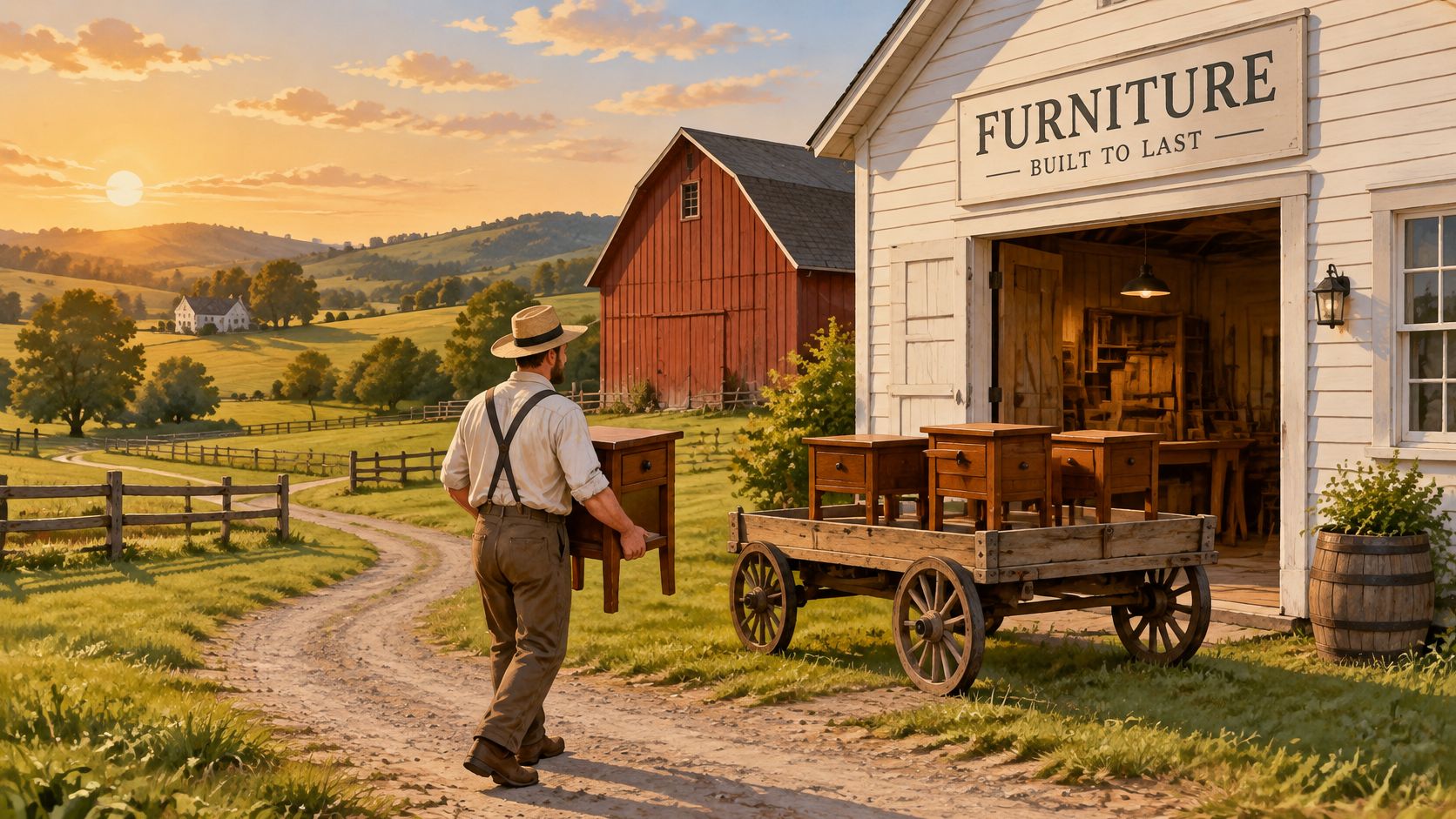
The Ohio Amish furniture cluster used approximately 43.5 million board feet of hardwood, about 11% of Ohio's total hardwood lumber production (TimberLine magazine). Local mills feed the shops. Species on offer, and how long a custom top takes, often follow what those mills are cutting.
Small Workshops
Most of these businesses are family shops with a small crew, building one order at a time. That is why a buyer can set species, size and finish before construction instead of taking floor stock.
The trade-off is capacity. A small shop can match a top to the rest of the room. It will not stock every size. Before you treat the maker's name as proof, ask three shop-floor questions: how the top attaches to the base, which joints hold the apron, and how the lumber was dried for seasonal humidity. A shop that answers those, and that names its region and lumber source, is giving you a repair path you can plan for. A tag that only says the piece was made by hand does not.
The question that separates a workshop from a label: who built it, where, and from what wood? A maker who names the shop, the region and the lumber source gives you something you can check.
Vinson Fine Furniture, at Easton Town Center in Columbus, carries that kind of work through custom bedroom and dining lines by Mavin, custom dining by Canadel, and Smith Brothers. How a specified build is ordered is laid out in this overview of custom-made Amish furniture.
Buy at the Easton Showroom
You are at the order desk with a sofa-arm measurement and a photo of the room. Before anyone writes a finish, ask for the kiln-drying record: the target moisture content, how long the lumber sat after the kiln, and whether that figure was checked again once the top was glued up. A seller who can put those numbers on the order can also say how the top fastens to the base, and what the shop will do if a joint loosens or the finish needs work years later. That is the repair path. I would rather leave with a written moisture figure than a verbal promise that the wood "should be fine."
Central Ohio heating season drops indoor humidity hard. A top that left the shop near the moisture it will live at moves less once it is beside a register. Ask what range they build to, and what they recommend for the first winter in the house.
Services That Change the Buying Experience
The in-store Design Studio is where the table gets coordinated with the room. A complimentary consultation covers space planning, finish pairing and scale, so the end table reads with the sofa instead of as a leftover piece.
Custom ordering extends that. Many pieces can be specified with a choice of fabric, leather, wood finish, size and configuration, and the Custom Order Program covers partner lines including Mavin, Smith Brothers and Canadel.
Two policies set the budget. The Low Price Guarantee refunds 110% of the difference if you find a lower price at a local authorized dealer within 30 days. The Clearance Gallery holds floor samples, overstocks and seasonal closeouts at up to 70% off when you want the piece now and can live with what is already built. A clearance table saves money and skips the wait. It also means the size, species and finish were chosen by someone else.
White-Glove Delivery inspects each item, then places it, assembles it and clears the packaging. The table arrives in the room it was measured for, and you are not left hauling a carton up the steps.
A note on sequence: choose the size and species first, the finish second, and the price conversation last. Buyers who start with the discount end up fitting a room around a table instead of the reverse.
Three Ways to Start
Book a showroom visit at Easton Town Center in Columbus and bring the tape measure. Call (614) 476-5858 ext.3 first if you want the kiln-drying and repair questions answered before you drive. Or start in the Clearance Gallery when the budget is fixed and the timeline is short, then decide whether a custom build is worth the wait.
Vinson Fine Furniture, formerly Kitchen Tables & More, serves Columbus and the surrounding cities from that Easton showroom. Visit Vinson Fine Furniture to plan the visit or see what is currently in the Clearance Gallery.