Custom Solid Wood Furniture: A Buyer’s Guide to Lasting


A homeowner at the Easton showroom runs a hand across two tabletops. One feels smooth and substantial, with visible grain that changes from board to board. The other looks uniform and arrives with a more limited design story. The decision isn't only about today's price. It's about whether the table will still suit the home after a renovation, a move, or years of family dinners.
Custom solid wood furniture deserves that longer view. It combines material selection, joinery, finish, dimensions, delivery, and future care into one ownership decision. For Columbus homeowners, the Vinson Fine Furniture showroom at Easton Town Center provides a place to compare grain in person, inspect construction, sit-test motion seating, and evaluate whether a custom order fits the room and the household's timeline.
Why a Custom Solid Wood Piece Is a Different Kind of Purchase
A seasonal furniture purchase solves an immediate problem. A custom solid hardwood dining table solves a spatial, practical, and emotional problem at the same time. It can be sized for the room, finished to coordinate with existing pieces, and built around the way the household uses the space.
That distinction matters in Central Ohio homes, where dining rooms and living rooms often need to handle more than formal entertaining. A table may host homework, holiday meals, remote family gatherings, and everyday breakfasts. A sectional may need to support quiet reading, movie nights, and guests. The right piece has to perform through all of those uses without looking temporary.
The investment starts with the room
At Easton Town Center, a homeowner can compare solid cherry, oak, maple, and walnut samples under showroom lighting rather than relying on a small photograph. The tactile inspection matters. Grain variation, edge profiles, seat height, cushion support, and reclining mechanisms all influence the purchase in ways that a product page can't communicate.
The same logic applies to the bedroom. A Mavin bedroom suite can be evaluated as a complete environment, from the scale of the bed to the proportions of the case pieces. Buyers considering Mavin bedroom furniture should check drawer operation, finish consistency, hardware placement, and how the pieces relate to the room's existing flooring and lighting.
Investment rule: A piece that fits the room, supports the household, and can be repaired later earns its place more convincingly than a piece chosen only for immediate availability.
Furniture should outlast the current decorating cycle
The global custom-furniture market is estimated at USD 38.78 billion in 2026 and projected to reach USD 66.49 billion by 2033, with a 9.4% CAGR over that period. Wood is expected to represent 40.5% of the market by the end of 2026, according to market projections for solid wood furniture. Those figures point to broad demand for personalization and wood-based construction, particularly in premium residential and design-led spaces.
The buyer still has to separate genuine quality from attractive styling. A custom label doesn't automatically guarantee sound construction. The useful questions are more concrete: What hardwood is used? How does the top accommodate movement? Are the drawers properly joined? Can the finish be refreshed? Does delivery include placement and inspection?
That is why the sit-test remains essential. A homeowner should visit the Easton showroom with room measurements, test the seating, open drawers, inspect table edges, and compare samples before committing to a piece intended to serve for decades.

What Custom Solid Wood Furniture Actually Means
Custom solid wood furniture starts with a material standard, not a finish color. Every visible board, panel, and structural member should be specified as solid cherry, oak, maple, or walnut when those are the hardwoods selected for the design. Vinson's hardwood standard is strict. The company sells solid hardwood furniture and doesn't sell or promote engineered wood, MDF, laminate, or particle board.
That standard gives the buyer a clearer ownership story. The piece has natural grain, real dimensional behavior, and the possibility of repair or refinishing rather than a design that depends on a fixed surface layer. The construction still needs to be assessed carefully, because solid material alone can't compensate for poor joinery or an unsuitable design.
Customization is a series of decisions
A proper custom order usually involves several coordinated choices:
- Choose the room and dimensions. The table, bed, case piece, or seating arrangement must fit circulation paths as well as the wall or dining area.
- Select the hardwood. Cherry, oak, maple, and walnut create different visual effects and respond differently to light and use.
- Specify the finish. Finish color changes how the grain reads and how the piece relates to floors, trim, upholstery, and natural light.
- Refine the form. Edge profiles, legs, hardware, drawer configurations, and table extensions affect both appearance and daily use.
- Coordinate upholstery. Motion seating can pair solid hardwood framing with top-grain or performance leather, along with motorized reclining, swivel, rocker, or glider features.
Vinson's Custom Order Program supports fabrics, finishes, and digital visualizers for Smith Brothers of Berne, Mavin, and Canadel. That lets a buyer preview a custom solid-wood dining design or a top-grain leather sectional before production begins. The solid wood furniture guide can also help clarify the material questions that should be answered before a design is finalized.
Brand origin should match the buyer's priorities
Smith Brothers of Berne is made in Indiana, USA, which makes it a direct choice for buyers prioritizing American-made upholstered furniture. Mavin is Amish-made in Ohio, USA, with a strong local connection for Central Ohio homeowners. Canadel is handcrafted in Quebec, Canada, making it a North American-crafted option rather than an American-made one.
That distinction should remain clear. An American-made selection can center on Smith Brothers and Mavin. A North American-crafted roundup can include all three. The origin is part of the purchase, especially for buyers who care about regional manufacturing, domestic production, and the relationship between craftsmanship and service.
Choosing the Right Hardwood for Your Home
The best hardwood depends on the room's demands, the desired grain, and the atmosphere the homeowner wants to create. Solid cherry brings warmth and develops a richer appearance over time. Oak offers pronounced grain and a familiar, grounded character. Maple reads cleaner and more subtly. Walnut makes a statement with deep color and visual depth.
No species should be chosen only because it looks attractive on a sample board. The surrounding light, flooring, upholstery, wall color, and frequency of use all matter. A dining table that anchors a busy household has different requirements from a bedroom suite intended to create a calmer, lower-contrast environment.
Solid hardwood species at a glance
| Species | Hardness (Janka) | Grain Character | Best Room Fit |
|---|---|---|---|
| Solid cherry | Varies by board and selection | Smooth, warm, and refined | Dining rooms and bedrooms where the finish can develop visual richness |
| Solid oak | Varies by board and selection | Pronounced, open, and expressive | High-use dining rooms and traditional or transitional interiors |
| Solid maple | Varies by board and selection | Clean, subtle, and even | Bright dining spaces, contemporary rooms, and lighter bedroom settings |
| Solid walnut | Varies by board and selection | Distinctive, deep, and dramatic | Statement living rooms, feature pieces, and sophisticated bedroom designs |
The table intentionally avoids unsupported hardness rankings. Janka hardness depends on the specific wood selection and should be discussed with the design consultant when a buyer has unusually demanding use requirements.
Match species to the room, not the trend
For an Ohio Amish dining set, Mavin can provide a useful setting for comparing oak, cherry, maple, and walnut in practical proportions. Canadel's customizable dining program offers another route for buyers who want to coordinate size, finish, and dining-room style with a North American-crafted line. In the living room, Smith Brothers seating can bring top-grain or performance leather into the composition, with solid hardwood frame components supporting sectionals, recliners, swivel chairs, rockers, and gliders.
A bedroom often benefits from a species that supports rest rather than competing with it. Cherry can add warmth, maple can keep the room visually light, and walnut can create a richer, more architectural effect when the surrounding palette is restrained.
Bed construction deserves attention as well. Buyers evaluating a solid wood bedroom should review practical guidance on how to extend your bed's lifespan, particularly when selecting support components and planning for long-term daily use.
For a deeper species-selection discussion, the hardwood longevity and style guide gives homeowners a useful framework before they compare samples at the showroom.
Joinery and Construction Details That Decide Longevity
Wood species gets attention because buyers can see it. Joinery often decides whether the piece remains stable and useful after years of movement, loading, and repeated opening and closing. Solid hardwood furniture needs construction that respects the material's behavior rather than trying to force it into a permanently fixed shape.
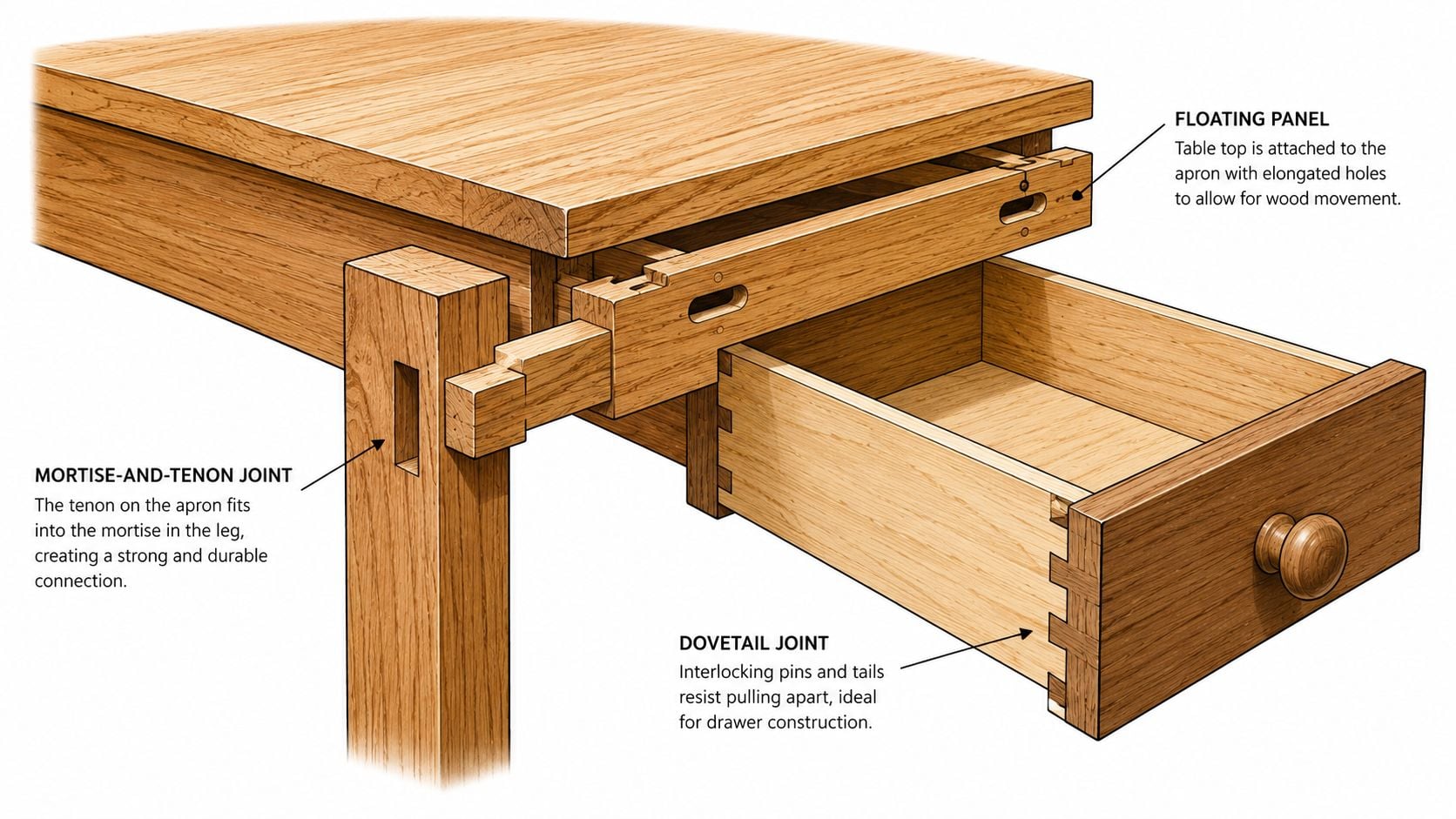
Mortise-and-tenon construction is a strong example. The joint creates broad wood-to-wood contact and a mechanical interlock that resists shear and racking better than simpler fastener-based connections, which is why solid hardwood furniture and mortise-and-tenon methods are consistently associated with long-life construction in furniture joinery guidance.
What to inspect on the showroom floor
A buyer doesn't need to be a cabinetmaker to identify meaningful details. The inspection should focus on how the piece carries weight and accommodates seasonal change.
- Mortise-and-tenon joints: Look for structural connections at tables, chairs, beds, and case-piece frames where the joint does real mechanical work.
- Dovetail drawers: Check whether drawer corners show carefully interlocked construction and whether the drawer moves smoothly without racking.
- Floating panels: Wide tops, cabinet panels, and drawer fronts need room to expand and contract across the grain.
- Grain-aligned glue-ups: Boards should be arranged with attention to grain direction, visual continuity, and the movement that will occur across a wider surface.
- Hardware and fasteners: Slotted holes and appropriately placed fasteners can secure a top while allowing it to move rather than split.
The guide to various wood joints gives buyers vocabulary for discussing these details with a design consultant. That vocabulary makes the showroom conversation more productive because the buyer can ask about a specific joint instead of relying on a general impression of sturdiness.
Construction should accommodate wood, not fight it
Most dimensional change occurs across the grain, not along it. Wide tabletops, cabinet panels, and drawer fronts therefore deserve closer scrutiny than narrow rails or legs. A maker who uses floating panels, slotted screw holes, and grain-matched joinery is allowing the furniture to respond to its environment without splitting, binding, or loosening prematurely.
Mavin's Amish-made production in Ohio and Canadel's handcrafted production in Quebec both give buyers a useful context for discussing bench-made construction and regional manufacturing. The important question remains practical: how does the particular piece handle load, movement, and repair?
Designing Your Piece at the In-Store Design Studio
The strongest custom orders begin with a room problem, not a color preference. A dining table may need to preserve a walkway while seating a larger household. A sectional may need to fit a narrow stair landing and still provide motorized reclining. A bedroom suite may need storage that works around windows, doors, or an existing architectural feature.
Vinson's In-Store Design Studio gives Columbus-area homeowners a place to work through those decisions with complimentary design consultations. The process covers space planning, fabric coordination, finish selection, and the relationship between wood, upholstery, lighting, and scale.
Bring the information that changes the design
A productive consultation starts with usable information:
- Room dimensions: Include wall lengths, ceiling height, doorways, stair access, and the location of windows or vents.
- Photos and swatches: Flooring samples, paint cards, rugs, curtains, and existing upholstery help the consultant coordinate finishes.
- Lifestyle details: Note pets, children, entertaining habits, mobility needs, preferred seat depth, and whether the furniture will receive daily or occasional use.
- Timeline constraints: A move, renovation, holiday gathering, or construction handoff can affect whether a custom order or clearance piece makes more sense.
- Must-have functions: Identify extension leaves, storage, power motion, swivel capability, rocker or glider movement, and preferred leather or performance fabric.
A buyer considering Custom leather sectionals Columbus should bring the actual room measurements and identify every path needed for delivery. A top-grain leather sectional can look appropriately scaled in a showroom yet become difficult to place if the entry route wasn't considered early.
Use visualization before production
The Custom Order Program supports Smith Brothers, Mavin, and Canadel with fabrics, finishes, and 3D visualizers. Those visualizers can help a homeowner test a custom solid-wood dining table against different finish directions or preview a top-grain leather sectional before production.
The preview won't replace a physical sit-test or a review of actual wood and upholstery samples. It does reduce avoidable uncertainty around proportions, finish combinations, and the relationship between a wood dining design and nearby living-room furniture.

Homeowners who want to prepare before visiting can review how to get started with a custom order. The practical goal is simple: arrive with enough information to make decisions, but leave room for the consultant to identify problems the homeowner may not have considered.
Setting Realistic Expectations on Price and Lead Time
Custom furniture has three separate financial questions. The first is the purchase price. The second is how long the order takes. The third is whether the piece remains useful, serviceable, and attractive over its ownership life.
Floor stock can solve an immediate need, but custom work adds design review, material selection, production scheduling, finishing, inspection, and delivery coordination. Current industry coverage places average order-to-delivery cycles at 16.3 weeks, compared with 11.8 weeks in late 2022, with FSC-certified hardwood shortages, longer curing times for water-based coatings, and additional compliance handoffs contributing to delays. Buyers can review that lead-time context in recent solid wood furniture trend coverage.
Build the timeline around the deadline
A homeowner moving before a renovation finishes shouldn't treat a quoted production window as a casual estimate. The design consultation should identify the required arrival date, then account for approval time, production, finishing, inspection, and white-glove scheduling.
Customization choices can also affect the schedule. Unusual dimensions, special finishes, certification requirements, and coordinated multi-room orders may create additional production steps. The most reliable approach is to ask which selections are readily available, which require additional curing or sourcing time, and what happens if a material becomes unavailable.
Use value levers deliberately
Vinson provides several ways to manage the purchase:
- Low Price Guarantee: If a lower price is found at a local authorized dealer within the stated policy period, Vinson offers a 110% refund of the difference.
- Clearance Gallery: Floor samples, overstocks, and seasonal closeouts offer savings of up to 70%, subject to available inventory.
- Custom Order Program: A buyer can prioritize exact dimensions, hardwood, finish, upholstery, and motion features when the room and timeline justify made-to-order work.
- Synchrony HOME Credit Card: Financing options are available, with promotional plans for qualified buyers subject to account terms and approval.
White-glove delivery should be treated as part of the ownership experience, not an afterthought. Established delivery guidance describes it as bringing the furniture inside, unpacking it, inspecting it for damage, assembling required parts, placing it in the desired room, and removing packing debris before leaving. That service is especially valuable for a substantial dining table, bedroom suite, or power-motion sectional.
For homeowners comparing the broader economics of durable materials, a regional solid hardwood flooring cost comparison for Richmond homeowners offers a useful reminder to separate initial price from long-term material value.
Caring for Solid Wood So It Outlives the Next Remodel
Solid wood responds to the air around it. For most species used indoors, moisture content is typically targeted at 7% to 11%, because wood continues exchanging moisture with the environment until it reaches equilibrium. If a piece enters a home too wet or too dry, seasonal humidity changes can loosen joints, open gaps, or contribute to warping, as explained in this guidance on wood movement and seasonal accommodation.
Control the environment first
Columbus homes experience changing indoor conditions across heating and cooling seasons. A homeowner doesn't need to stop natural movement, but the room should avoid extreme swings whenever possible. Wide tops are particularly important because most dimensional change occurs across the grain, not along it.
A practical working estimate for flatsawn domestic hardwoods is roughly one-quarter inch of movement per 12 inches of width across a typical year, according to seasonal wood movement guidance. That is why quality construction uses floating panels and slotted fastener holes rather than locking a wide surface rigidly in place.
Keep maintenance gentle and consistent
- Dust regularly: Use a soft, dry cloth to prevent grit from wearing the finish.
- Clean lightly: Use a slightly damp cloth and a product appropriate for the manufacturer's finish. Avoid soaking the surface or allowing moisture to sit around joints.
- Protect the top: Use coasters, placemats, and trivets, while avoiding direct heat and prolonged sunlight where practical.
- Inspect seasonally: Watch for binding drawers, new gaps, loose hardware, or changes in chair and table stability.
- Plan for renewal: A well-built solid hardwood piece can often be repaired, touched up, or refinished later rather than discarded when its surface shows age.
For upholstered seating, spills and odors need a separate approach. Homeowners dealing with persistent upholstery smells can review practical advice to banish stale smells from upholstery. Wood-care guidance, including finish-specific cleaning recommendations, is available in Vinson's wood furniture care guide.
Repairability is the decisive advantage of a genuine lifetime purchase. A scratched top, worn finish, loose joint, or tired cushion doesn't necessarily end the useful life of the furniture. The original construction and material choices determine whether future service is straightforward or limited.
Your Decision Framework Before You Visit the Showroom
An investment-minded purchase becomes easier when the decisions are made in the right order.
- Start with the room. Decide whether the immediate priority is a living room, dining room, or bedroom. Measure the room and the delivery route before selecting a style.
- Choose the hardwood. Solid cherry, oak, maple, and walnut each create a different visual and practical result. Select based on use, light, grain preference, and the surrounding interior.
- Evaluate construction. Ask about mortise-and-tenon joints, dovetail drawers, floating panels, grain alignment, and provisions for seasonal movement.
- Set the origin preference. Smith Brothers of Berne is made in Indiana, USA. Mavin is Amish-made in Ohio, USA. Canadel is handcrafted in Quebec, Canada. American-made priorities point toward Smith Brothers or Mavin, while North American-crafted selections can include Canadel.
- Choose the budget path. The Custom Order Program suits buyers who need exact specifications. The Low Price Guarantee supports value review. The Clearance Gallery offers savings up to 70% for buyers who can work with available pieces and timing.
- Plan delivery and care. Confirm the lead time, white-glove service, room placement, and maintenance requirements before approving the order.
The next practical step is a complimentary consultation at the Easton Town Center Design Studio. A homeowner can bring measurements, fabric or flooring samples, and a target date, then sit-test the furniture and compare hardwood samples with a consultant who can turn broad preferences into a workable specification.
Vinson Fine Furniture offers solid hardwood dining, living-room, and bedroom furniture through a Custom Order Program supported by design consultations, 3D visualizers, value options, and white-glove delivery. Visit Vinson Fine Furniture at Easton Town Center to inspect joinery, compare solid cherry, oak, maple, and walnut, and build a custom piece around the home's long-term needs.