Tufted Leather Sectional Sofa: An Essential Buyer’s Guide

A homeowner often reaches the same point in the life of a living room. The starter sofa no longer fits the space, daily routines, or the look the home has grown into. Family movie nights need more room. Guests need better seating. The room needs one piece that feels settled, substantial, and worthy of the house around it.
That's where a tufted leather sectional sofa enters the conversation. It carries a formal design language, but it also solves a practical problem. It anchors a room, defines a gathering area, and gives a household a place to live. For many buyers, it's the first furniture purchase that feels less like decorating and more like investing.
A careful buyer usually has good instincts but real questions. Does tufting affect comfort? Will leather feel too formal for everyday use? How much does frame construction matter if the outside looks beautiful? Those are the right questions. A sectional of this kind should be judged by how it sits, how it's built, how it ages, and how well it fits the room.
For anyone beginning that process, this guide works best as a grounded companion to what to look for when buying a sofa. It focuses on the details that turn a striking piece into a smart long-term choice.
Table of Contents
- An Investment in Timeless Style and Lasting Comfort
- Deconstructing the Tufted Leather Sectional
- The Hallmarks of Quality Leather and Hardwood Construction
- Finding Your Perfect Fit With Configurations and Measurements
- Creating a Sectional That Is Uniquely Yours Through Customization
- Investing Wisely With Budgets and Long-Term Care
- Style Your Space and Experience the Quality In Person
An Investment in Timeless Style and Lasting Comfort
A tufted leather sectional sofa tends to appeal to a very specific kind of homeowner. The room isn't being furnished for a quick refresh. It's being shaped for the next chapter of the home. That buyer wants something polished enough for entertaining, comfortable enough for long evenings, and durable enough that replacing it in a few short years won't be part of the plan.
The appeal is easy to understand once the piece is viewed in context. Tufting gives visual rhythm. Leather adds depth, tone, and a surface that changes character with use. A sectional creates the room's seating architecture. Together, those elements produce a piece that feels composed rather than temporary.
In many homes, this sofa becomes the room's working center. Children stretch out on the chaise. Adults gather at one end for conversation while someone else claims the corner seat with a book. A well-chosen sectional doesn't just fill square footage. It organizes how the room lives.
A major furniture purchase should answer two questions at once. Does it look right on day one, and will it still feel right years later?
That's why discerning buyers usually slow down before choosing one. They look past surface styling and begin noticing scale, leather feel, support, and the confidence of the frame beneath the upholstery. Those are the qualities that separate a dramatic showroom impression from a piece that still satisfies after seasons of daily use.
For households furnishing with longevity in mind, the tufted leather sectional sofa belongs in the same category as a well-made dining table or a solid hardwood bed. It's a foundational purchase. It should earn its place.
Deconstructing the Tufted Leather Sectional
A tufted leather sectional sofa combines two furniture ideas with very different histories. Sectional seating gained broad popularity in the 1970s as open-plan homes made modular seating more practical, while tufting is tied to the classic Chesterfield tradition that dates to 18th century Britain, as noted in this sectional history overview.
Where the style comes from
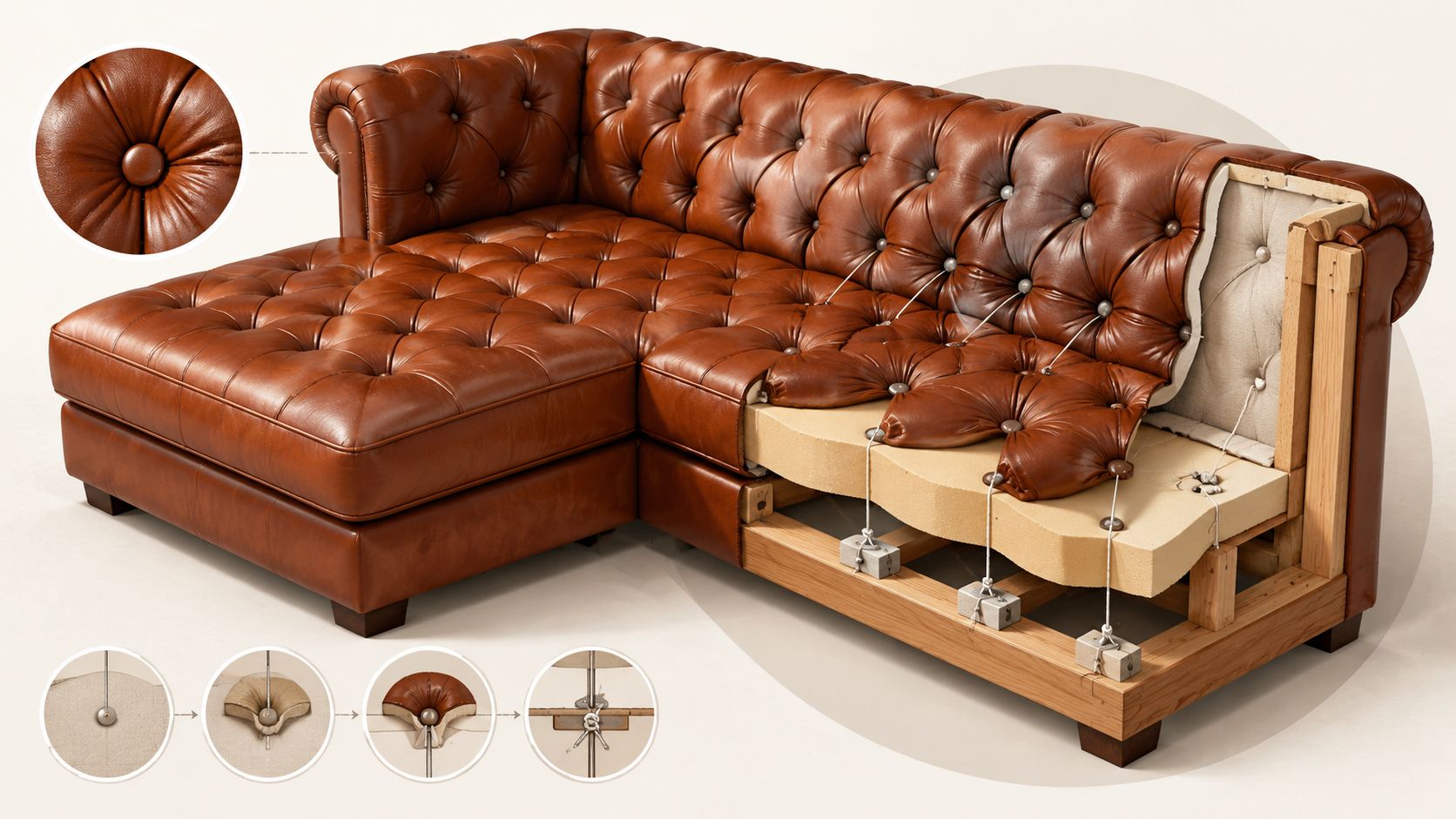
Tufting is often mistaken for a purely decorative flourish. It does create texture and shadow, but it also changes how the surface reads from across a room. Instead of one broad, flat plane, the back and sometimes the seat take on a structured, pillowed topography.
Button tufting is the most commonly recognized look. It creates a more traditional, architectural face. Diamond tufting pushes that effect even further, giving the sofa a strong rhythm that pairs naturally with classic interiors, mixed transitional rooms, or spaces that need a sense of visual authority.
That Chesterfield influence matters because it explains why tufting still feels established rather than trendy. The detail has survived across centuries because it communicates structure, not fussiness. On leather, especially, it tends to look richer over time as the surface develops variation and soft sheen.
Practical rule: If tufting is the reason a sofa catches the eye, the buyer should immediately shift attention to comfort and construction. The detail is only successful when the seat and frame support it.
Why the sectional format matters
The word sectional means the sofa is built as multiple connected pieces rather than one long fixed form. That changes how the piece works in a home. A corner unit, chaise, loveseat section, or terminal seat can be arranged to suit the room instead of forcing the room to adapt to a single rigid shape.
That flexibility is one reason the style remains relevant in contemporary homes. A tufted leather sectional sofa can carry the heritage of classic upholstery while still fitting modern traffic patterns, television walls, fireplaces, and open-concept layouts.
The result is a category with unusual range. One version may feel formal and library-like. Another may feel relaxed enough for a family room. The buyer is not choosing one fixed object. The buyer is choosing a design language and a layout system at the same time.
The Hallmarks of Quality Leather and Hardwood Construction
A sectional can look impressive from across the room and still disappoint within months of regular use. A proper assessment starts with touch, support, and structure. Quality reveals itself in the hand before it ever proves itself over time.
What good leather feels like
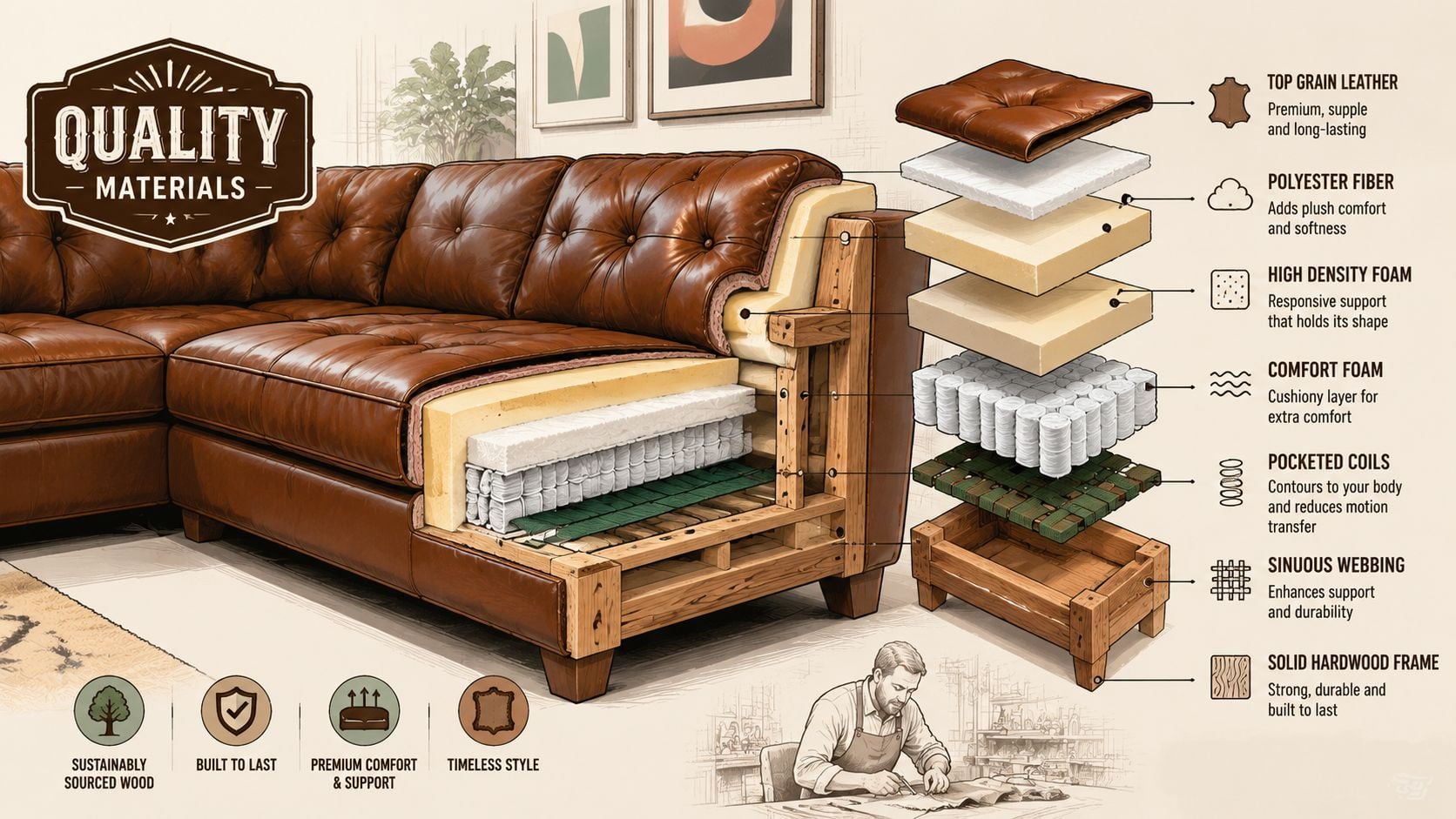
A buyer usually notices leather first through feel. Better leather has a supple hand, a natural grain pattern, and a surface that doesn't feel plasticky or overcorrected. It should invite touch rather than repel it.
For a long-term purchase, top-grain and performance-oriented leathers are often where the conversation becomes serious. They offer the tactile richness many buyers want, along with the visual depth that helps a sofa avoid looking flat under natural and evening light. On a tufted piece, that matters even more because every fold and pull catches light differently.
Quality matters for longevity too. One leather furniture source notes that well-made leather furniture is designed to last 20+ years, while lower-durability upholstered alternatives are often replaced within 5 to 10 years, according to this guide on investing in quality leather sectionals. That same source also states that comfort is a major buying priority, which helps explain why the best pieces don't ask buyers to choose between refinement and daily ease.
Why the frame deserves more attention
The most overlooked part of a tufted leather sectional sofa is the part no one sees. The frame determines whether the sofa stays quiet, square, and supportive after years of sitting, shifting, and daily pressure along corners and seams.
For buyers who care about heirloom-quality furniture, solid hardwood should be the standard. Solid cherry, oak, maple, and walnut bring the density and stability that premium seating needs. A bench-made frame built from solid hardwood has a different character. It feels substantial under load. It resists the vague looseness that often shows up first in the arms, corners, and deck.
Craftsmanship and material discipline matter most. A tufted exterior can be recreated in many ways. Structural integrity cannot be faked for long. In better upholstery, the frame and suspension carry the visual tailoring without strain.
For shoppers comparing custom seating, guidance on how to choose leather furniture helps connect leather selection with the build quality underneath it.
A quick quality comparison
| Feature | Higher-quality choice | Why it matters |
|---|---|---|
| Leather surface | Top-grain or premium performance leather | Better feel, richer visual texture, more graceful aging |
| Frame material | Solid hardwood such as cherry, oak, maple, or walnut | Stronger long-term support and greater structural confidence |
| Seat experience | Balanced cushioning with supportive rebound | Helps the sofa stay comfortable beyond the first showroom impression |
| Tufting execution | Even, consistent tailoring | Keeps the sofa looking composed instead of puckered or sloppy |
| Modular connection points | Securely engineered sectional joins | Reduces shifting between pieces over time |
The buyer should think of the leather as the visible luxury and the solid hardwood frame as the hidden discipline. Both are necessary.
The same logic applies to motion seating. If a tufted leather sectional includes reclining or power features, the mechanism should feel smooth and quiet, never abrupt or loose. Premium motion belongs in the same conversation as premium leather because both change the daily ownership experience.
For Columbus-area shoppers looking at custom leather sectionals Columbus homeowners often prioritize, this is also where brand philosophy matters. Programs from makers such as Smith Brothers of Berne, along with custom opportunities associated with solid wood furniture Ohio buyers seek for the rest of the home, tend to appeal to people who value enduring materials rather than quick visual impact.
Finding Your Perfect Fit With Configurations and Measurements
A sectional succeeds or fails on fit. Not just whether it physically enters the room, but whether it supports the way the room is used. A beautiful sofa that blocks circulation or leaves seats awkwardly distant from conversation points won't feel right for long.
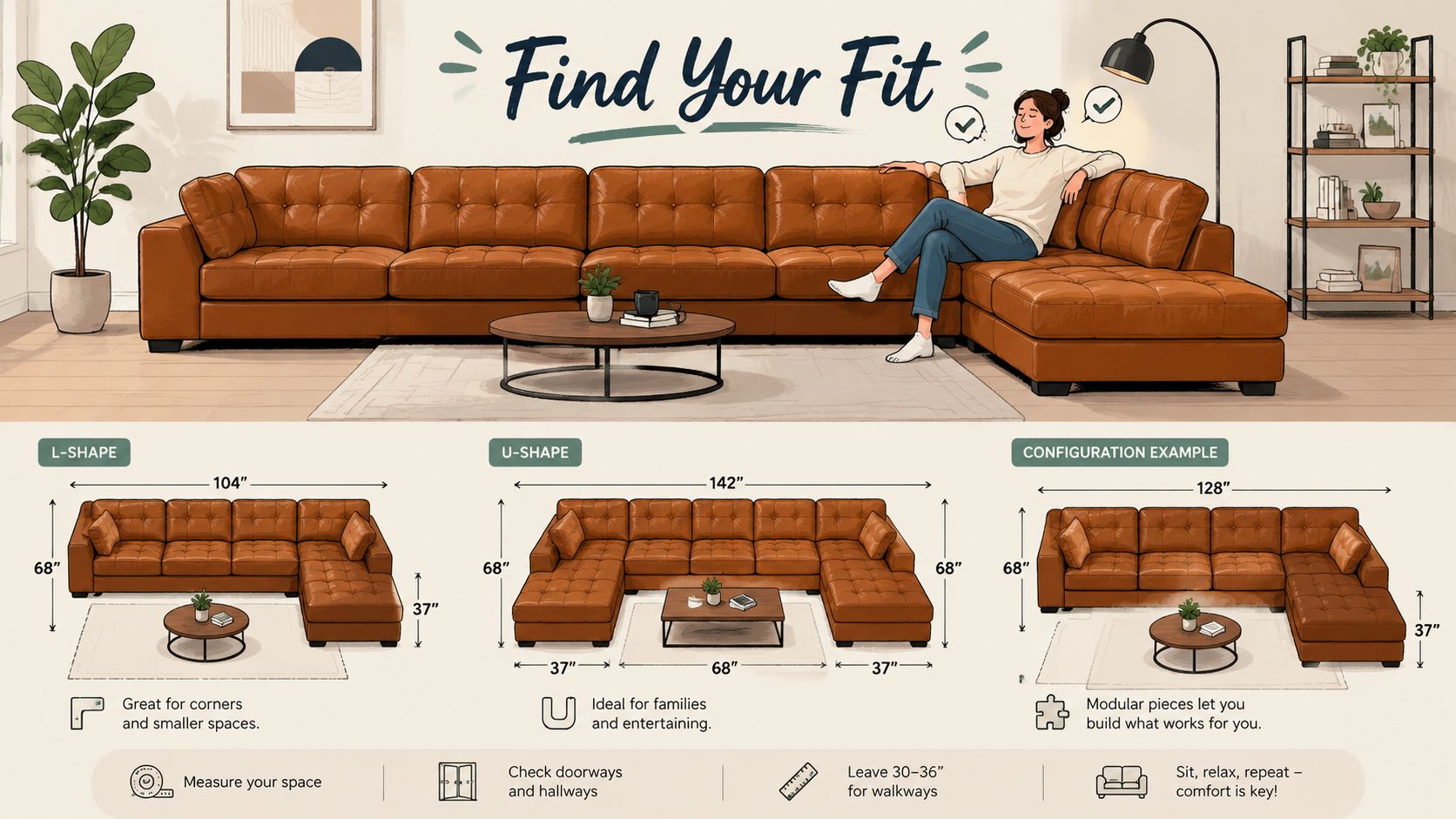
A sectional is a modular assembly of sofa components, allowing flexible layouts and custom configurations, as described in this explanation of what a sectional sofa is. That flexibility is the advantage, but it also means the buyer has more decisions to make.
How layouts change the room
An L-shaped sectional is often the most versatile. It can define a seating zone in an open room without overwhelming it. A chaise-ended version creates an easy lounging seat while keeping the footprint visually lighter than a fully enclosed arrangement.
A U-shaped layout suits households that entertain often or need several people to face one another comfortably. It creates a strong gathering area, but it needs enough floor space so the room doesn't feel crowded. In a compact room, it can make every other piece feel like an afterthought.
Modular layouts with separate components offer the most adaptability. They're useful in homes with unusual floor plans, future renovations, or a desire to rework the room later rather than replace the entire sofa.
How to measure before the sit test
Before any buyer chooses leather, tufting style, or arm profile, these measurements should be on paper.
- Room width and length determine whether the sectional will anchor the space or swallow it.
- Wall interruptions such as windows, radiators, vents, and door swings often matter more than the wall length itself.
- Walk paths should stay easy and natural, especially in family rooms that connect to kitchens or hallways.
- Entry access includes front doors, stair turns, elevators, and interior corners. A sectional may fit the room but fail the path into it.
For buyers comparing shapes, sectionals 101 and what to know before buying a sectional is a practical companion to room planning.
Bring a floor plan, rough room dimensions, and a few photos to the showroom. That's often enough to eliminate the wrong scale before anyone even discusses leather color.
Why dimensions affect comfort
Comfort isn't one thing. It's geometry. One example in the market lists a 19.5-inch seat height, 24-inch seat depth on the loveseat portion, and a 52-inch chaise depth, while another lists a 22-inch seat depth and 20-inch seat height in these sectional dimensions. Those differences may sound small on paper, but they change the sitting experience immediately.
A deeper seat usually feels more lounge-oriented. It can be excellent for stretching out, but if the back pitch and cushion support aren't right, some people end up perching forward or slouching. A slightly shorter seat height often makes it easier for a wider range of people to sit down and stand up comfortably.
This is why the sit test matters. A discerning buyer should check three things in person: where the lower back lands, whether the feet rest naturally, and whether the arm height supports relaxed use. A tufted leather sectional sofa can be visually perfect and physically wrong. The body notices before the eye admits it.
Creating a Sectional That Is Uniquely Yours Through Customization
A premium sectional should not force a homeowner into someone else's floor plan or someone else's finish palette. The strongest custom programs let the buyer shape the sofa around the room, the household, and the home's broader material story.
What can actually be customized
Customization becomes meaningful when it moves beyond color alone. On a tufted leather sectional sofa, buyers should ask about leather selection, sectional shape, seat firmness, arm style, leg finish, and motion options where available.
A household with a formal living room may lean toward a smoother, dressier leather and a more structured arm. A family room with everyday traffic may call for a more relaxed leather with a forgiving grain and a configuration that includes a chaise or power reclining seat. Neither approach is better. The right answer depends on how the room works.
The strongest showroom experience brings those choices into one coordinated process. A buyer can compare warm and cool leather tones against nearby case pieces, flooring, and wall color rather than making a blind swatch decision at home.
- Leather choice affects sheen, softness, grain character, and how the tufting reads.
- Configuration determines whether the sectional welcomes conversation, lounging, or both.
- Seat feel changes the difference between upright support and sink-in comfort.
- Wood details such as feet or exposed accents should relate to other solid wood furniture in the home.
Why showroom tools matter
This is where a design studio earns its keep. A good consultant helps narrow options without flattening the buyer's taste. Photos, room dimensions, and finish samples become far more useful when paired with full-size seating and visible leather panels under real lighting.
Vinson Fine Furniture offers a design-your-own sectional program alongside an in-store design studio, complimentary consultations, and custom order options associated with makers such as Smith Brothers, Canadel, and Mavin. For buyers also furnishing adjacent spaces, that matters because the sectional can be coordinated with pieces tied to phrases like Smith Brothers furniture Easton, Mavin bedroom furniture, and Amish-made dining sets without the home feeling pieced together from unrelated decisions.
Customization works best when the buyer edits with discipline. Fewer, better choices usually create the most lasting room.
Digital visualizers are useful because they reduce guesswork. A buyer can see whether a darker leather will ground the room elegantly or make it feel heavy. They can compare leg finishes to nearby solid cherry, oak, maple, or walnut furniture. They can confirm that the sectional's scale supports the room instead of overpowering it.
The advantage is confidence. A custom piece should feel intentional long before delivery day.
Investing Wisely With Budgets and Long-Term Care
A tufted leather sectional sofa usually isn't an impulse purchase. It's a category where the smartest buyers think in terms of service life, daily use, and replacement cycles rather than sticker shock alone. That mindset tends to lead to better decisions.
Thinking in years not impulse
Value in this category comes from alignment. The right sofa fits the room, suits the household, and holds its appearance with ordinary care. A lower initial price can lose its appeal quickly if the piece stops feeling supportive, shows wear unevenly, or no longer suits the room after a short period of ownership.
That doesn't mean a buyer has to ignore savings. It means the buyer should look for intelligent value. Programs such as a low price guarantee, custom ordering that avoids compromise, and a clearance gallery with selected floor samples can all support a more disciplined purchase. Shoppers often find that savings matter most when paired with quality materials and a layout they'd choose again.
The upkeep questions buyers should ask
One of the least discussed parts of ownership is maintenance. Many product pages for tufted leather sectionals gloss over how tufting affects cleaning and long-term wear, as noted in this discussion of leather sectional product-page gaps. That omission leaves buyers to guess about the very details that shape long-term satisfaction.
Tufting creates beauty, but it also creates creases, folds, and stitched recesses where dust can settle. Leather needs a steady, careful routine. Nothing dramatic. Just consistent attention.
- Dust the surface regularly with a soft cloth, paying extra attention to tufted channels and seam lines.
- Address spills promptly by blotting gently rather than rubbing product into the leather.
- Use leather-safe care products only after confirming they suit the leather type and finish.
- Watch the room itself. Direct sunlight, nearby heat, and very dry air can be hard on leather over time.
For households that want a deeper maintenance plan, how to protect leather furniture offers a helpful starting point. When a sofa needs more than routine home care, especially in heavily used rooms or after an accident, some owners also look into professional upholstery services to handle more involved cleaning with less guesswork.
A leather sectional ages best when care is light, regular, and informed. Neglect usually does more damage than use.
Good care preserves more than appearance. It preserves the pleasure of ownership. A tufted sofa should continue to feel inviting, not delicate. The goal isn't perfection. It's graceful wear.
Style Your Space and Experience the Quality In Person
A tufted leather sectional sofa has enough presence to lead the room, so the surrounding materials should support it rather than compete with it. A wool rug with soft pattern, a substantial wood cocktail table, and a few textural layers such as a throw or well-crafted pillow usually do more than a crowded mix of accents. The room should feel settled, not staged.
This is also where material contrast becomes important. Smooth leather benefits from neighboring surfaces with grain and variation. Solid oak, cherry, maple, or walnut tables bring warmth. A woven rug softens the architecture of tufting. Matte finishes nearby can make the leather's natural luster feel even richer.
But the final decision still belongs in person. Screen images can suggest color and shape, yet they can't communicate the buttery hand of a good leather, the quiet confidence of a solid hardwood frame, or the smooth action of a well-engineered motion seat. Those things have to be felt. They have to be tested under real weight, in real posture, by the people who'll use them.
For buyers planning delivery into a new home, renovation, or upper-floor space, logistics matter too. If access is complicated before white-glove placement is arranged, it can help to find reliable loading services via Voodoo Moving as part of broader moving coordination.
The showroom remains the best place to judge whether a sectional belongs in the home. That's especially true in a destination setting like Easton Town Center, where design consultations, material comparisons, and the sit test can happen in one visit.
For homeowners ready to compare leather feel, test seat depth, and explore custom configurations in person, Vinson Fine Furniture offers a practical next step. A visit to the Easton Town Center showroom gives buyers the chance to work with design consultants, review custom order options, and finish the process with white-glove delivery that carries the piece from showroom decision to fully placed room.