Corner Hutches for Kitchen: Maximize Your Space

There's a corner in many kitchens that never quite earns its keep. It's too tight for a standard cabinet, too visible to ignore, and too awkward to leave empty. Over time, it becomes the place where serving trays lean, small appliances drift, and visual clutter gathers.
For a Columbus-area homeowner updating a kitchen for the long term, that neglected angle can become something far more useful. A corner hutch can turn dead space into a piece of architecture. It offers display above, concealed storage below, and a sense of permanence that feels especially right in a home where every furnishing choice is meant to last. For homeowners sorting through layout ideas, a practical small kitchen remodel guide can help frame the broader renovation decisions, while thoughtful furniture planning matters just as much in tighter rooms. For homes where every inch counts, it also helps to study furniture ideas for smaller spaces before choosing a substantial corner piece.
Table of Contents
- An Elegant Solution for the Forgotten Corner
- Understanding the Kitchen Corner Hutch
- Measuring Your Space for a Perfect Fit
- Choosing Your Solid Hardwood and Finish
- Creating Your Custom Hutch in Our Design Studio
- Styling and Integrating Your New Corner Hutch
- Your Vinson Investment and Our Promise
An Elegant Solution for the Forgotten Corner
A well-chosen corner hutch doesn't behave like a filler piece. It settles a room. In a kitchen with hardworking cabinetry and long sightlines, it gives an awkward junction a clear purpose and a finished presence.
That's why corner hutches for kitchen planning deserve more thought than they usually receive. The right one can hold everyday dishes behind solid doors, frame glassware on upper shelves, and soften the sharp geometry of a room that otherwise feels all straight lines and utility. In older homes, it can echo traditional millwork. In newer open layouts, it can add warmth where broad cabinet runs sometimes feel too flat.
A kitchen corner often looks like a storage problem, but it's just as often a proportion problem.
For the investment homeowner, the distinction matters. A forever piece should do more than fit. It should feel substantial when a hand closes the door, grounded in the room, and worthy of the floor space it occupies. That is where solid hardwood changes the conversation. The weight of solid cherry, oak, maple, or walnut gives a corner hutch the kind of physical presence that lighter substitutes cannot imitate.
A thoughtfully built hutch also offers a different rhythm than standard cabinetry. The upper section can bring in glass, lightness, and display. The lower section can hide the visual noise of real life. Together, those two roles make the piece useful every day without making the room feel busier.
Understanding the Kitchen Corner Hutch
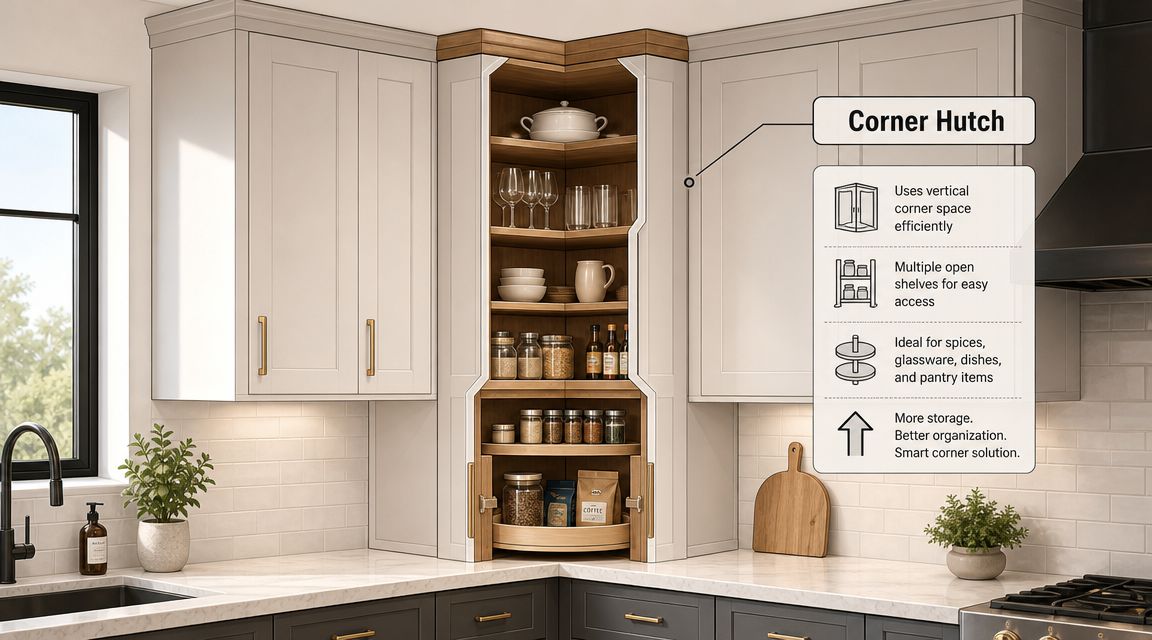
A corner hutch sits somewhere between furniture and cabinetry. It isn't merely a freestanding cabinet pushed into an angle, and it isn't only a corner wall cabinet with a decorative face. It's a two-part storage piece shaped specifically to work with the geometry that makes kitchen corners difficult in the first place.
What makes it different
The typical corner hutch has an upper display section and a lower enclosed cabinet. The top often includes glass doors, open shelves, or both. The base usually handles the practical work of storing heavier or less attractive items such as serving bowls, linens, platters, or pantry overflow.
That split is what confuses some homeowners at first. They may think of a hutch as decorative only, or assume a corner cabinet is automatically more efficient. In reality, the hutch solves two problems at once. It gives the eye a pleasing vertical feature while also bringing order to a corner that often fails standard cabinetry.
Why the shape matters
Its shape isn't stylistic whim. It comes from the way kitchen corners are built. In cabinet design, corner wall cabinets often need at least 24 inches of wall space from each corner, while base cabinets commonly occupy a 36 by 36 inch footprint, as described in corner cabinet geometry guidance. That's why angled fronts, beveled backs, and other corner-specific forms became standard solutions rather than decorative extras.
A simple way to think about it is this:
| Element | What it must solve | Why it matters |
|---|---|---|
| Upper hutch section | Display and reachability | Keeps everyday or special pieces visible and easier to access |
| Lower cabinet section | Concealed storage | Uses the deeper part of the corner more discreetly |
| Angled or beveled form | Fit within the room junction | Reduces wasted space created by a sharp corner |
| Overall silhouette | Visual balance | Helps the kitchen feel intentional rather than improvised |
Some kitchens benefit from reclaiming every bit of corner volume. Others work better when the design accepts that not all corner space is equally usable. A hutch often lands in the middle ground. It acknowledges the corner's limitations, then turns them into a form that feels elegant instead of compromised.
The most successful corner hutch usually looks as though the room was always waiting for it.
Measuring Your Space for a Perfect Fit
Good measuring saves a great deal of disappointment. Corner hutches are forgiving in style, but they aren't forgiving in fit. A piece can be beautiful on paper and still feel cramped if it blocks a walkway, catches crown molding, or sits proud of nearby cabinetry in a way that looks accidental.
Start with the walls
The first measurement is the most obvious one. Measure each wall from the corner outward. This reveals how much room the hutch can claim without crowding nearby doors, windows, or base cabinets.
A homeowner should also note where trim begins and ends. Baseboards can keep a piece from sitting fully back, and uneven plaster can create small but visible gaps. It helps to write down both the maximum width available and the width that would still feel comfortable.
A practical measuring checklist helps:
- Wall length on both sides: Measure outward from the corner on each wall.
- Baseboard depth: Check whether the hutch must be notched, scribed, or held slightly forward.
- Nearby obstacles: Watch for vents, switches, outlets, windows, and door casings.
- Depth into the room: Confirm that doors and drawers can operate without interrupting traffic flow.
For homeowners preparing for a consultation, a room-by-room furniture measuring guide can make those first notes much more reliable.
Don't ignore the room around it
A corner hutch doesn't live on paper. It lives in a path of travel. If the kitchen opens into a dining area, mudroom, or breakfast space, the piece needs enough breathing room that it doesn't feel like an obstacle.
It's common for homeowners to get tripped up. They focus only on whether the back fits into the angle. The better question is whether the front belongs in the room. A hutch with graceful scale should still allow chairs to move, drawers to open, and sightlines to stay calm.
Practical rule: Measure the corner, then stand in the room and imagine the piece at full depth with its doors open.
Check the height before anything else
Vertical clearance is one of the biggest constraints. Commercially available corner hutch styles commonly range from 81 to 86 inches tall, and some makers offer custom sizing, according to corner hutch sizing information. That's why ceiling height alone isn't enough. Soffits, crown molding, nearby wall cabinets, and even light fixtures can affect what will fit.
This is often where a custom approach makes the most sense. A fraction too tall can turn installation into frustration. Slightly adjusted proportions can make the whole piece feel built for the room rather than merely placed in it.
A careful homeowner usually records these height conditions before shopping:
| Vertical detail | What to check |
|---|---|
| Ceiling height | Overall room height from finished floor |
| Crown molding | Whether it projects into the hutch's top line |
| Soffits | Whether the corner has a dropped section |
| Adjacent cabinets | Whether nearby uppers limit width or height |
| Light fixtures | Whether swing, shade, or placement create interference |
Complimentary design consultations are helpful at this stage because small measuring errors tend to show up dramatically in a corner. One overlooked trim profile can change the entire fit.
Choosing Your Solid Hardwood and Finish
The wood choice determines whether a corner hutch feels merely useful or firmly rooted in the home. In a kitchen, where light shifts all day and hands touch surfaces constantly, solid hardwood reveals its value slowly and convincingly. It has depth, weight, and a surface character that becomes more appealing with age.
How each hardwood feels in a kitchen
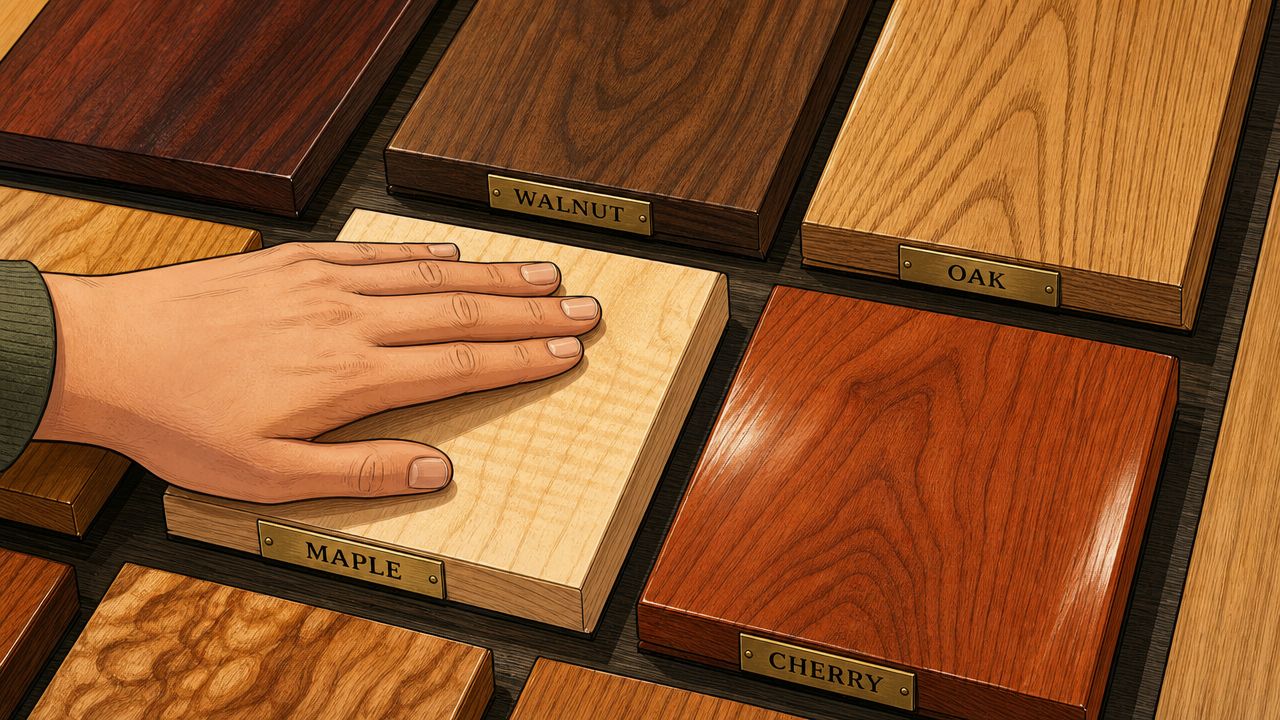
Solid cherry brings warmth. Its grain tends to read refined rather than busy, and it suits homeowners who want a hutch that feels traditional without becoming heavy.
Solid oak has a familiar honesty to it. It carries visible grain and a sturdy presence that works beautifully in homes where the kitchen needs a little more architectural strength.
Solid maple feels clean and adaptable. Its smoother grain makes it especially attractive for painted or more contemporary finishes, while still offering the substance expected from a lasting piece.
Solid walnut carries drama in a quieter way. It often appeals to homeowners who want a corner hutch to read as furniture first, with rich tone and a more refined silhouette.
For readers who enjoy a broader woodworking perspective, this overview of hardwoods 101 for makers gives useful context on why species selection affects both feel and longevity. A second helpful resource is this guide to choosing the right hardwood for longevity and style, especially for households balancing kitchen style with everyday wear.
Finish choices that change the character
The finish determines whether the hutch blends quietly or steps forward as a focal point. A deep stain on walnut can make the corner feel grounded and formal. A lighter maple finish can brighten a tighter kitchen. Painted finishes can soften a large piece and help it sit more comfortably near painted cabinetry.
A few finish directions often work well:
- Warm natural tones: These highlight grain and pair well with traditional millwork.
- Painted surfaces: These can lighten the visual mass of a tall piece.
- Contrasting stains: These help the hutch read as furniture in an open-plan room.
- Low-sheen finishes: These keep the surface elegant and forgiving in active family kitchens.
Why construction matters in the lower cabinet
The lower cabinet is where craftsmanship matters most. This area does the heavy lifting, both visually and functionally. Corner storage always involves tradeoffs between capacity and access, and that's where thoughtful woodworking earns its keep.
Well-designed corner drawers can use nearly 50% of the available corner space, according to discussion of corner storage efficiency. That figure is useful because it reminds homeowners that the goal isn't theoretical volume. The goal is usable storage. Shelves and doors should open in a way that makes daily life easier, not just more impressive on a floor plan.
A beautiful hutch should still make ordinary mornings simpler. That's the real test.
Brands known for solid wood customization, including Mavin and Canadel, are often part of these conversations because finish, scale, and species all need to work together. The hutch has to feel right when seen from across the room and when touched at arm's length.
Creating Your Custom Hutch in Our Design Studio
Some kitchens need more than an off-the-floor solution. The corner may be slightly uneven, the ceiling line may shift, or the homeowner may want a piece that relates closely to existing cabinetry without copying it exactly. That's where custom work becomes less of a luxury and more of a practical design choice.
From showroom conversation to working design
A good custom process starts with the room, not the catalog. Homeowners typically arrive with a few dimensions, inspiration images, and a sense that the corner needs to work harder. From there, the conversation moves toward proportion, wood species, finish, storage priorities, and how the hutch should relate to the rest of the home.
One practical option for that process is Vinson Fine Furniture, where the Custom Order Program includes complimentary design support, access to 3D visualizers, and customization through lines such as Smith Brothers, Canadel, and Mavin. Even in an article focused on kitchen storage, that matters because investment homeowners often want the kitchen hutch, dining furniture, and nearby seating to feel connected in tone and craftsmanship. In open-plan homes, that might include a solid-wood dining set nearby or top-grain leather swivel seating that echoes the hutch's finish and visual weight.
The custom details worth deciding early
A custom corner hutch can be shaped in surprisingly specific ways. Some homeowners want mullioned glass doors and interior lighting for heirloom china. Others want mostly concealed storage with just a small glazed upper section. Adjustable shelving matters if serving pieces vary in height. Hardware matters because a corner piece sits in plain sight.
Important decisions often include:
- Door style: Glass-front, solid-panel, or a mix of the two.
- Interior function: Fixed shelves, adjustable shelves, drawers, or concealed compartments.
- Lighting: Useful for display and for soft evening ambience in open kitchens.
- Hardware finish: A small detail that strongly influences whether the piece feels formal, rustic, or transitional.
- Overall stance: Tall and architectural, or slightly lighter and more furniture-like.
A true custom build also depends on how the back is made. Custom corner hutches often use triangulated or beveled back panels, including 45-degree beveled corner pieces and pocket-hole joinery, as shown in this corner hutch construction example. That construction allows the piece to sit snugly in a 90-degree corner, improve rigidity, and use the space more intelligently than a simple rectangular case pushed into an angle.
A corner hutch earns its permanence when the back is built as carefully as the front.
That's one reason Amish-made furniture remains so compelling in this category. The value isn't only visual. It's in the disciplined joinery, the measured proportions, and the sense that the piece was built to serve a real room for a very long time.
Styling and Integrating Your New Corner Hutch
Once the hutch is in place, styling decides whether it feels curated or crowded. A handsome piece can disappear under too many objects. It can also feel isolated if its finish, scale, or contents have no relationship to the rest of the kitchen.
Match the kitchen or add contrast
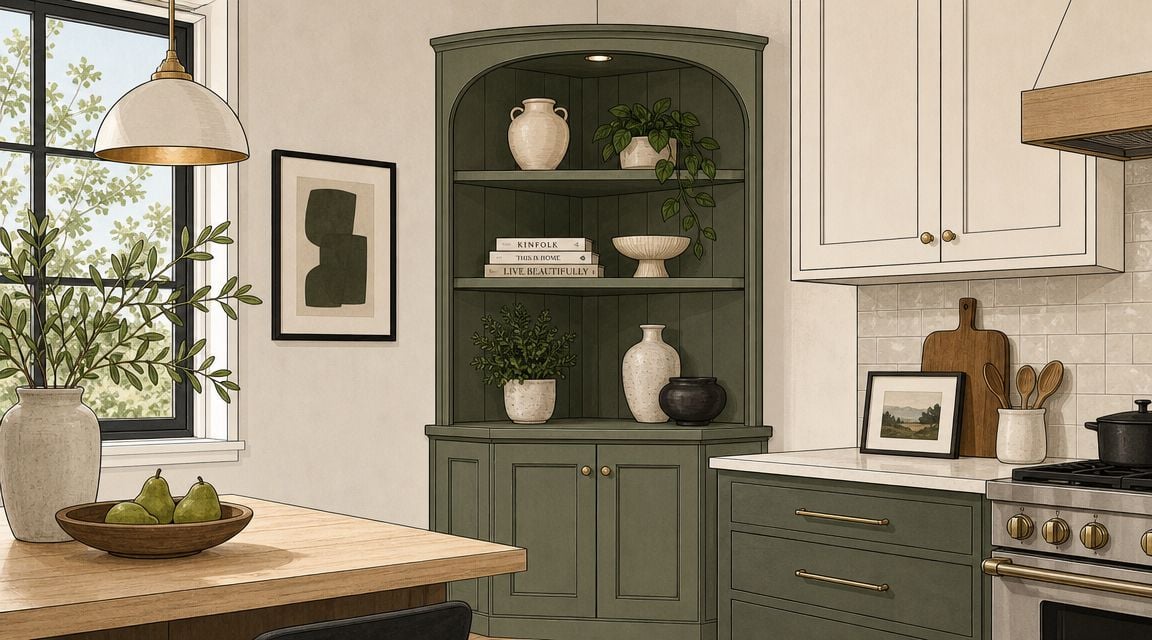
In open-plan kitchens, the corner hutch often functions as a decorative anchor rather than pure storage. Design guidance increasingly favors using such pieces to add visual weight and shape sightlines, especially when the finish contrasts with the main cabinetry, as noted in open-plan corner cabinet design guidance.
That doesn't mean contrast is always better. It means the choice should be intentional.
A simple comparison helps:
| Approach | Best for | Visual effect |
|---|---|---|
| Match existing cabinetry | More formal or built-in feeling kitchens | Calm, seamless, tailored |
| Use a contrasting finish | Open-plan homes needing definition | Furniture-like, layered, distinctive |
| Use glass in upper doors | Corners that need visual lightness | Airy and less bulky |
| Use mostly solid doors | Busier kitchens needing quiet storage | Cleaner and more contained |
For homeowners studying broader visual trends before deciding on color and display strategy, Explore AI design trends can be a useful starting point for seeing how lighter, more intentional styling choices are evolving.
Style the shelves with restraint
The upper section should look edited. A corner hutch is not a place to display every attractive object in the house. It works best when the grouping has repetition, breathing room, and a clear sense of purpose.
A strong approach usually includes:
- Everyday beauty: Stack a few dishes or bowls that are used regularly.
- Height variation: Mix taller pitchers or vases with lower pieces.
- Negative space: Leave portions of each shelf open so the wood and joinery can still be seen.
- A limited palette: Keep colors related so the display reads as calm.
A buffet-and-hutch pairing can offer helpful ideas for balancing display and concealed storage in nearby dining spaces. This gallery of buffet and hutch inspiration shows how upper and lower sections can work together without feeling cluttered.
Your Vinson Investment and Our Promise
A corner hutch is one of those purchases that rewards patience. It's not only about solving a storage issue. It's about placing a lasting object in a visible part of the home and expecting it to serve well for years. That's why material, fit, and customization matter so much more here than they might with a smaller accent piece.
For the Columbus homeowner furnishing thoughtfully, the strongest value often comes from choosing solid hardwood, tailoring the dimensions carefully, and treating the hutch as part of the home's long-term architecture. Amish-made craftsmanship, customizable finishes, and durable joinery all support that goal. So do broader showroom services that help coordinate surrounding pieces, whether that means Amish-made dining sets, solid-wood bedroom furniture from Mavin, or seating programs with top-grain leather, swivel chairs, rockers, gliders, and power motion options from Smith Brothers.
The financial side matters too. A confident purchase is easier when there's clear value behind it. The Low Price Guarantee includes a 110% refund of the difference if a lower price is found at a local authorized dealer within the stated period, and the Clearance Gallery offers savings of up to 70% on select floor samples, overstocks, and closeouts. White-Glove Delivery helps ensure that a substantial piece arrives, is placed properly, and enters the home without added stress.
A well-made corner hutch should feel as reassuring on day one as it does years later. The right one brings order to a difficult corner, beauty to the daily routine, and a sense that the room has finally been finished the way it ought to have been.
For homeowners ready to choose a forever piece, Vinson Fine Furniture offers a clear next step at Easton Town Center. A visit to the showroom lets shoppers feel the weight of solid hardwood, compare cherry, oak, maple, and walnut in person, explore custom options through the In-Store Design Studio, and discuss layout details with a design consultant during a complimentary consultation.