How to Tell if Furniture Is Real Wood: Expert Guide

You’re in a showroom, standing in front of a dining table that looks exactly right for your home. The finish is rich. The shape works. The tag says “wood.” That sounds reassuring until you realize that “wood” can mean several very different things.
That moment matters more than most shoppers think. A table can photograph beautifully and still be built with a thin decorative skin over a manufactured core. Another can look simpler on the floor and turn out to be the piece that stays in the family for decades.
For an investment homeowner, learning how to tell if furniture is real wood isn’t trivia. It’s an appraisal skill. You’re not just buying a look. You’re judging lifespan, repairability, and whether the piece will age with your home or give out long before it should.
Your Guide to Identifying Heirloom-Quality Furniture
The initial assessment often involves the surface. One might run a hand across a tabletop, spot a pretty grain pattern, and assume it’s solid wood. Sometimes it is. Other times, it’s veneer, laminate, or a carefully finished engineered panel that only mimics the look.
The better approach is to think like a furniture appraiser, not just a shopper.
A real appraisal asks different questions:
- What is the core material
- Does the grain behave like natural wood
- Can this piece be repaired or refinished later
- Are the hidden areas as honest as the visible ones
That last point separates casual shopping from informed buying. The underside of a table, the back of a case piece, or the edge inside a drawer tells you more than a polished top ever will.
The safest buyers aren’t the ones who trust labels. They’re the ones who inspect edges, corners, and hidden construction details.
That’s especially useful if you’re furnishing a home for the long term and want pieces that can take everyday life, seasonal changes, and years of use without becoming disposable. Care matters too. If you end up choosing solid wood, proper maintenance will help protect the finish and movement of the material over time. Vinson’s guide on how to care for wood furniture is a practical follow-up once you know what you’re buying.
Why Real Solid Wood Is an Investment in Your Home
A couple walks into our Easton showroom looking at two dining tables that seem similar from across the room. One carries a lower price tag. The other costs more up front, but it is built to stay in the home for decades, not just fill the room for a few years.

What you’re really paying for
Furniture value is not only about how a piece looks on delivery day. It is about what that piece can handle, how it ages, and whether it can be repaired instead of replaced.
That is why I encourage shoppers to treat wood furniture like an investment appraisal. Ask what the piece will look like after family dinners, a few moves, dry Ohio winters, and ten years of daily use. Solid wood usually gives you better answers than lower-cost materials because it can be refinished, tightened, repaired, and kept in service.
That difference shows up in ordinary life. Table corners stay sound longer. Tops are less likely to become throwaway surfaces after wear. Drawer fronts, bed rails, and case pieces have a better chance of being serviced instead of discarded when something needs attention.
Why investment homeowners care
Homeowners furnishing for the long term usually care about three things. How long a piece will last, how well it will age, and whether it will still deserve a place in the home five or ten years from now.
A well-made wood bed, dining table, or dresser often clears that test. It becomes part of the house rather than a temporary solution inside it. That matters most in rooms that take real use every week, especially dining rooms, bedrooms, and storage pieces that open and close every day.
Here is the practical return:
- Longer service life means fewer replacement purchases
- Repairable surfaces and parts mean scratches, dents, and finish wear do not automatically end the piece’s usefulness
- Better aging means many solid wood pieces develop character instead of looking tired after a few seasons
Species matters too. Oak, cherry, maple, and walnut do not wear the same way, and they do not bring the same look to a room. If you want a clearer sense of which woods hold up best in different spaces, this guide to choosing the right hardwood for longevity and style is a useful place to start.
Investment rule: Put your money first into the furniture you touch every day. Dining, bedroom, and storage pieces usually justify better materials and better construction.
Not every item in a home needs to be solid wood. Accent pieces, trend-driven items, or occasional-use furniture can justify different choices. But if you want furniture with a long service life and real refinishing potential, material honesty matters. That is one reason shoppers at Vinson’s often ask to see the construction details before they ever talk about finish color.
The 5-Second Visual Check for Real Wood Grain
The fastest useful test is visual. Before you ask a salesperson anything, study the grain.
Look for pattern, not just color
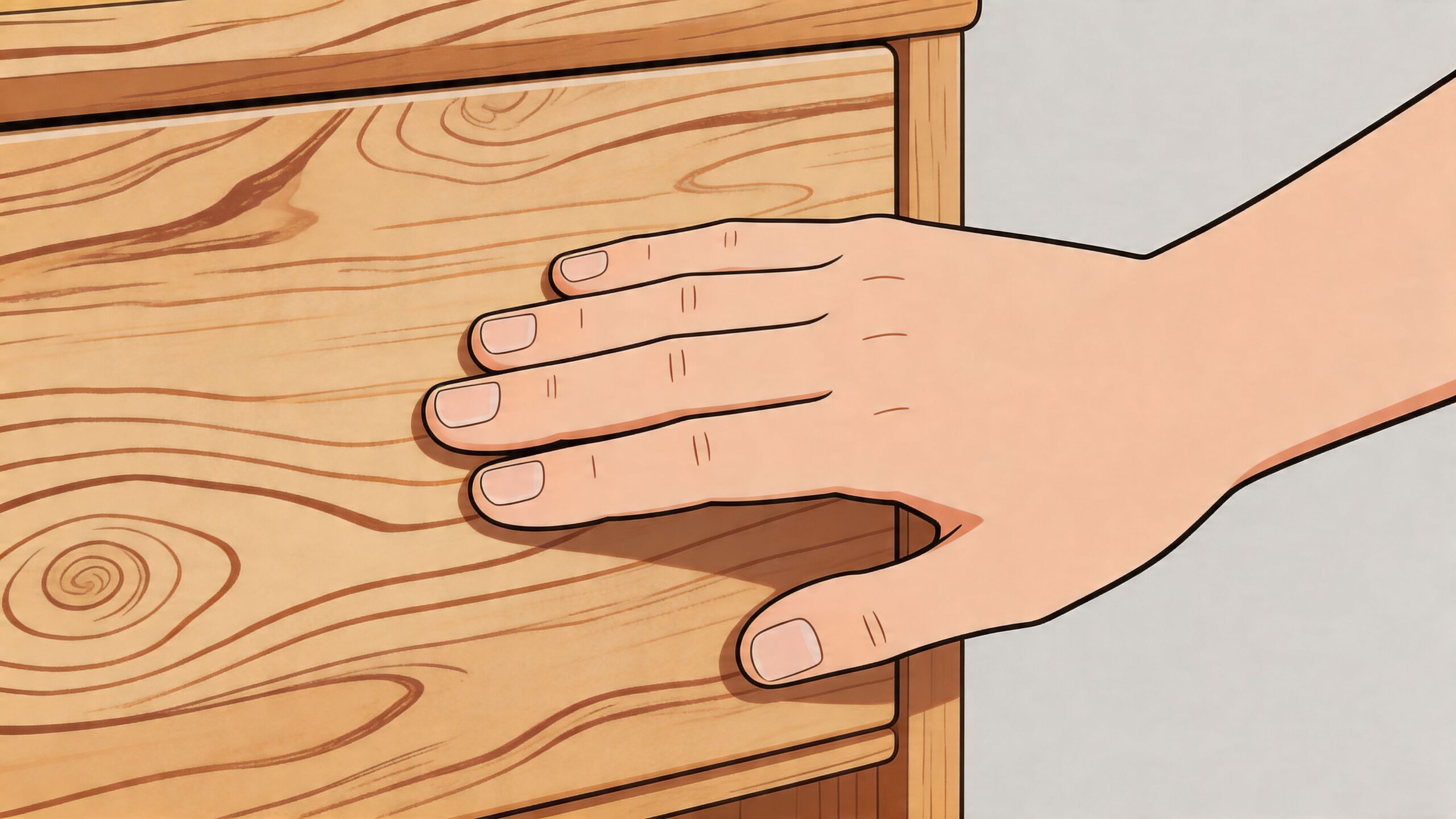
Real wood grain behaves like something grown, not printed. It flows. It changes direction. It has minor irregularities. A knot or mineral streak appears where nature put it, not where a factory repeated it.
Expert appraisers find that visual grain and edge checks achieve 85 to 95% accuracy in identifying solid wood, because veneers often show repeating symmetrical motifs from sheet manufacturing, unlike the continuous, non-repetitive patterns of real wood (expert guide to identifying real wood furniture).
That means your eyes can do a lot of the work if you know what to watch for.
What to scan in a few seconds
Start with the largest visible panel, usually the top of a table, dresser, or nightstand.
Check for these signs:
- Natural variation. The lines should shift organically, not repeat like wallpaper.
- Asymmetry. Real wood often looks balanced but not mirrored with machine-like precision.
- Depth. Grain in solid wood tends to feel visually layered, not flat and printed on.
- A believable transition at edges. If the top looks rich but the edge looks plain or layered, pause.
Then move your eyes to the side or underside edge. Veneered furniture often gives itself away there. You may see a thin face layer over a different core, or a clean seam where the decorative surface ends.
A quick comparison
| What you see | More likely meaning |
|---|---|
| Flowing grain with irregular shifts | Solid wood |
| Repeating swirls or mirrored motifs across a wide panel | Veneer |
| Surface pattern that stops abruptly at the edge | Veneer or laminate |
| Visible layered edge | Engineered construction |
Where shoppers get fooled
High-gloss finishes can flatten the look of the wood. Dark stains can hide a lot. On a polished showroom floor, that can make lower-grade construction look more convincing than it is.
So don’t judge by beauty alone. Judge by continuity.
If a grain pattern looks too perfect across a broad surface, inspect the edges before you trust it.
This is why trained buyers rarely stop at the tabletop. They track the pattern into the cuts, corners, and transitions where imitation has a harder time hiding.
Hands-On Tests to Confirm Authenticity in the Showroom
A good showroom visit should feel a lot like an appraisal. You are not only asking, “Is this wood?” You are asking what this piece is likely to look like, feel like, and be worth living with ten or twenty years from now.
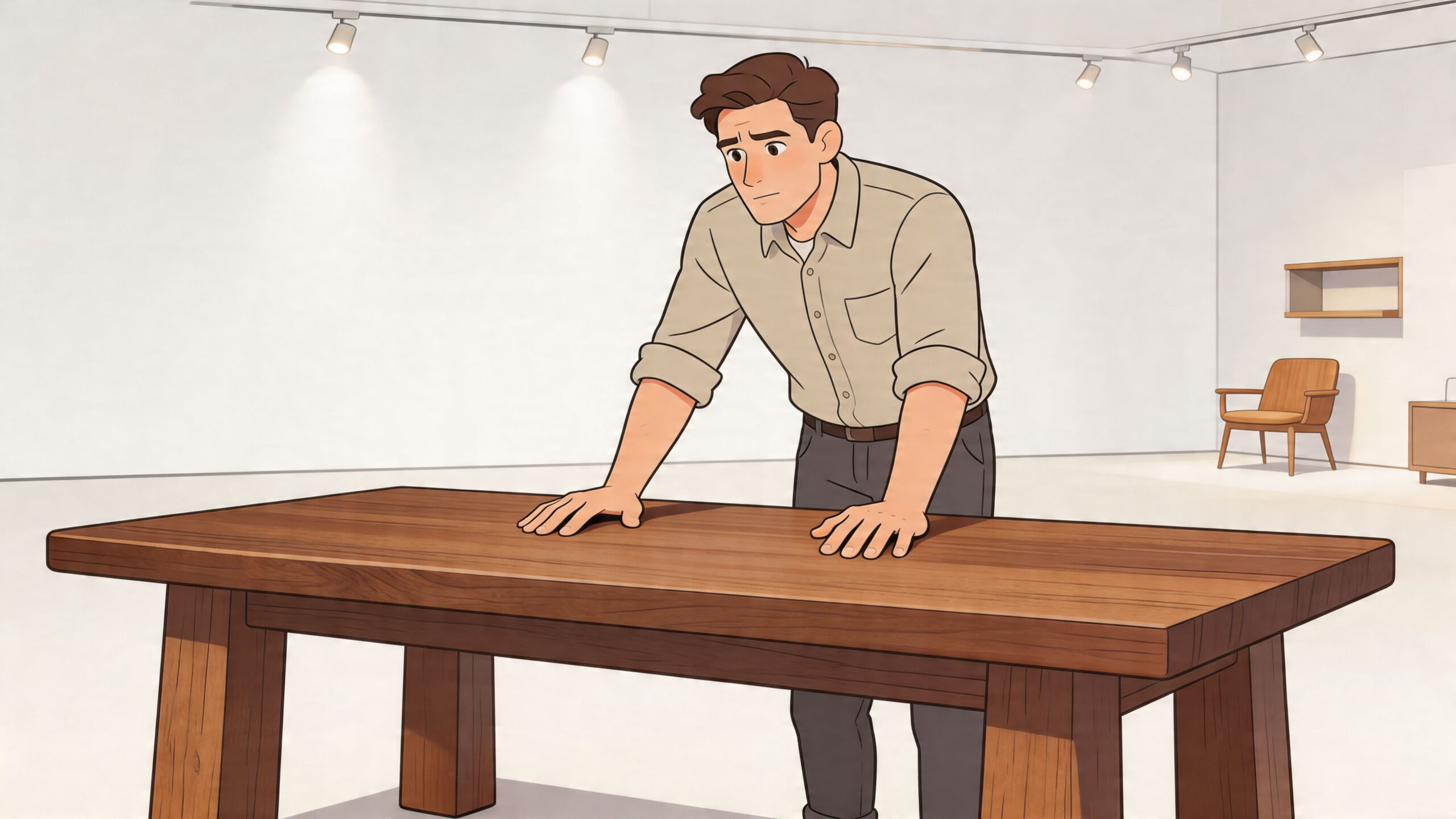
Use your hands. Open the drawers. Touch the underside. Feel the edges where finishes are lighter and construction is harder to hide. A polished top can impress you in five seconds. The less visible parts usually tell the truth.
The end-grain test
If you learn one in-person check, learn this one. End grain shows how a board was made because you are looking at the wood across its growth, not just across the finished face. Solid wood shows natural growth pattern and pore structure. MDF and particleboard look compressed, flat, or uniformly fuzzy. Plywood shows layers.
Look in places shoppers often skip:
- Drawer interiors
- The bottom of legs
- The underside of a tabletop
- The back edge of a case piece
Different species show it differently. Oak often has more visible pore structure. Cherry usually looks finer and more even. The goal is the same in either case. Look for natural cellular structure instead of a manufactured core.
Weight and feel
Weight helps, but only as a supporting clue. Some solid woods are heavier than others, and a well-built veneered piece can still feel substantial because the core and joinery add mass.
What matters is how the piece carries that weight. Lift one corner carefully if the showroom allows it. A solid wood table usually feels dense and grounded. Lower-grade construction often feels top-heavy, hollow, or oddly light for its size.
Then run your hand across the surface and along an edge. Thick finish can hide texture, but real wood usually has a warmer, less plastic feel. It does not feel like a printed skin wrapped over a substrate.
Hidden spots tell the truth
Drawers are one of the fastest reality checks in the room. Open one fully and inspect the sides, back, and underside of the front. If the sales tag says solid wood, these areas should support that claim.
Use this quick routine:
- Open, do not just glance
- Check spots with lighter finish or no finish
- Look at the back side of panels
- Ask to see the underside if the construction is not clear
Skip a few common mistakes. Do not rely on color alone. Do not assume any label that says “wood” means solid wood. Do not let a glossy finish stand in for construction quality.
Material terms also matter here. Veneer, plywood, MDF, and particleboard each have a place, but they do not offer the same repair and refinishing potential over time. If you want a clearer breakdown before you shop, our guide to engineered wood vs. particle board helps put those showroom labels into plain language.
At Vinson, shoppers regularly compare drawer construction, exposed undersides, and finish details side by side in person. That kind of guided inspection helps you judge a piece the way a long-term owner should. Not by the sales tag, but by what the construction says about its lifespan.
Understanding Veneers Laminates and Engineered Woods
Not all non-solid construction is bad. But the differences matter, and the terms often get blurred in marketing.
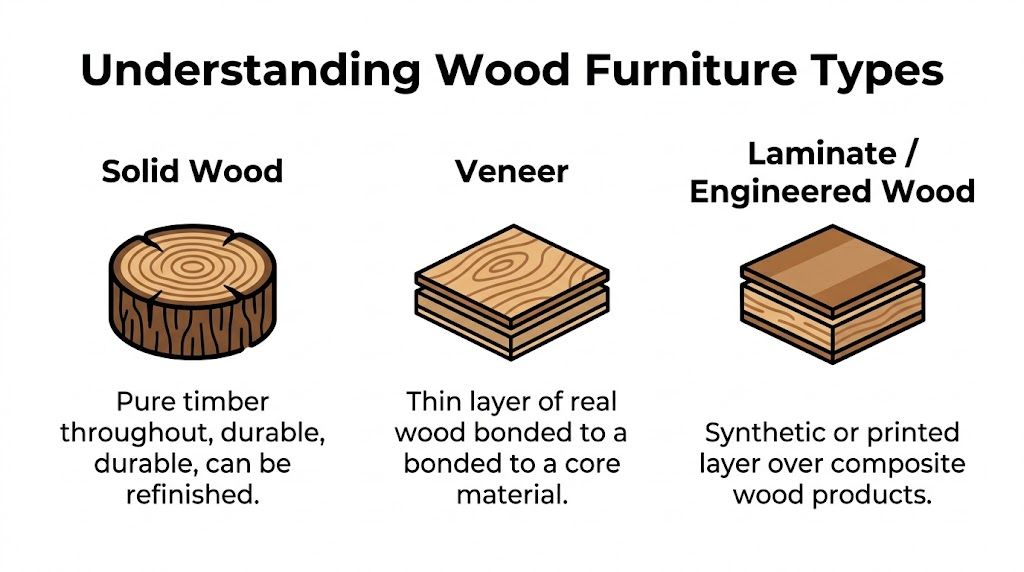
Three categories that shoppers should separate
The easiest way to think about wood furniture is as a hierarchy of materials.
| Type | What it is | Strengths | Limits |
|---|---|---|---|
| Solid wood | Wood throughout the structural part | Durable, repairable, refinishable | Costs more, can move with seasons |
| Veneer | Thin real-wood layer over a core | Attractive, stable on large panels, can be well-made | Limited refinishing compared with solid wood |
| Laminate or photo finish | Printed or synthetic top layer over composite | Consistent appearance, value-oriented | Can chip, peel, and is difficult to repair |
Veneer isn’t fake wood
Experienced buyers approach veneer with a balanced perspective. Veneer uses real wood on the surface. In a well-made piece, it can look beautiful and perform well in the right application. Large panels, matched grain layouts, and certain design styles often use veneer intentionally.
What veneer is not is the same long-term ownership proposition as solid wood.
The most important trade-off is repair. Once the top layer is thin, your margin for future sanding and restoration is much smaller. For some accent pieces, that may be acceptable. For a dining table that sees daily wear, many homeowners prefer the security of thicker material.
Laminate and engineered cores
Laminate and photo-printed surfaces are different from veneer. They imitate wood visually, but they don’t offer the same tactile or restoration potential. If they chip at an edge or swell from moisture, repair options are limited.
That’s why material transparency matters when you’re selecting custom pieces. If you’re comparing constructions, this explanation of engineered wood vs particle board helps clarify what sits under the finish and why it affects lifespan.
Veneer can be a design choice. Laminate is usually a budget construction choice. Solid wood is an ownership choice.
A careful buyer doesn’t reject every veneered piece on sight. They match the material to the job. Use that standard and the showroom gets much easier to read.
Verifying Craftsmanship Beyond the Wood Itself
A piece can be made from solid wood and still be built poorly. Material quality matters, but construction quality decides whether the piece stays tight, square, and dependable.
Start with the joints
The first place to look is where one part meets another. Drawer corners, table aprons, leg connections, and cabinet frames all tell a story.
Better signals include:
- Interlocking joinery such as dovetails on drawers
- Clean, tight fits with no visible gaps
- Stable leg attachments that don’t shift when the piece is moved
- Drawer action that feels controlled rather than loose
If a drawer box looks stapled together as an afterthought, the wood species won’t save it. Good furniture feels resolved at the joints.
For homeowners who want to understand what they’re seeing, this overview of various wood joints is helpful before you visit a showroom.
Hardware and finish tell you a lot
Then check the parts people overlook.
Pick up the drawer pull. Does it feel substantial or flimsy? Open and close the drawer a few times. Does it rack, bind, or wobble? Look at the finish under light. A good finish protects the wood without making it look like plastic.
These details matter because heirloom furniture is used, not admired from a distance.
The long-term test is refinishing
A major advantage of solid wood is what happens years later. According to Luke’s Furniture, a key differentiator for solid wood is its refinishing potential. An investment homeowner can expect to refinish a solid wood piece multiple times over its decades-long lifespan, while veneered or laminate furniture typically cannot be refinished at all, which changes total cost of ownership (guide to telling solid wood from veneer or MDF).
That’s the proper appraisal mindset. Don’t just ask, “Is this wood?” Ask, “What can this piece become after ten years of family life?”
A refinishable piece can recover from scratches, water marks, and changing tastes. A non-refinishable piece usually can’t.
That’s why experienced buyers inspect furniture as a whole system. Wood, joinery, hardware, and finish all have to work together.
Investing with Confidence at Our Easton Showroom
A good showroom shouldn’t ask you to take quality on faith. It should let you inspect it.
When you shop with a sharper eye, a few things become easier very quickly. You stop being distracted by stain color alone. You start checking end-grain, edges, drawer construction, and weight. You ask better questions. You notice which retailers welcome those questions and which ones steer you back to the tag.
That’s the right way to buy furniture for a long-term home.
At Easton Town Center, shoppers can use those same tests while also getting practical support that makes the decision easier. Complimentary design help in the In-Store Design Studio can help you narrow scale, finish, and room layout. The Custom Order Program lets you tailor fabrics, finishes, and configurations with digital visualizers, which is especially useful when you’re comparing custom dining sets, Amish-made furniture, or other solid wood furniture Ohio homeowners plan to keep.
The value side matters too. A Low Price Guarantee with a 110% refund of the difference is part of the offer if a lower local authorized dealer price is found within the stated terms, and the Clearance Gallery includes savings up to 70% off on selected premium pieces. Flexible financing through Synchrony HOME and White-Glove In-Home Delivery make the purchase easier to complete once you’ve made the right call.
If you want a starting point for shopping locally, this guide on where to buy solid wood furniture is a useful next step.
For Columbus shoppers comparing a furniture store Columbus Ohio option, exploring custom dining sets, or pairing a furniture visit with a stop for the best mattresses Easton Town Center has to offer, the goal is the same. Buy with your eyes open, your hands involved, and your standards intact.
Visit Vinson Fine Furniture to compare materials in person, work with a design consultant, and shop for pieces built for long-term use in your home.