How to Choose a Dining Room Table: Vinson’s Expert Guide

A lot of dining table mistakes begin the same way. A family moves into a new home, stands in the empty dining room, and starts with the wrong question. They ask, “What table looks good here?” The better question is, “What kind of life needs to happen here?”
Some tables host quick weekday dinners and science projects. Some need to handle holiday meals, extra guests, and the wear that comes from daily use. Others have to bridge all of it, looking refined on Saturday night and forgiving enough for Tuesday morning cereal. That’s why learning how to choose a dining room table has less to do with chasing a trend and more to do with understanding scale, use, construction, and comfort.
At Easton Town Center, I’ve watched Columbus homeowners make this decision in every season of life. Newly renovated homes need a table that anchors an open plan. Growing families need flexibility without sacrificing style. Empty nesters often want to replace a temporary purchase with something that feels settled, substantial, and made to last. The right table becomes part of the rhythm of the house.
That’s also why this decision deserves a longer view. A dining table isn’t just another surface. It’s where birthdays are toasted, homework is spread out, contracts are signed, and grandchildren eventually learn where everyone sits. If you choose well, the table doesn’t just fit the room. It supports the life unfolding around it.
For a deeper look at how a table shapes daily living, Vinson shares thoughtful ideas in Dining Tables More Than Just Dining.
The Heart of the Home An Investment in Togetherness
The dining room is rarely only a dining room. In most homes, it’s a shared workspace, a gathering place, and a visual anchor all at once. The table at the center has to carry more than plates and serving bowls. It has to carry routine.
One Columbus family I think of often had been living with a table they bought quickly after moving. It technically seated everyone, but the room felt pinched, the finish showed every mark, and holidays turned into a game of squeezing in extra chairs and apologizing for the layout. What they wanted wasn’t more furniture. They wanted ease.
That’s the difference between a short-term purchase and a long-term investment. An investment table looks right in the room, but above all, it works without friction. Chairs pull out cleanly. The top has enough depth for place settings and shared dishes. The proportions support the room instead of crowding it. Years later, it still feels like it belongs.
Why this piece matters more than most
A sofa can define comfort. A bed can define rest. A dining table often defines connection.
When homeowners choose well, they usually aren’t responding only to style. They’re responding to permanence. Solid wood under the hand feels different than a lightweight substitute. A well-built base has presence. A hand-finished surface reflects light with more depth and softness than a flat factory sheen.
A dining table should feel calm in the room. If it creates constant workarounds, it’s the wrong table no matter how attractive it is.
That perspective has guided Vinson through decades of helping Central Ohio families furnish their homes. Formerly known as Kitchen Tables & More, the business has long centered on pieces that are meant to stay, not cycle out with the next move or the next trend. For homeowners looking at custom dining sets, solid wood furniture Ohio shoppers can count on, and even neighboring categories like best mattresses Easton Town Center visitors often explore on the same trip, the common thread is longevity.
The table should match the life, not just the room
Before you compare wood species or finishes, pause on three questions:
- How do you use it now. Daily family meals call for different priorities than a formal room used a few times a year.
- Who needs to fit comfortably. Children, tall adults, frequent guests, and multigenerational gatherings all change the seating plan.
- How long do you want this piece to serve you. A temporary table solves a moment. An heirloom table supports decades.
That last category matters. Many homeowners who visit a furniture store Columbus Ohio shoppers trust aren’t looking for novelty. They’re looking for confidence. They want to know the table they bring home will still make sense after the next renovation, the next phase of family life, and the next holiday gathering.
Measure Twice Buy Once A Framework for Space and Flow
A family can live with the wrong paint color for a while. They do not live comfortably with a table that jams every walkway, clips the patio door, and forces someone to stand up every time another person leaves the room.
That is the mistake to catch before you shop.
A good dining layout starts with movement. The table has to work when chairs are occupied, when dinner is being served, and when children cut through the room on the way to the kitchen. In our studio, the tables that hold up best over time are rarely the largest ones a room can accept. They are the ones that leave enough space for daily life to feel easy.
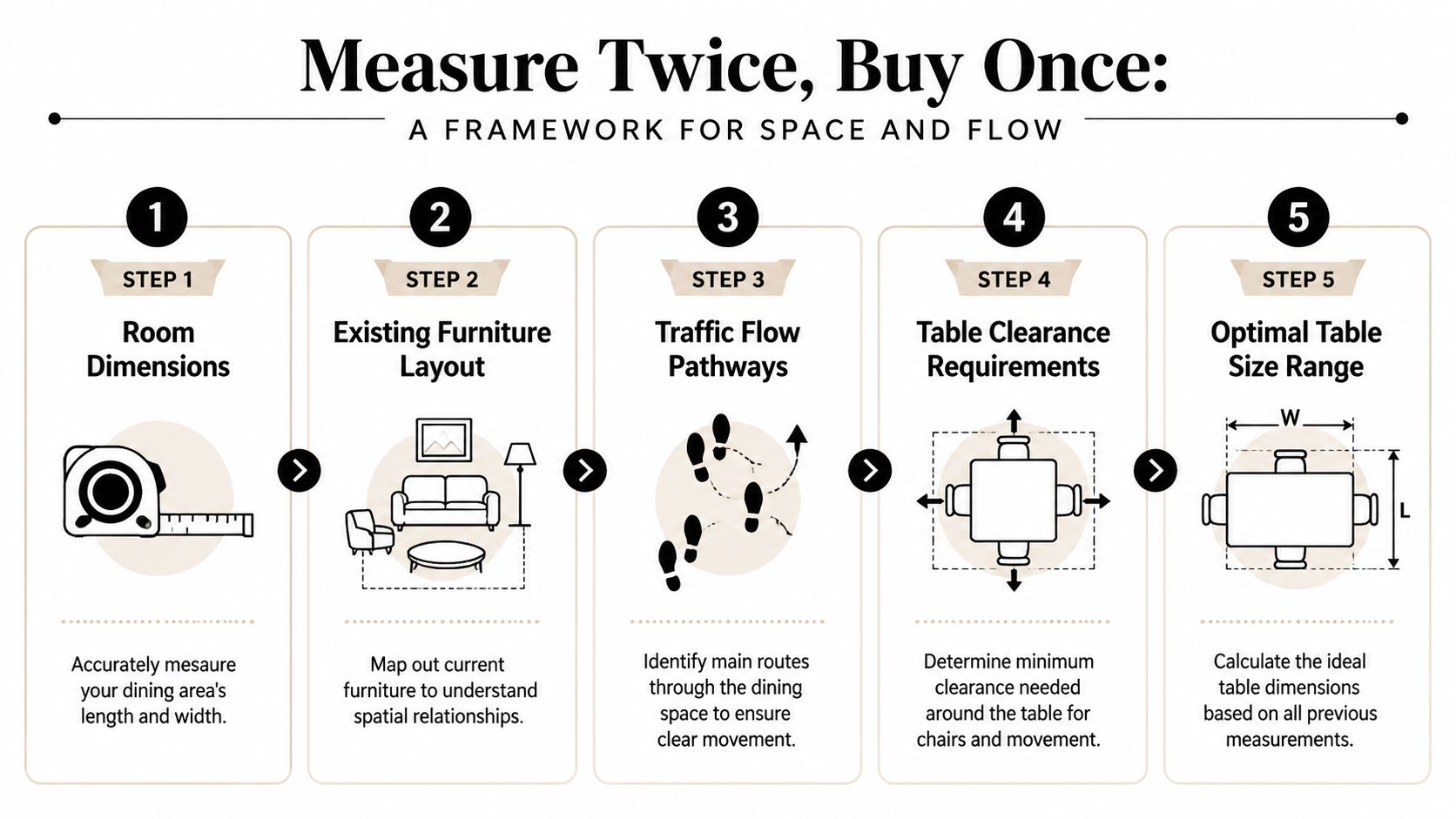
Start with the room, not the table
Measure the full room first. Then measure the usable room.
Those are not always the same number. Door swings, floor vents, radiators, low windows, buffets, and transition paths all reduce what the table can realistically occupy. Open-concept homes add another layer. The dining area may not have walls defining it, but it still needs clear boundaries so chairs can move without pushing into the kitchen or living zone.
Leave at least 36 inches between the table edge and walls or other obstacles. That is a dependable planning standard for chair movement and basic circulation.
If you want a clear process before you start comparing sizes, this furniture measuring guide walks through the basics.
A practical five-step method
Use this sequence to test the room before you commit:
- Measure the full footprint. Record the longest usable length and width of the dining area.
- Subtract clearance on each side. Protect that 36-inch buffer first, then see what table size remains.
- Mark fixed obstacles. Door swings and casegoods often cause more trouble than the walls do.
- Tape the outline on the floor. Painter's tape shows the footprint faster than a sketch.
- Test the room in motion. Pull out a chair position, walk past it, and carry something through the space.
That last step matters.
A layout can look fine on paper and still fail once chairs are occupied. If someone has to turn sideways to pass behind a seated guest, the table is too large for the room.
Practical rule: If the room only functions when the chairs are pushed in and no one is sitting down, size down.
Use proportion as a second check
Clearance comes first. Proportion comes after that.
A table should feel settled in the room, not crowded and not adrift. In practice, many rooms look balanced when the table length takes up roughly a third of the room's length. Treat that as a visual checkpoint, not a hard formula. A 15-foot room, for example, often carries a 5-foot table well, but windows, traffic paths, and chair scale can shift that answer.
Here is the faster way to judge it:
| Room planning factor | What to check | What usually works |
|---|---|---|
| Clearance | Space from table edge to wall or obstacle | Keep at least 36 inches around the table |
| Traffic path | Routes to kitchen, patio, or hall | Keep main walkways clear even with chairs occupied |
| Visual proportion | Table length compared with room length | About 1/3 of the room's length is a strong starting point |
| Obstacle control | Doors, buffets, vents, radiators | Keep each one usable after the table is placed |
What works in real homes
Open-concept rooms often tempt homeowners into buying too much table because the square footage feels generous. The actual dining zone is usually smaller than it appears once chair movement and circulation are accounted for. A table with presence is good. A table that swallows the zone is not.
Long, narrow dining rooms create the opposite problem. Families often shop for the two holidays each year when they host ten people, then spend the other three hundred plus days squeezing around a table that is too long for everyday use. In those homes, an extendable solid-wood table is often the better investment. It preserves comfort most of the year and still gives you capacity when the house fills up.
That is the larger framework. Buy for the life you live every week, then build in flexibility for the days that ask for more.
Matching Table Shape and Size to Your Lifestyle
Saturday night is when the wrong table shows itself. Someone squeezes past a chair to refill water. A serving bowl lands with no place to spare. The meal still happens, but the room works harder than it should.
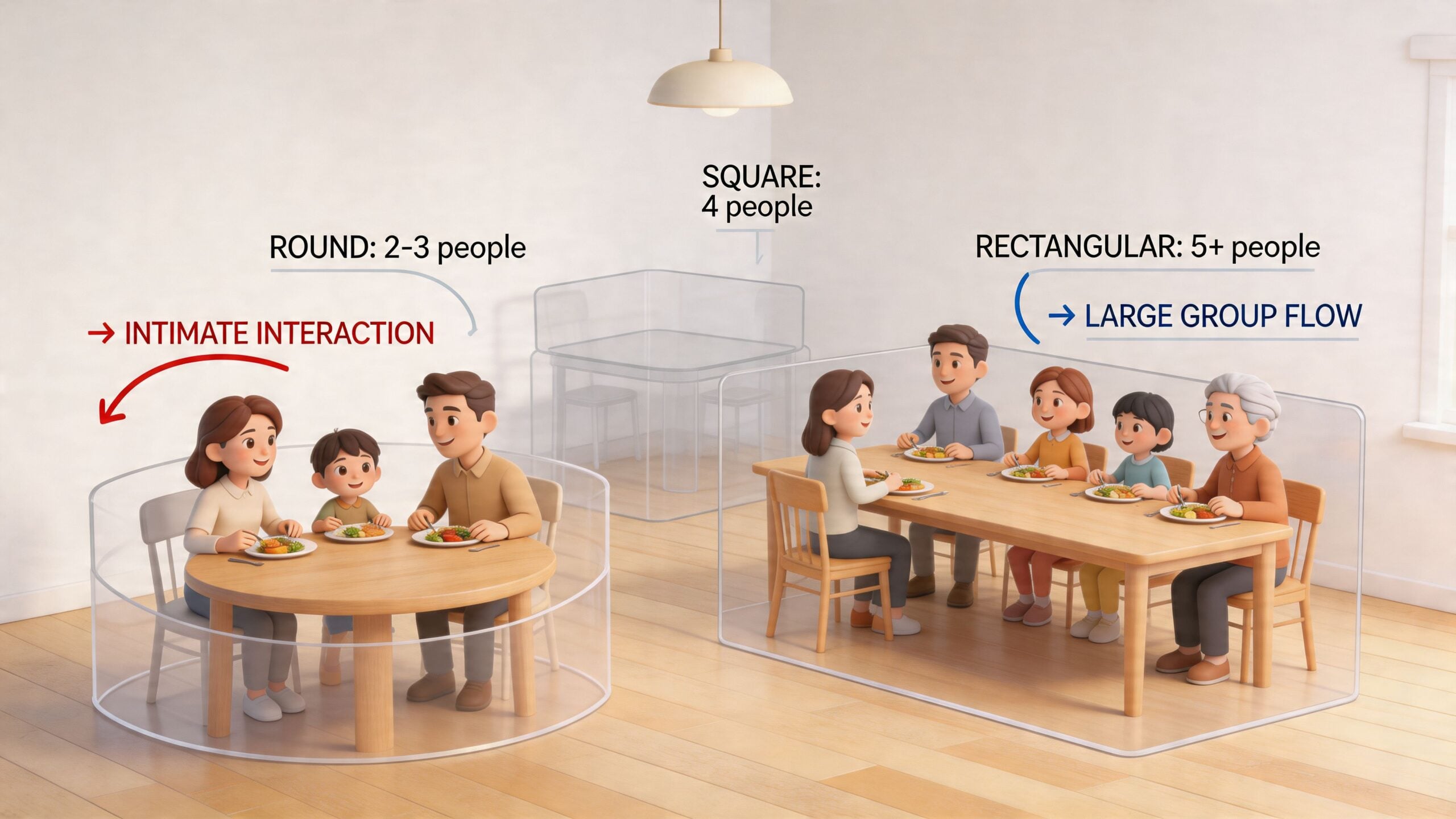
Room dimensions set the limits. Your habits decide the right shape inside them. I walk Columbus clients through this distinction every week because a table can fit a room on paper and still feel wrong in daily use. The central question is how your family gathers, serves, lingers, and hosts over the course of a year.
For a broader look at layout pairings, this guide to table shapes and seating arrangements is helpful.
Rectangular, round, oval, or square
Each shape changes the experience of the room.
Rectangular tables
Rectangular tables suit long rooms, larger households, and homes that host often. They give serving pieces a natural center line, and they usually pair well with leaves, which matters if Thanksgiving seating looks very different from a Tuesday dinner.
They can feel formal, but they do not have to. In a solid-wood build with the right chair scale, a rectangular table reads grounded and generous rather than stiff. The trade-off is width and circulation. If the room is narrow, a rectangle can make every chair pull-out feel like a traffic problem.
Round tables
Round tables keep everyone in the conversation. No one ends up at the far corner, and the lack of sharp corners makes the room feel easier to move through, especially in breakfast areas and square dining rooms.
They are not always the best answer for bigger gatherings. Once a round table grows large enough to seat more people comfortably, reaching shared dishes becomes less convenient, and the center can turn into wasted space unless you use a large lazy Susan or keep the setting simple.
Oval tables
Oval tables often solve a design problem that clients do not know how to name. They want the capacity and direction of a rectangle, but they want the room to feel softer. Oval tops do exactly that.
They work especially well in homes with children, tight pass-throughs, or a dining room that risks feeling too rigid with straight lines everywhere. You still get length, but the edges are gentler visually and physically.
Square tables
Square tables make sense in square rooms and in households where four people dine together most nights. They create balance, and they can feel intimate in a way a long table cannot.
In larger rooms, they need careful handling. A square table that is too small looks stranded. One that is too large pushes diners so far apart that conversation loses its ease.
Size should follow real use
A table should support the meals you have, not only the two biggest holidays on the calendar. I usually ask clients to start with their ordinary week. How many people sit down at once. Do homework and laptops share space with dinner. Are platters set on the table or plated at the counter. Those answers shape the right top size more accurately than any trend.
A good rule is simple. Each seated person needs enough room to eat without bumping elbows or crowding the place settings. If every inch is spoken for before serving dishes hit the table, the table is undersized for your routine.
These patterns hold up in real homes:
- A family of four eating together most nights often does better with a table sized for comfort now, with expansion built in for guests.
- Frequent hosts usually benefit from rectangular or oval shapes because they add seats more gracefully.
- A couple in a nook or smaller dining area often prefers a round pedestal table because it keeps movement easy and conversation close.
- A multifunction room benefits from an extendable table that shrinks back after the gathering ends.
Shape affects mood as much as capacity. Some tables encourage long conversation. Others keep the room efficient and ordered.
Extendable tables solve the daily-versus-holiday problem
This is often the smartest long-term investment for Central Ohio families. Daily life rarely calls for the same footprint you need when relatives are in town, and a permanently oversized table can make the room feel heavy for the other fifty weeks of the year.
An extendable solid-wood table gives you two benefits at once. You keep openness in everyday life, and you keep hosting capacity in reserve. That matters even more if you are buying a piece you expect to live with for decades.
Custom sizing adds another layer of value. A fixed retail dimension may come close, but close is not always good enough in a room with specific traffic patterns, heirloom dining chairs, or a sideboard that needs clearance. At Vinson Design Studio, we often help families choose a shape first, then fine-tune the dimensions around how they live. That is how a dining table becomes more than a furniture purchase. It becomes part of the home's rhythm for years.
The Enduring Value of Quality Materials and Craftsmanship
Shape and size determine whether a table fits the room. Material and construction determine whether it deserves to stay there for decades.
A dining table takes repeated impact. Plates slide. Chairs bump the apron. Children lean on corners. Serving pieces sweat through hot dishes and cold glasses. If the table is poorly built, everyday use exposes it quickly. If it’s well made, wear tends to read as character rather than failure.
The most important distinction is often between a table built from solid wood and one built to imitate it. For homeowners searching for solid wood furniture Ohio families can live with long term, this difference matters more than surface appearance.
What to inspect before you buy
When evaluating quality, inspect joinery first. Dovetail or mortise-tenon joints are superior to butt joints, which can fail three times faster under load. Finish matters too. A hand-rubbed oil finish penetrates wood for better water and scratch resistance, while sprayed veneers can peel in 2-5 years, according to this guide to evaluating dining furniture quality.
That one source is enough to explain why two tables that look similar online can perform very differently in a home.
Dining Table Material Comparison
| Material | Durability | Maintenance | Best For |
|---|---|---|---|
| Solid wood | Strong, repairable, and suited to long-term daily use | Needs routine care and an understanding of natural wood movement | Families, investment homeowners, heirloom-minded buyers |
| Wood veneer over engineered core | Can look refined at first, but damage is harder to repair cleanly | Lower day-to-day effort until edges, corners, or finish begin to fail | Light-use rooms or style-driven purchases |
| Glass | Vulnerable to visible smudges, edge chips, and everyday visual wear | Requires frequent cleaning to stay crisp | Contemporary spaces with lighter use |
| Metal and mixed materials | Can be sturdy, but often feel colder and show dents or finish wear differently than wood | Varies by finish and construction | Industrial or modern aesthetics |
| Stone or marble-look surfaces | Substantial visual presence, but can be high-maintenance in active family dining | Needs careful cleaning and attention to surface sensitivity | Formal rooms and lower-frequency use |
Why solid wood keeps earning its place
A solid-wood table can usually be maintained, touched up, and in some cases refinished. That repairability is one of the strongest arguments in its favor. Instead of replacing the whole piece when life leaves marks, you preserve the table and restore the surface as needed.
This is one reason Amish-made furniture and North American solid-wood construction continue to matter for serious buyers. The value isn’t just visual warmth. It’s structural honesty. You can feel it in the weight, the edges, and the way the table responds to use over time.
There’s also a sensory component people notice immediately in the showroom. Hand-finished wood has depth. Grain variation gives the top movement and subtle contrast. A substantial base steadies the whole room.
A well-built dining table doesn’t need to announce itself. You notice it in the absence of wobble, the confidence of the joinery, and the way the finish ages.
The hidden cost of choosing only by price
Many shopping guides focus heavily on dimensions and shape. They spend less time on the long-term cost of ownership. That’s a mistake, especially for a dining table that sees daily family use.
A lower-cost table may seem sensible until the finish lifts, the joints loosen, or the top begins to show damage that can’t be repaired attractively. Then the “savings” disappear into replacement, frustration, and another round of shopping.
High-end materials ask for more thought up front, but they often give back through service life, repairability, and visual maturity. If you’re comparing options in person, this guide to solid wood dining tables gives a useful framework for what to inspect.
For homeowners using custom programs and digital visualizers, including options available through Vinson’s dining resources, that material conversation becomes even more important. Finish choice, wood species, edge profile, and base style all affect how the piece performs over time, not just how it photographs on day one.
Defining Your Style from Classic to Custom
Once the table fits the room and meets the demands of daily life, style becomes the layer that makes it personal. At this point, a dining set moves beyond function and starts to express the house around it.

The strongest dining rooms don’t usually come from copying a showroom vignette exactly. They come from selecting a table that anchors the architecture, then layering chairs, finishes, lighting, and textiles with intention. If you want inspiration for the bigger design direction, these dining room styles for different homes can help narrow your visual language.
Start with the home you already have
A traditional home often benefits from a table with weight, shape, and visible craftsmanship. Think substantial legs, rich wood tone, and chairs with fitted upholstery or carved detail.
A modern farmhouse room usually wants warmth without heaviness. A simple plank top, softened corners, and a finish that shows grain can create that balance. Contemporary interiors often do better with cleaner silhouettes, quieter bases, and a more restrained finish palette.
The mistake is trying to force the table to carry every style note by itself. Let it be the anchor, not the entire conversation.
Comfort is part of style
Dining rooms that look polished but feel awkward never get used the way they should. Chair scale, seat height, and knee clearance matter just as much as finish selection.
For investment homeowners, pairing a 29-31 inch height table with 16-19 inch seat chairs provides an ergonomic 11-12 inch knee gap, boosting comfort by 40% according to design consultants in the quality guidance cited earlier. I’m not repeating that source link here because the craftsmanship section already carries it, but the principle is worth applying when you test seating in person.
A beautiful chair that tucks too tightly or sits too high will wear on you faster than any color choice.
Choose a dining set the way you choose a good kitchen layout. It should disappear into comfort while still looking intentional.
Why custom often solves the hardest design problems
Custom ordering matters most when off-the-floor options are almost right but not fully right. Maybe the size works but the stain is too dark. Maybe the top is perfect but the base feels too formal. Maybe your chairs need performance fabric because this is a real family dining room, not a staged one.
That’s where customization becomes practical, not indulgent.
Consider what can be adjusted in a thoughtful custom program:
- Wood finish so the table works with your flooring instead of fighting it
- Base style to shift the room from rustic to refined, or from formal to relaxed
- Chair upholstery in fabric or leather that fits how your household lives
- Configuration so you can choose fixed seating, extension leaves, host chairs, or benches
- Digital preview tools that let you see combinations before the piece is built
This is especially relevant for homeowners furnishing a long-term residence. Trends fade quickly. Proportion, comfort, and a finish you still enjoy years later have much more staying power.
Build around permanence, not novelty
If you’re unsure where to begin, use this order:
- Architecture first. Match the home’s lines and tone.
- Daily use second. Choose surfaces and seating that support real life.
- Finish third. Select colors that age well with your home.
- Accent last. Let lighting, rugs, and art carry more trend-sensitive choices.
That sequence protects you from overdesigning the table itself. The best custom pieces feel settled from the beginning. They don’t try too hard.
Finalizing Your Investment The Vinson Advantage
The last step is less about style and more about judgment. A dining table can look right in the showroom and still be the wrong buy if the lead time, finish durability, delivery process, or long-term service are unclear. I tell Columbus clients to treat this stage like any other home investment. Ask what the table will cost you over ten or twenty years, not just what it costs on the invoice.

Ownership horizon matters. A lower-priced table made with thinner veneers or softer construction can look like a savings at checkout, then show wear, movement, or finish failure much sooner than a well-built solid-wood piece. The Lumens guide on choosing a dining table shape, size, and more also points to the long view, including how maintenance and refinishing timelines affect value over time. That is the right frame for the final decision.
At Vinson Fine Furniture, the advantage is not a single feature. It is the ability to make a clear decision with real support behind it. You can compare materials in person, review custom options with a designer, and buy with a better understanding of how the piece will live in your home. For families furnishing a long-term residence in Central Ohio, that guidance often prevents the expensive mistake of buying twice.
A practical buying checklist
Before you place the order, confirm these points:
- Measurements are final. Include walls, walkways, and the furniture that shares the room.
- Your seating plan reflects real life. Buy for daily use first, then add leaves or extra seating for holidays and larger gatherings.
- The construction matches the household. Active family use calls for materials and finishes that can handle repetition, spills, and regular cleaning.
- Service details are clear. Confirm lead time, delivery scope, assembly, and what happens if the piece arrives with damage or a finish issue.
- The table has a future in the home. A good piece should still make sense if you repaint, reupholster, or shift the room around it.
Price still matters, of course. It just needs context.
A Low Price Guarantee with a 110% refund of the difference can help when you are comparing authorized local pricing on the same item. A Clearance Gallery with savings of up to 70% can make sense for a floor sample, a discontinued style, or a faster timeline, as long as the dimensions and condition work for the room. Flexible financing through Synchrony HOME can also help households stage a larger purchase responsibly instead of compromising on the piece they want.
Delivery matters more than many homeowners expect. A dining table is heavy, often assembled in multiple parts, and easy to damage during a rushed install. White-Glove In-Home Delivery protects the table, the walls, and the finish, and it gives you a chance to inspect the piece in the room where it will reside.
The right table settles a room. It supports weeknight dinners, holiday meals, school projects, and the slow wear that makes a house feel lived in. That is the Vinson advantage at its best. A table chosen with care, built to last, and backed by people who understand the difference between a quick purchase and a lasting piece.
Frequently Asked Questions About Dining Tables
What if my dining area is open to the kitchen or living room
Treat the dining zone as its own footprint. Measure only the area the table should visually occupy, then protect circulation between adjoining spaces. In open plans, homeowners often oversize the table because the room feels generous. The better move is to preserve walkways and let the table define the dining area without interrupting the rest of the floor plan.
Are benches a good idea for everyday dining
Benches can work well on one side of the table, especially for families with children or for a more relaxed look. They’re less comfortable for long meals than supportive dining chairs, and they’re not ideal if every person needs easy in-and-out access. I usually recommend benches as a complement, not a full-room solution, unless the household strongly prefers the casual feel.
Is a round table better for conversation
Usually, yes. A round table keeps everyone in a more equal visual relationship, which helps smaller groups talk easily. It’s especially effective in square rooms or breakfast spaces. For larger gatherings, a rectangular or oval table often handles serving and seating more gracefully.
How do I care for a new solid-wood dining table
Use placemats or trivets for heat and moisture, wipe spills promptly, and clean with products appropriate for the finish. Don’t let standing water sit on the top. Wood rewards consistent care, not aggressive cleaning. If you’re choosing among finishes in person, ask how each one will age under your kind of daily use.
Should my dining chairs match the table exactly
Not necessarily. Matching can be elegant, but contrast often gives the room more personality. You can vary chair shape, upholstery, or wood tone while still keeping the overall palette cohesive. The room feels more collected when everything relates without looking overly uniform.
Is custom worth it for a dining table
It often is, especially if your room has specific measurement constraints or you want a finish and configuration that won’t be easy to find on the floor. Custom is most valuable when it solves a practical problem and gives you a table you won’t need to replace because of a compromise you made too quickly.
If you’re ready to choose a dining table that fits your room, your routine, and the way you want your home to feel years from now, visit Vinson Fine Furniture. At Easton Town Center, you can explore solid-wood options, review custom configurations with 3D visualizers, compare finishes in person, and work through measurements with a complimentary design consultation.