Repair Heat Stains on Wood Tables: A Homeowner’s Guide

That sinking feeling when a cloudy white ring from a pizza box appears on your beautiful wood table is an unwelcome surprise. But don't panic. Most heat stains on wood tables are entirely fixable. The key is to correctly identify the type of mark you’re dealing with first.
Your First Look at Heat Stains on Wood Furniture
A surprise heat stain on your prized dining table can feel like a disaster, but it’s really a moment for quick diagnosis. Understanding the blemish is the most important step toward restoring your furniture’s beautiful, hand-finished surface. The color of the stain tells you everything you need to know.
A white or cloudy mark simply means moisture is trapped in the finish. On the other hand, a dark or black mark signals a scorch to the wood itself.
White Stains vs. Dark Stains: What's the Difference?
White heat stains are the most common, and thankfully, the easiest to resolve. They happen when steam from a hot mug or serving dish gets trapped in the top layer of the finish, like lacquer or shellac. It looks like a ghostly white ring because you’re seeing moisture, not damaged wood.
Because these marks are on the surface, they're often reversible with some gentle, at-home methods.
Dark or black stains, however, are a tougher opponent. This discoloration means the heat was intense enough to penetrate the protective finish and actually scorch the wood fibers underneath. These marks require a more involved repair, often a light refinishing of the area, but it’s a job a confident homeowner can still tackle.
To help you quickly figure out what you're looking at, here’s a simple table.
Quick Diagnosis: Heat Stain Types and Common Causes
Use this table to quickly identify the type of heat stain on your wood table and understand its common source.
| Stain Appearance | What It Means | Common Causes | Initial Action |
|---|---|---|---|
| White, cloudy, or milky ring | Moisture is trapped in the top layer of the finish (lacquer, shellac). | Warm coffee mugs, damp cloths, pizza boxes, warm serving dishes. | Gentle, non-abrasive methods to release trapped moisture. |
| Dark brown or black mark | The wood fibers beneath the finish have been scorched or burned. | Pans directly from the stove, hot irons, casserole dishes from the oven. | More intensive repair, likely requiring light sanding and refinishing. |
Once you know the type of stain, you can choose the right method for the job and avoid making the problem worse.
This infographic gives you a quick visual guide for diagnosing the heat stain on your furniture.
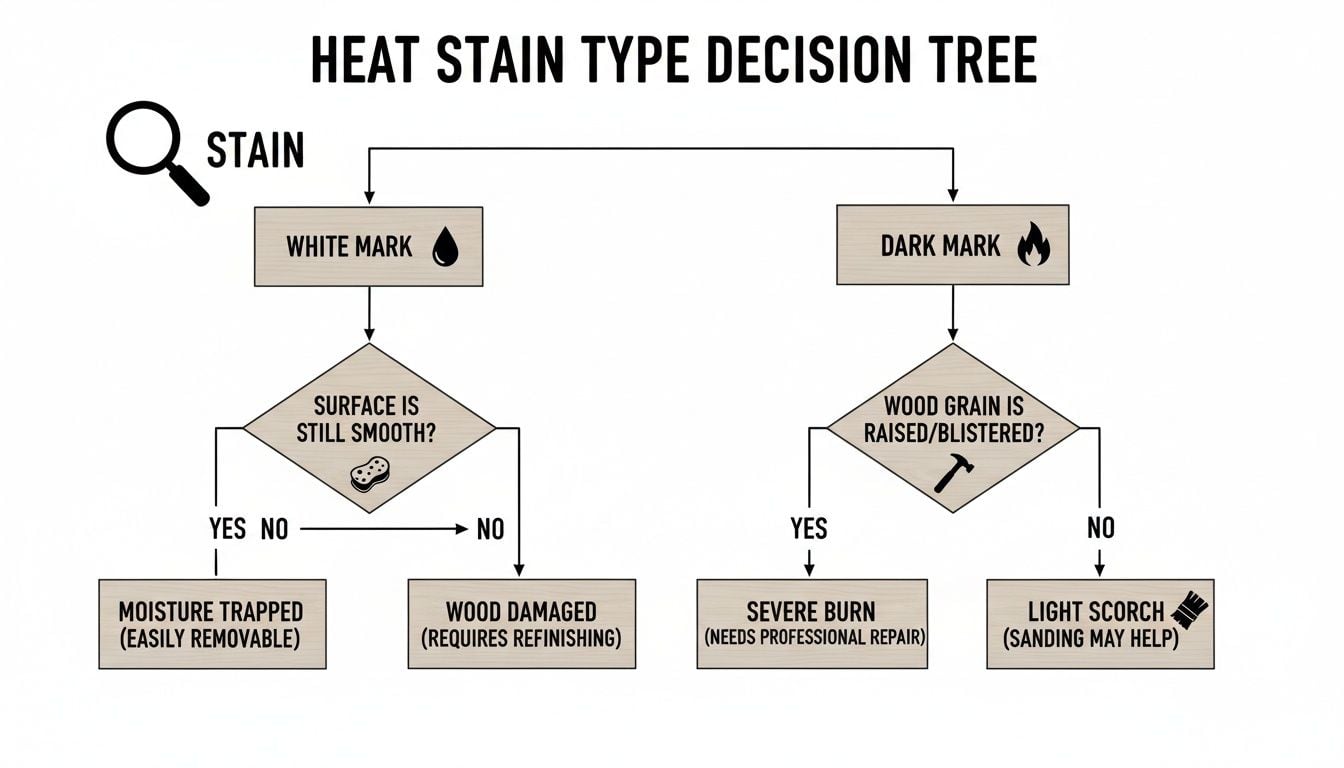
As you can see, the color of the mark is your primary clue. It tells you whether you're up against trapped moisture or a true scorch, which then guides your next steps.
The type of finish on your furniture also plays a significant role. Different finishes offer varying levels of protection, a key consideration when you're selecting a piece designed to last a lifetime. To learn more, check out our guide on choosing the right hardwood for longevity and style.
Knowing this distinction not only empowers you to fix the current issue but also helps protect your investment for years to come. During our Complimentary Design Consultations at our Easton Town Center showroom, we often cover the practical side of furniture care, ensuring the solid wood furniture Ohio families choose is a perfect fit for their home and lifestyle.
Gentle DIY Methods for Removing White Heat Stains
It’s a familiar, sinking feeling: you lift a hot pizza box or coffee mug and find a ghostly white ring left behind on your heirloom-quality table. The good news is that you likely won’t need harsh chemicals to fix it. Those cloudy heat stains on wood tables are usually just moisture trapped in the top layer of the finish.
The goal is to gently coax that moisture out. With a little patience and a gentle touch, you can often restore the finish to its original clarity using items you already have at home. Before you start, always test your method on a small, hidden spot—like the underside of the table or the back of a leg. It’s a simple step that ensures the technique is safe for your table’s unique, hand-finished surface.
Using Gentle Heat to Release Trapped Moisture
It might sound counterintuitive, but fighting heat with a bit more controlled heat is one of the most effective techniques. A little warmth can soften the finish just enough to let that trapped steam finally evaporate.
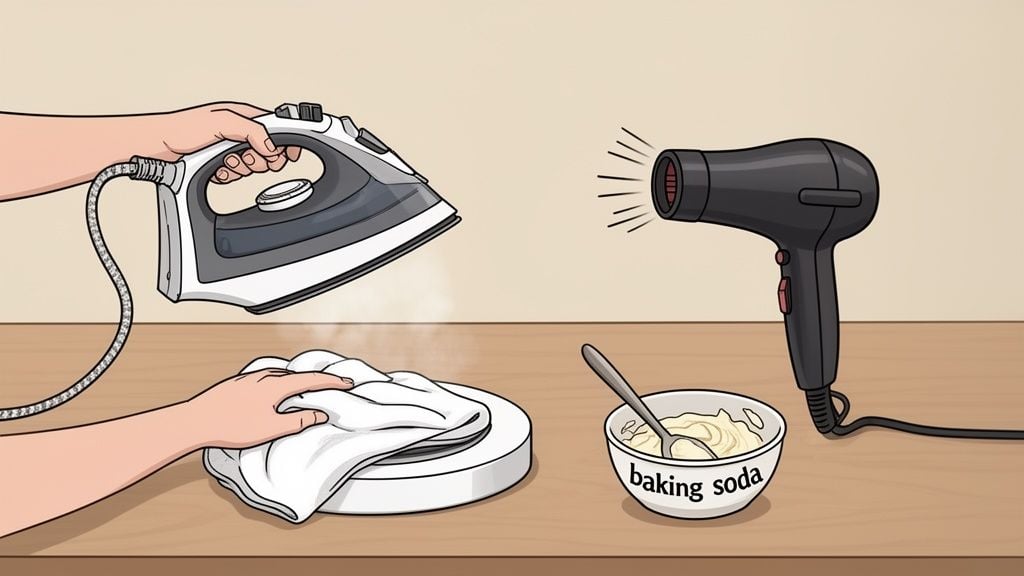
A hairdryer is your best friend for this job because it offers excellent control.
- Set your hairdryer to its lowest heat setting.
- Hold it several inches away from the wood surface.
- Keep the dryer moving in a constant side-to-side motion over the stain. Never let the heat sit in one spot.
- You should see the stain start to fade and disappear right before your eyes.
If the mark is a bit more stubborn, you can bring out a household iron. This method requires a buffer to protect the wood from direct heat. First, ensure your iron is completely empty of water and the steam setting is turned off. The last thing you want is to add more moisture.
Lay a clean, dry cotton towel or t-shirt over the stain. Set your iron to its lowest, driest setting and pass it over the towel for just a few seconds at a time. Lift the towel frequently to check your progress. This is all about patience; a slow and steady approach will always yield better results than rushing and risking more damage.
Making a Mildly Abrasive Paste
Another trusted approach is to use a simple paste to gently buff the moisture out of the finish. These home remedies use common ingredients with just enough fine texture to work on the finish without scratching the wood itself.
A classic paste can be made with two simple items from your kitchen and bathroom.
- The Ingredients: Mix one part plain white toothpaste (not gel or whitening formulas) with two parts baking soda.
- The Application: Dab a small amount of the paste onto a soft, clean cloth and gently rub it into the stain, always moving with the wood grain.
- The Finish: After a minute of gentle rubbing, use a separate clean, damp cloth to wipe all the paste away. Dry the spot completely with another soft cloth.
You can also try using household oils to displace the moisture. Something like mayonnaise or petroleum jelly is dense enough to penetrate the finish and push the water out. Just apply a small amount to the stain, let it sit for a few hours (or even overnight for a tough spot), then wipe it all clean and buff the surface.
Expert Tip: After successfully removing a heat stain, it's a great time to give your entire tabletop a proper cleaning and conditioning. This helps restore a uniform luster and protects the finish. For a comprehensive overview, explore our detailed guide on how to properly clean your wood furniture.
These gentle DIY methods are often all it takes to restore the timeless beauty of your solid wood furniture Ohio homes are built around. If the stain persists after trying these techniques, it might be time to consider a slightly stronger, yet still safe, commercial product.
Using Commercial Products for Stubborn Marks
So you’ve tried the hairdryer trick and the toothpaste paste, but that cloudy white mark is still staring back at you. Don't throw in the towel just yet. When a simple home remedy doesn't quite cut it, that doesn't mean you're facing a full-blown refinishing project.
Sometimes, a stubborn heat stain just needs a little more persuasion. This is where a carefully chosen commercial product can be invaluable, offering a reliable fix for those persistent blemishes. These products are formulated to work with your furniture's existing finish, not against it, helping restore that seamless beauty you love.
Selecting the Right Restoration Product
The key here is choosing a product that matches your goal. You aren’t trying to strip the finish; you're reviving it. You’ll want to look for a furniture restorer, which is designed to blend into the existing topcoat, mask imperfections, and bring back that original luster.
A go-to choice for many is a product like Howard Restor-A-Finish. This isn't a heavy varnish or a traditional stain. It’s a unique formula with a small amount of stain and restorative oils that penetrates the existing finish to hide scratches, blemishes, and those frustrating white heat stains on wood tables.
These restorers come in a whole range of shades to match your furniture, from light maple and cherry to dark walnut and mahogany. Picking the right color is absolutely crucial for a seamless repair, making sure the treated spot blends invisibly with the rest of the tabletop.
The Gentle Power of Steel Wool and Mineral Spirits
For a particularly tenacious white ring, you might need a slightly more assertive approach. This method is a classic in the woodworker’s playbook, combining a lubricant with an ultra-fine abrasive to gently buff the stain out of the finish layer without harming the wood underneath. It demands a delicate touch, but the results can be fantastic.
You’ll only need two specific things for this task:
- #0000 Grade Steel Wool: This is the finest grade you can buy. Anything coarser will leave noticeable scratches on your finish. The goal is to polish, not to scour.
- Mineral Spirits: This acts as a lubricant, letting the steel wool glide smoothly over the surface instead of digging into the finish.
Start by lightly dampening a small piece of the #0000 steel wool with mineral spirits—it shouldn’t be dripping wet. Gently rub the stained area, always moving in the same direction as the wood grain. The key is to use very light pressure and let the combination of the steel wool and mineral spirits do the work. After a few passes, wipe the area with a clean, soft cloth to check your progress. You can repeat this as needed until the stain vanishes, then wipe the surface completely clean and dry.
Restoring a finish is part art, part science. Understanding the type of finish on your furniture is essential for any repair. To deepen your knowledge, we recommend exploring our insights on natural wood finishes and their characteristics.
Application for a Flawless Repair
Once you have your product, proper application is everything. Whether you’re using a liquid restorer or the steel wool method, your technique and environment make all the difference.
Safety and Preparation First:
- Always work in a well-ventilated area. Opening a window or using a fan makes a big difference.
- Wear gloves to protect your hands from the chemicals and oils.
- Before you start, give the entire tabletop a thorough wipe-down to ensure it’s free of dust and grime.
If you’re applying a liquid restorer, use a clean, soft cloth. Pour a small amount of the product onto the cloth and work it into the stained spot, again, always moving with the wood grain. Feather your application at the edges to help the repair blend into the surrounding finish. In many cases, it’s best to treat the entire surface for a perfectly uniform appearance.
These methods are perfect for revitalizing the heirloom-quality solid wood furniture Ohio families treasure. At Vinson Fine Furniture, we believe in empowering you with the knowledge to care for your pieces. While we love creating new, beautiful furnishings through our Custom Order Program, we also know how important it is to maintain the pieces you already cherish.
How to Repair Dark Heat Stains and Scorched Wood

When a heat stain goes past that milky white haze and turns dark brown or black, you have a different challenge on your hands. This isn't just trapped moisture; it's a scorch mark. The heat has burned through the finish and seared the wood fibers themselves.
It’s a more involved repair, but it doesn't have to be a catastrophe. If you’re a confident homeowner, this is a small refinishing project you can absolutely tackle. The goal here is to carefully remove the damage and blend a new finish so seamlessly that no one would ever know it was there.
Preparing and Sanding the Scorched Area
First things first, you need to isolate the burn. A bit of painter's tape around the scorch mark creates a perfect boundary, protecting the surrounding finish from any accidental scuffs while you work.
Now, your mission is to sand away just the darkened wood until you get back to the clean, natural grain underneath. The trick is to do this gently with a few different sandpaper grits.
- Start with a medium grit paper, something around 120-grit, to remove the scorched wood. Wrapping it around a small wood block helps keep the pressure even.
- Work slowly and stay inside your taped-off area. Keep checking your progress and stop the moment the dark color is gone.
- Next, switch to a finer 220-grit paper. This will smooth out any sanding marks left by the coarser grit, leaving you with a flawless surface that’s ready for stain.
Remember to always sand with the grain of the wood. Going against it will create scratches that will stand out once you apply the new finish.
After sanding, you’ll have a patch of raw, beautiful wood. This is the same starting point our craftsmen begin with when creating a new piece of solid wood furniture Ohio families bring into their homes. It’s a canvas ready for color and protection.
The Art of Matching the Stain
Here’s where the real artistry comes in, and frankly, it’s the most difficult part of the process. Matching a new stain to your table's aged, original color can be a challenge. A near miss on the color can look even more obvious than the scorch mark you just removed.
Trying to mix stains from the local hardware store is an option, but getting that perfect shade is exceptionally difficult. Your table has aged and developed its own unique color, and different wood species accept stain in very different ways. For context, one industry analysis showed that warm stains were 4.5 times more popular than cool stains in 2023, and you can discover insider furniture trend data to get a feel for the vast world of wood finishes.
This is where a little professional guidance can save you a lot of guesswork. At Vinson Fine Furniture, our Custom Order Program includes hundreds of finish options, and our designers are experts at color matching.
We invite you to bring a clear photo of your table—or even a small part like a removable table leaf—to our In-Store Design Studio at Easton Town Center. Our team can offer a Complimentary Design Consultation to help you identify the right color family and point you toward a stain for a truly seamless repair.
Applying the Finish for a Perfect Blend
Once you have your stain, less is more. Apply it sparingly with a clean cloth, wiping it on and then immediately wiping off the excess. You can always build up the color with a second thin layer, but it’s much harder to correct a spot that’s too dark.
Let the stain dry completely, following the manufacturer’s directions (this usually takes 24-48 hours). The final step is applying a protective topcoat to seal your repair and match the sheen of your tabletop. A clear, oil-based polyurethane is a durable choice. Use a good-quality brush and apply it in long, even strokes. You might need a couple of coats, with a very light sanding in between (using 220-grit paper), to build up a protective layer that blends perfectly.
Following these steps will make the evidence of even the darkest heat stains on wood tables disappear, leaving your furniture looking as good as the day it arrived with our White-Glove In-Home Delivery service.
Preventing Heat Stains to Protect Your Furniture
Now that you’ve brought your beautiful wood table back to life, the real work begins: keeping it that way. The best way to deal with heat stains on wood tables is to stop them from ever happening. When you treat your furniture as the long-term investment it is, protecting its hand-finished surface becomes part of daily life.
This all comes down to creating a simple barrier between hot items and your wood. It’s a small habit, but one that will preserve the integrity and beauty of your furniture for decades.
Simple Habits for Everyday Protection
More often than not, heat stains come from the most ordinary items—a steaming mug of coffee, a warm bowl of soup, or a pizza box plopped down after a long day. The easiest and most stylish defense is to make protective layers a natural part of your home’s decor.
- Coasters: These are absolutely essential for any wood surface. We recommend materials with excellent insulation, like cork, felt, or thick woven fabric, which absorb condensation and block heat.
- Placemats: A must-have for daily dining. They don't just protect from the heat of a plate; they also guard against spills and scratches, creating a safe zone for every meal.
- Trivets: Anything coming straight from the stove or oven needs a trivet, no exceptions. Keep a few handsome wooden or silicone trivets in the kitchen so they’re always ready to go when you're serving hot dishes.
Think of these items less as chores and more as accessories that complete your home's look. They are, without a doubt, the easiest way to prevent accidental damage.
Protecting Your Table During Gatherings
When you’re hosting a dinner party or a large family gathering, your table is going to see a lot more action. For these bigger events, you’ll want to step up your protection strategy to handle multiple hot dishes and more people around the table.
A high-quality tablecloth is a great start, but for total peace of mind, nothing beats a custom table pad. These are thick, felt-backed pads cut to the exact size of your table, offering unbeatable protection against high heat, spills, and dings. You can simply lay your favorite tablecloth right over the pad, giving you a flawless look with some serious, hidden security underneath.
A Note on Finishes: Your furniture’s finish is its first line of defense. Modern catalyzed conversion varnishes, which we often use on our custom dining sets, offer far better resistance to heat and moisture than older lacquer or shellac finishes.
Choosing the right finish is a huge part of the customization process. A more durable finish can be a lifesaver for those moments when a coaster is forgotten. For a deeper dive into the world of wood protection, check out our ultimate guide to protecting wood furniture.
Customizing for Durability and Beauty
Here at Vinson Fine Furniture, we believe you should never have to choose between a beautiful piece and a durable one. Our In-Store Design Studio at Easton Town Center is where we make that happen.
During a Complimentary Design Consultation, our experts will walk you through the hundreds of finish options available through our Custom Order Program. We’ll help you find a finish that not only gives you the exact look you want for your Amish-made furniture but also provides the right level of protection for your family's lifestyle.
Whether you need a table that can handle daily homework sessions or a formal dining surface for special occasions, we’ll make sure your investment is both stunning and practical. And for even more value, don't forget to ask about our Low Price Guarantee and our Clearance Gallery, where you can find incredible savings.
When to Call a Professional for Furniture Repair
Knowing your limits is a crucial part of caring for your furniture. While many heat stains on wood tables can be fixed with some DIY elbow grease, some situations are best left to a professional. A botched repair on a valuable piece can do more harm than good, turning a small blemish into a much bigger, more expensive problem.
Recognizing when to put down the tools is the mark of an "Investment Homeowner"—someone who truly values the long-term beauty and life of their furniture. Sometimes, the heat damage is just too deep, too widespread, or on a finish so delicate that trying to fix it yourself is too risky.
Signs It’s Time to Call for Help
If you're looking at one of these scenarios, it’s a good idea to get a professional opinion before you start sanding or reaching for chemicals. A pro has the right tools, years of experience, and a controlled environment to handle these tougher repairs.
- Deep Scorches: If a dark burn has left a noticeable divot or created a rough texture, it needs more than a surface fix. A professional will need to carefully sand, fill, and blend the area to make the repair truly disappear.
- Widespread Damage: When you have multiple heat rings spread across a large area of your tabletop, trying to fix them one by one will almost always leave the finish looking blotchy and uneven. A pro can refinish the entire surface for a flawless, consistent look.
- Damage to Veneers: Wood veneer is an incredibly thin slice of beautiful wood bonded to a base material. It's shockingly easy to sand right through it, and that’s a mistake you can’t undo. Experts know how to work on these fragile surfaces without causing permanent damage.
- High-Gloss or Lacquered Finishes: These super-shiny finishes are notoriously tricky to spot-repair. Getting that seamless, mirror-like gloss back requires special spray equipment and techniques that are nearly impossible to duplicate by hand.
For a treasured family heirloom, especially the Amish-made furniture Columbus, Ohio families prize, professional restoration is an investment in its future. It's the surest way to protect both its monetary and sentimental value.
When Your Furniture Is an Antique
Antiques are in a league of their own. Their original finish, the patina that’s developed over generations, and the way they were built are all part of their story and their value. An aggressive DIY repair can easily strip that history right off.
A furniture conservator or restoration expert knows how to stabilize a damaged finish without diminishing the piece's historical character. While online guides can offer some tips, like how to discover practical tips on wood stain removal, they can’t replace an expert's hands-on assessment of a one-of-a-kind antique.
How Vinson Fine Furniture Can Guide You
Here at Vinson Fine Furniture, our passion is crafting new, heirloom-quality pieces that fit your life perfectly. Through our Custom Order Program and advanced 3D visualizers, you can design your ideal custom dining sets from the ground up, making sure the style and durability are just right for your home from day one.
While we don't offer full-scale refinishing services in-house, our commitment to our clients doesn't end when the furniture is delivered. Our design experts at the Easton Town Center showroom have a deep knowledge of wood, finishes, and furniture construction.
If you bring a photo of the damage to us during a Complimentary Design Consultation, we can offer our expert opinion. We can also connect you with trusted local refinishers in the area who share our high standards for quality. Our goal is to ensure the furniture in your home—whether it’s a new piece brought to you with our White-Glove In-Home Delivery or a beloved family table—gets the best care possible. We make ownership easy with flexible financing options and stand behind our value with a 110% Low Price Guarantee. If you need guidance on a potential repair, you can always reach out to our service team for advice.
At Vinson Fine Furniture, a premier furniture store in Columbus, Ohio, we believe in building and preserving beauty that lasts a lifetime. Whether you’re looking for advice on caring for a piece you already own or you’re ready to design your next family heirloom, our team is here to help. Explore our showroom and discover the difference craftsmanship makes. Learn more at https://vinsonfinefurniture.com.