Salvaged Wood Round Dining Table: A Buyer’s Guide


On a busy Sunday evening, the table usually tells you what kind of home you’ve built. If everyone leans in, stays longer than planned, and reaches for one more cup of coffee, the table is doing more than holding plates.
The Soul of Your Home A Salvaged Wood Table
A salvaged wood round dining table has a different presence from a factory-perfect piece. The top may show old grain movement, softened edges, a knot that was left in place on purpose, or color shifts that only time can create. Those details don’t read as damage when the table is made well. They read as history.

That emotional pull isn’t happening in a vacuum. The global wood dining table market was valued at USD 4.58 billion in 2025 and is projected to reach USD 8.36 billion by 2034, with a projected CAGR of 7.03%, according to Fortune Business Insights on the wood dining table market. Buyers aren’t only chasing fashion. Many are choosing wood tables, including reclaimed and salvaged looks, because they want materials with staying power and a more thoughtful story.
In practice, that story can begin in an old barn, a retired industrial building, or another structure where solid wood already lived a full first life before entering your home again. For homeowners who want something more personal than a catalog table, that matters. The surface doesn’t feel anonymous.
A round table makes that feeling even stronger. No head seat. No hard corners. Better conversation. Easier circulation in rooms where people pass through often. In many homes, it becomes the one piece everybody uses without being asked.
A dining table earns its place slowly. First through daily use, then through memory.
If you’re drawn to furniture with visible age and real material depth, it helps to start with examples made from regional reclaimed wood. Tables made from Ohio barns show how old structural lumber can become a refined dining piece without losing its original character.
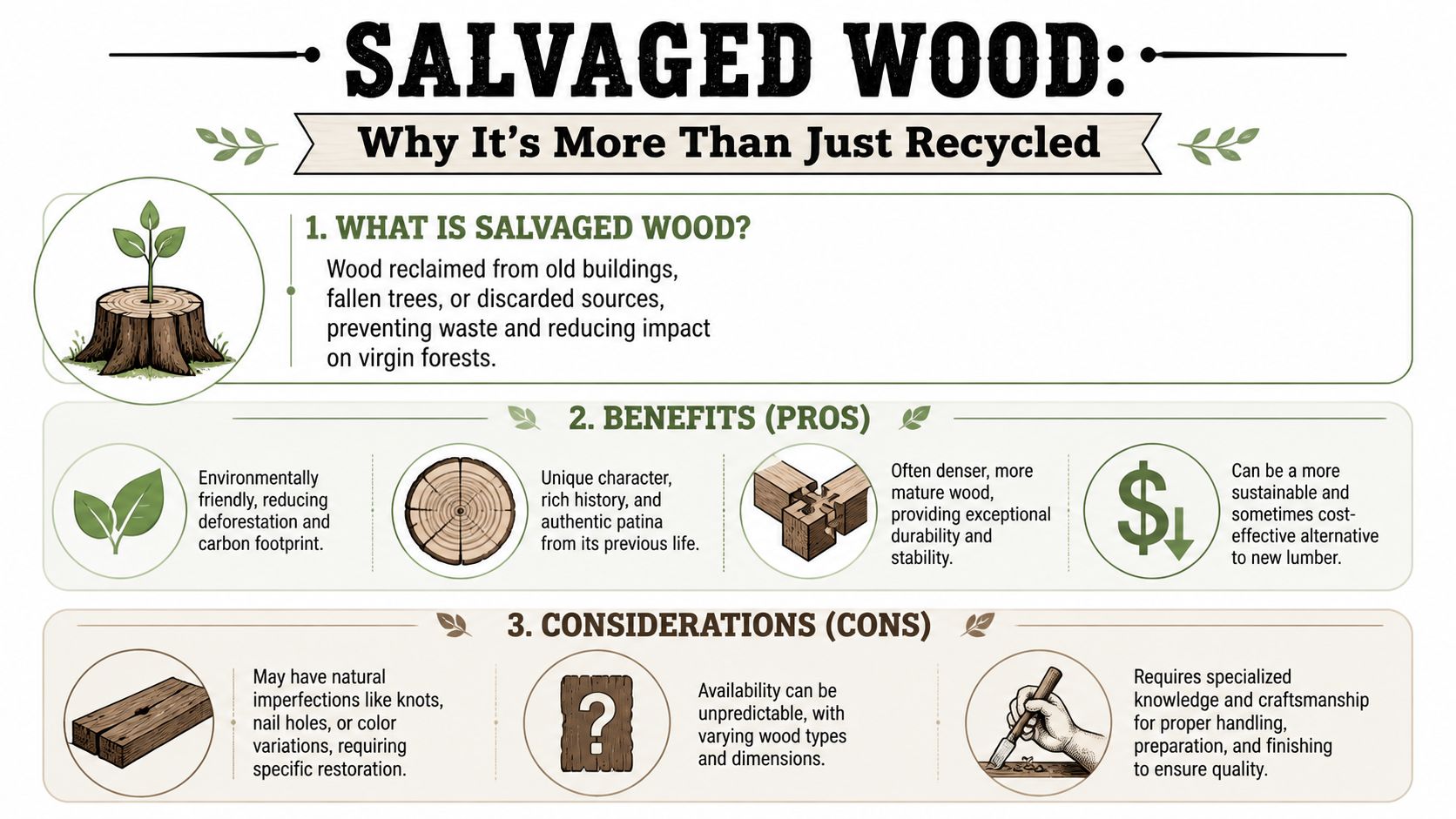
What Salvaged Wood Means and Why It Matters
People often confuse salvaged wood with furniture that has been distressed. They aren’t the same thing.
A distressed table is usually new wood that a maker has textured, stained, scraped, or rubbed to look older. A salvaged wood round dining table starts with wood that came from an earlier use. The marks are not theater. They’re evidence.
What counts as salvaged wood
The material may come from barns, factories, warehouses, fencing, or structural beams removed during demolition and recovery. A craftsperson then sorts, cleans, mills, stabilizes, and finishes it for furniture use.
That process is why good salvaged furniture doesn’t feel rough or unfinished, even when it keeps old saw marks or weathered patina. The best pieces preserve the right imperfections and remove the wrong liabilities.
A helpful analogy is this:
- Distressed furniture is like a new leather jacket made to look broken in.
- Salvaged furniture is like a vintage jacket that has already lived a life, then gets expertly restored so you can wear it for decades more.
Why old wood can outperform new wood
Age alone doesn’t guarantee quality. Proper preparation does. But well-sourced salvaged wood often begins with an advantage because it has already spent decades adjusting to real conditions.
Salvaged wood exhibits superior structural integrity because the timber has naturally seasoned over time, minimizing post-construction warping by up to 70% compared to new kiln-dried lumber, according to this reclaimed wood table reference from AptDeco. That matters in Ohio homes, where indoor conditions shift across the year.
What confuses many buyers is the difference between a board that looks old and a board that is stable. Those are separate questions. A beautiful top can still move badly if the wood wasn’t prepared, joined, and sealed correctly.
Practical rule: Ask how the wood was cleaned, acclimated, and finished, not just where it came from.
The real advantages
A salvaged wood round dining table offers value in several ways at once:
- Material character. Grain variation, nail traces, small checks, and tonal shifts make the piece impossible to duplicate exactly.
- Design flexibility. Salvaged tops work in farmhouse, industrial, transitional, and even cleaner modern rooms when paired with the right base.
- Environmental appeal. Reusing existing timber can reduce demand for newly harvested material.
- A sense of continuity. Some homeowners want furniture that feels rooted, especially in renovated or long-term family homes.
For buyers comparing wood species and long-term wear, this guide to choosing the right hardwood for longevity and style is useful because species, cut, and finish all affect how a table lives day to day.
The tradeoffs you should accept before you buy
Salvaged wood isn’t for someone who wants perfect uniformity. If matching grain and identical color from board to board are absolute requirements, you may be happier with another style.
Here are the usual points of tension:
| Consideration | What it means in real life |
|---|---|
| Character marks | You may see knots, old holes, grain variation, or slight surface irregularity |
| Higher upfront cost | The labor is heavier because the material needs more preparation and selective use |
| Inconsistent supply | You can’t always repeat a past table exactly because the source material changes |
| Finish sensitivity | The final result depends heavily on how thoroughly the wood was sealed and stabilized |
That last point is important. Salvaged wood rewards craftsmanship, and it exposes shortcuts. A weak finish schedule can turn a beautiful table into a maintenance headache. A proper build turns the same material into an heirloom.
Finding Your Perfect Fit A Style and Sizing Guide
A round table can rescue a room that never quite felt settled. I have seen dining spaces in older Central Ohio homes go from awkward to welcoming with one change in diameter. The reason is simple. A round table does not just fill square footage. It sets the rhythm for how people walk, sit, talk, and live around it.
With salvaged wood, that decision carries more weight, visually and practically. Old-growth boards often have deeper grain, richer color shifts, and thicker-looking profiles than mass-produced tops. In a room with winter dryness, summer humidity, boots by the door, and daily family traffic, the right size is not only about appearance. It is about leaving enough space for the table to age gracefully without turning every meal into a squeeze past chairs and walls.
Start with the room, not the table
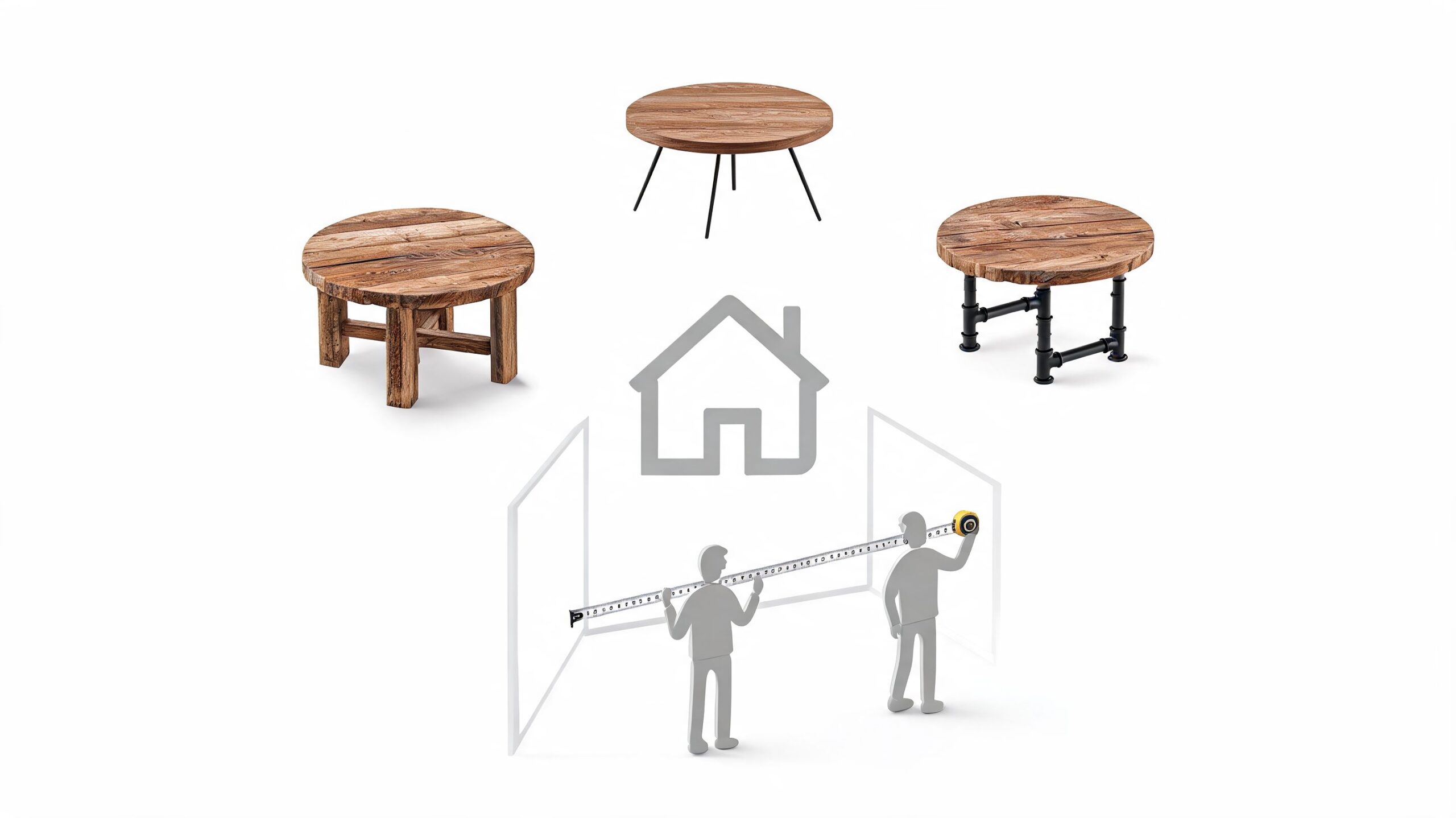
Designers often begin on the floor plan because the room tells you what the table is allowed to be. Measure the dining area first. Then account for pulled-out chairs, walking paths, nearby casework, and any doorway that swings into the space. A useful planning guideline is to leave about 36 inches around the table for chair movement and day-to-day traffic.
That clearance matters even more in homes where the dining area is also a passage between kitchen, mudroom, or patio. Central Ohio houses often have exactly that kind of overlap. On paper, a larger diameter may fit. In real life, it can feel like wearing a heavy coat in a narrow hallway.
A simple test works well:
- Measure the room width and length.
- Subtract circulation space on all sides.
- Mark the proposed table diameter on the floor with painter’s tape.
- Set chairs around the outline and pull them out fully.
- Walk the room during normal use, including paths to doors, cabinets, and windows.
Test the room as you live in it. A tucked-in chair is storage mode. A pulled-out chair is real life.
Matching diameter to everyday use
Size should follow the meals you host most often, not the largest gathering you might have twice a year. Smaller round tables usually feel best in breakfast nooks, apartments, and square dining rooms where movement matters as much as seating. Mid-size diameters often suit households that eat together daily and host guests occasionally. Larger round tables create a strong center of gravity, but they need a room that can support that presence without crowding the edges.
The table base changes the experience too. A pedestal base usually gives chairs more freedom and makes it easier to add one more guest when needed. A multi-leg or trestle-inspired base can feel more grounded and architectural, but chair placement becomes more fixed. That tradeoff is easy to miss in a showroom and obvious by the third holiday meal.
Round tables also future-proof a room in ways people do not always consider. If you expect children to grow into full-size chairs, plan to use larger host chairs later, or want discreet power access for laptops during homework and remote work, leave margin in the layout now. Good custom furniture should fit the life you have and the life that is slowly arriving.
Style depends on the base as much as the top
The top gets the attention, but the base often decides the table’s personality. The same salvaged wood surface can read as farmhouse, refined, industrial, or subtly modern depending on the shape below it and the edge treatment above it.
| Style direction | Typical visual cues |
|---|---|
| Rustic farmhouse | Thick-looking top, visible grain variation, softened edge, warm finish |
| Modern industrial | Cleaner circular top, darker tone, simplified or metal-accented base |
| Transitional | Controlled surface texture, refined edge, balanced pedestal form |
| Organic casual | Lighter finish, tonal variation, relaxed silhouette |
This is also where material history meets proportion. Heavy patina and strong saw marks bring a lot of visual energy. In a smaller room, pairing that kind of top with a quieter base usually creates better balance than stacking rustic detail on rustic detail.
If you’re comparing shapes before you settle on round, this guide to table shapes and seating arrangements for dining spaces explains how each format affects traffic flow and seating comfort.
Choose for the room you use on an ordinary Tuesday night. That is the version of your home that will get the return on this investment.
The Vinson Advantage Customizing Your Heirloom Table
A custom salvaged wood table earns its keep in the decisions you notice years later. The diameter feels right when chairs are pulled out. The finish still makes sense after you repaint the walls. The base leaves enough knee room for long dinners, homework, and a laptop on an ordinary Wednesday.
That is the main advantage of custom work. It lets an heirloom piece serve daily life with more precision.

The details that deserve custom decisions
Buyers often start with size and stain. Those matter, but they are only the outer layer. A salvaged top has its own history, and your job is to decide how much of that history you want to feel and see every day.
The surface is one example. Some owners love open saw marks, dark mineral streaks, and visible repairs because they read like chapters in the wood’s first life. Others want a calmer face that still shows age but sits more comfortably in a cleaner interior. Neither choice is more correct. It is the difference between hearing the full orchestra and hearing a smaller ensemble. Both can be beautiful, but they create different rooms.
The same principle applies to the edge and base.
- Top expression. More texture and patina create a stronger sense of age. A more refined face puts the focus on shape and proportion.
- Edge profile. A straight eased edge feels disciplined. A softened edge feels familiar and time-worn.
- Base format. Pedestal, trestle, and mixed-material bases change legroom, stability, and how heavy the table looks in the room.
- Finish sheen. Lower sheen hides fingerprints better and usually suits older wood. More sheen makes grain contrast more pronounced.
- Chair relationship. Seat height, arm clearance, and visual balance should be planned with the table, not after it.
In Central Ohio, those choices also affect how the table ages. Seasonal humidity swings can make wood move a little, even when the table is well built. A finish that is practical for daily use, and a construction method that allows natural movement, matter just as much as the color you choose on day one.
Why visualizers and design consultations help
Salvaged wood can be hard to judge from a small sample because each board behaves differently. One plank may carry warm brown undertones, while another has gray weathering or old nail shadows. A digital preview helps you compare proportion, finish direction, and base style before the piece is built.
For homeowners exploring custom solid wood dining tables, that preview does more than make the process easier. It reduces expensive guessing. You can compare the table against flooring, cabinet color, wall tone, and the chairs you already own.
An in-store design consultation adds another kind of clarity. Room photos, measurements, flooring samples, and even a paint swatch can answer questions that sound small but affect the result in a big way. Should the finish warm up a cool room? Will a pedestal help traffic flow? Will a low-sheen top be easier to live with if children use the table daily?
Those are design questions, but they are also investment questions.
Future-proofing a traditional material
A salvaged wood table should feel rooted, not outdated. That distinction matters more now because dining tables often work as command centers for modern homes. They host meals, school projects, remote work, and device charging in the same week.
That reality has pushed custom furniture in a more thoughtful direction. Hidden charging points, better cable management, and planned access to power can be built in without making the table look electronic. The best version of this work is almost invisible. It respects the age of the material while making room for current habits.
Other future-minded choices are less flashy and often more valuable. Height planning for aging in place, base designs that preserve chair flexibility, and structural decisions that support a heavy top through Ohio’s seasonal shifts all help the table remain useful for decades.
Vinson Fine Furniture offers this kind of custom-order process through its design studio, where clients can compare solid wood furniture options, configure dining sets, and work through practical decisions in person rather than trying to piece them together from disconnected showroom categories and search terms. The point is not shopping jargon. The point is getting one salvaged wood table built for one home, one climate, and one long life of use.
Understanding Price and Recognizing True Value
The price of a salvaged wood round dining table often surprises buyers the first time they compare it with a mass-produced import. On paper, both pieces may share the same diameter. In real life, they are built on very different assumptions about materials, labor, repairability, and how long they are expected to stay in service.
Old wood asks more of the maker before it ever becomes furniture. A craftsperson may need to remove embedded metal, trim around checks, stabilize weak areas, mill boards in a way that preserves character without sacrificing strength, and apply a finish that can handle daily use in a Central Ohio home with humid summers and dry winters. Much of the price lives in that judgment.
That is the part many shoppers cannot see at a glance.
What you are actually paying for
A well-made salvaged table usually carries four forms of value at once:
| Cost driver | Why it affects price |
|---|---|
| Recovered material | Salvaged stock is limited, inconsistent, and harder to replace than new lumber |
| Skilled preparation | Older boards need more inspection, sorting, and corrective work before they are ready for joinery |
| Joinery and engineering | A round top concentrates weight differently and needs a base that stays stable through years of use |
| Finishing time | The finish determines how well the table stands up to meals, spills, friction, and seasonal moisture change |
Wood species and age matter too, but hardness numbers only tell part of the story. A harder board can resist dents better, yet a table’s long-term performance depends just as much on drying, joinery, base design, and finishing. A salvaged top that was prepared carefully will usually handle plates, elbows, homework, and holiday serving pieces with more grace than a cheaper table built to hit a shipping price.
That is why price should be read the way a builder reads a foundation. You are not just buying the visible surface. You are buying what supports it year after year.
Premium price, longer horizon
A low initial price can be expensive over ten or fifteen years. If the top scratches easily, the finish fails, the base loosens, or the table looks tired after a few Ohio heating seasons, the replacement cycle starts much sooner than expected. A stronger table spreads its cost across a much longer stretch of daily life.
Good buyers usually ask practical questions, not trendy ones:
- Is the top thickness in proportion to the span and weight of the base?
- Was the table built to handle seasonal wood movement without opening joints or stressing the finish?
- Can the finish be renewed years from now, or is it a short-term coating?
- Will the shape and construction still work if the room, family, or use of the space changes?
Those questions matter because a dining table is one of the few pieces in a house that gets used hard, seen often, and kept for decades if it earns its place.
Value also includes what happens after the purchase. Clear care guidance, the ability to refinish rather than replace, and a maker who understands local climate conditions all strengthen the investment. If you want a practical reference point for ownership costs over time, this wood furniture care guide for long-term maintenance helps explain how routine care protects the finish and reduces avoidable repair work.
For cost-conscious buyers, there is nothing wrong with considering floor models or discontinued finishes if the construction is sound. The better question is whether the table was built to mature with the home. Salvaged wood earns its value there. It carries history, but it also needs to function on a Tuesday night, survive January dryness, and still feel worth passing down years from now.
Caring for Your Table A Lifetime of Beauty
The day your table arrives isn’t the finish line. It’s the start of ownership.
A salvaged wood round dining table is durable, but it isn’t indifferent. Wood still reacts to sunlight, dryness, moisture swings, and the kind of repeated use family furniture gets. Good care doesn’t need to be complicated. It just needs to be consistent.
Daily habits that prevent major problems
Most routine care comes down to restraint. Don’t over-clean. Don’t soak. Don’t let residue build.
A simple maintenance pattern works well:
- Dust with a soft dry cloth so grit doesn’t act like fine sandpaper.
- Wipe spills promptly rather than letting moisture sit at seams or along grain lines.
- Use a damp cloth sparingly for sticky spots, then dry the surface.
- Place felt under decor that stays in one place for long periods.
- Rotate accessories so the top ages more evenly in light.
For a broader maintenance reference, this wood furniture care guide covers the basics homeowners often overlook.
Why Central Ohio conditions matter
In Columbus-area homes, the indoor environment changes with the seasons. Summer humidity and winter dryness can stress any wood table, especially one that wasn’t finished carefully.
A 2025 study found that 28% of improperly sealed reclaimed tables showed expansion cracks after two years in moderate humidity, according to this reclaimed table humidity reference. The lesson isn’t that reclaimed wood is risky. The lesson is that finishing quality is not optional.
That’s where buyers get confused. They assume old wood is automatically stable forever. It isn’t. Better starting material still needs expert sealing and sound construction.
What to ask before and after purchase
If you’re choosing a table for long-term use, ask practical questions:
- How was the wood stabilized before assembly?
- What kind of topcoat was used?
- Is the finish easy to refresh if surface wear develops?
- What should you use, and avoid, for regular cleaning?
- Where should the table sit relative to vents, windows, and strong sun?
Keep the table away from extreme heat sources and direct HVAC blast zones. Most wood problems begin with repeated environmental stress, not one dramatic event.
Minor scratches are part of a lived-in dining surface. Some owners prefer to let them accumulate as patina. Others want periodic touch-up. Both approaches are valid. The right choice depends on whether you want the piece to look carefully preserved or gracefully used.
Either way, maintenance should protect the table’s function first. Beauty follows from that.
The Final Step Bringing Your Vinson Table Home
A substantial dining table should feel exciting to buy, not stressful to coordinate. That’s especially true when the piece is customized, heavy, and intended to stay in the home for a long time.
Financing can remove one kind of hesitation. Flexible financing through Synchrony HOME gives many households a way to align a long-term furniture purchase with the rest of their renovation or furnishing budget. For buyers who are investing across multiple rooms, that matters.
Delivery removes another kind of friction. White-glove in-home delivery is different from curbside drop-off because the service continues past the truck. The table is inspected, brought into the room, assembled, placed, and cleared of packaging. That process matters with a salvaged wood round dining table because top weight, base alignment, and final positioning all affect the finished experience.
The purchase also becomes easier when the showroom can support different priorities at once:
- Customization through the Custom Order Program, with choices in finishes, configurations, and visualizer support
- Design help through the In-Store Design Studio and complimentary consultations
- Value protection through the 110% refund low price guarantee if a lower local authorized price is found within the stated policy window
- Immediate opportunity through the Clearance Gallery, where savings can reach 70% off
- Convenience through flexible financing and white-glove delivery
That combination is why many homeowners still prefer to shop in person for a dining table. They want to touch the surface, compare finish tones under real lighting, and understand scale before committing.
If your goal is a long-term piece that feels grounded, practical, and personal, the Easton showroom experience makes sense. A dining table isn’t only a purchase. It’s a decision about how your home will gather people for years.
If you’re ready to compare finishes, test scale in person, or talk through custom options for a salvaged wood round dining table, visit Vinson Fine Furniture at Easton Town Center. The showroom offers complimentary design consultations, a custom order process with 3D visualizers, clearance savings, flexible financing, and white-glove delivery for homeowners who want furniture that’s built to stay.