The Buyer’s Guide to Leather Furniture Made in USA


The most common advice about leather furniture made in USA sounds reassuring but stops too early. Buyers are often told to look for the label, trust the story, and assume the rest takes care of itself.
That shortcut doesn't protect a household from a weak frame, a thin hide, or a vague supply chain. A serious furniture purchase deserves better questions. It deserves attention to the wood under the cushions, the cut of the leather, the joinery inside the arms, and the way the piece feels when someone sits, swivels, reclines, and lives with it.
For Columbus homeowners furnishing for the long haul, that distinction matters. The search for American-made furniture often begins with pride in domestic craftsmanship, but it should end with something more practical: confidence that the piece is built for daily use, built with clarity, and built to age well in a real home.
Table of Contents
- The Enduring Appeal of American Craftsmanship
- Decoding the Made in USA Label
- The Foundation of Quality Solid Hardwood Construction
- A Buyer's Guide to Leather Grades and Types
- Experience Unrivaled Comfort and Engineering
- Tailor Your Furniture Your Way at Vinson
- Investing in Value and a Lifetime of Use
The Enduring Appeal of American Craftsmanship
The appeal of American craftsmanship isn't hard to understand. A well-made leather sofa has presence. The arm feels firm under the hand. The seat has depth without sag. The leather carries natural variation instead of a flat, plastic-looking surface. The frame underneath feels substantial, not hollow.
That instinct toward quality is showing up in the market. The U.S. leather furniture market is projected to reach USD 13,383.68 million by 2029, growing at a CAGR of 7.3%, according to Data Bridge Market Research's U.S. leather furniture market outlook. Buyers are still willing to invest in pieces that promise durability, comfort, and craft.
Why the label still matters
“Made in USA” remains a useful starting point because it often points toward stronger factory oversight, regional furniture-making traditions, and a higher expectation of fit and finish. It also tends to attract shoppers who care about heirloom quality rather than disposable styling.
In Central Ohio, that mindset fits the way many homeowners shop. They aren't just filling square footage. They're choosing the sectional where family gathers, the swivel chair that gets used every evening, or the leather recliner that becomes the favorite seat in the house.
Practical rule: The label should start the conversation, not finish it.
What thoughtful buyers look for next
A smart shopper looks past the tag and into the structure. That means checking how the sofa sits on the floor, whether the arms flex, how the leather is fitted around corners, and whether the frame feels dense and settled instead of light and springy.
It also means learning which makers still build with a strong furniture-making heritage. A helpful starting point is this guide to American-made furniture brands, which helps buyers sort through names and understand what craftsmanship looks like in practice.
The appeal of leather furniture made in USA isn't patriotism alone. It's the chance to buy something with substance, something that feels grounded the moment someone touches the wood, runs a hand across the leather, and notices that the details were handled by people who expected the piece to last.
Decoding the Made in USA Label
The phrase sounds simple. It usually isn't.
Many shoppers assume that if a leather sofa is described as American-made, the hide, frame, foam, labor, and final construction all come from the United States. That assumption often leads to disappointment because the furniture industry uses the phrase in ways that don't always match what buyers picture.
Assembly is not the same as sourcing
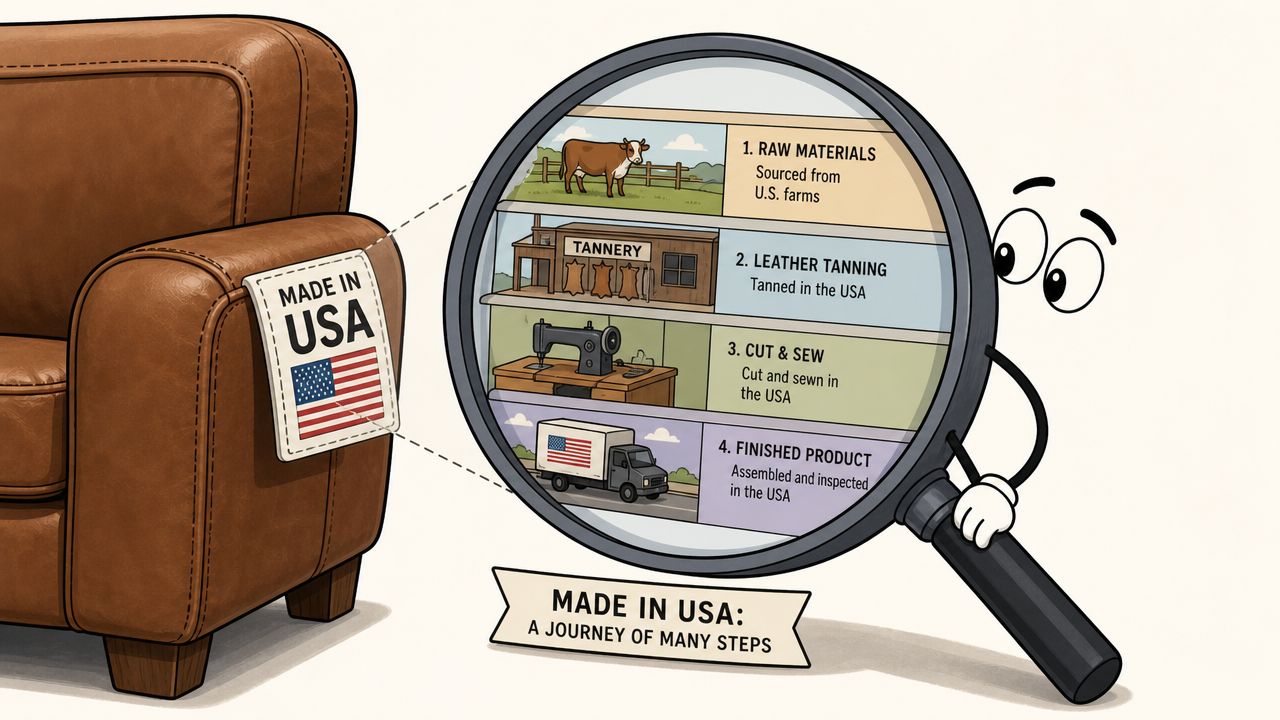
A product may be designed in the United States, assembled here, or finished here while still using globally sourced materials. That doesn't automatically make it a poor product. It does mean the label alone doesn't answer the question most buyers are asking.
As noted in Hydeline's FAQ page, many consumers assume “American-made” leather furniture guarantees 100% U.S.-sourced hides, but top brands often use globally sourced materials and assemble in Asia or design in the U.S. for overseas production. This creates a critical transparency gap about material origins.
That gap matters because leather quality depends on more than where the last staple went in. Hide selection, tanning quality, consistency of cutting, and frame construction all shape how the piece will wear in a living room over time.
Questions worth asking in the showroom
The clearest path isn't suspicion. It's precision. Buyers should ask direct questions and expect direct answers.
- Ask about the hide origin. “Was the leather sourced domestically, imported, or mixed?”
- Ask about the frame build. “Where was the frame made, and what hardwood species is used?”
- Ask what happened where. “Was this piece designed, cut, sewn, assembled, and upholstered in the same country?”
- Ask for language beyond the tag. “When the label says made in USA, what specifically does that refer to?”
Buyers don't need a dramatic sales pitch. They need a straight explanation of sourcing, construction, and finishing.
Here, many people get confused. They think the answer has to be all or nothing. In reality, leather furniture made in USA can still be a strong purchase when the brand is transparent and the build quality is there. The problem isn't global sourcing by itself. The problem is vague wording that prevents a buyer from knowing what they're paying for.
A clear showroom conversation turns the label into something useful. It separates symbolic marketing from tangible quality.
The Foundation of Quality Solid Hardwood Construction
A leather sofa can look refined on the outside and still fail where it counts. The frame decides whether the seat keeps its shape, whether the back stays square, and whether the whole piece still feels steady years later.
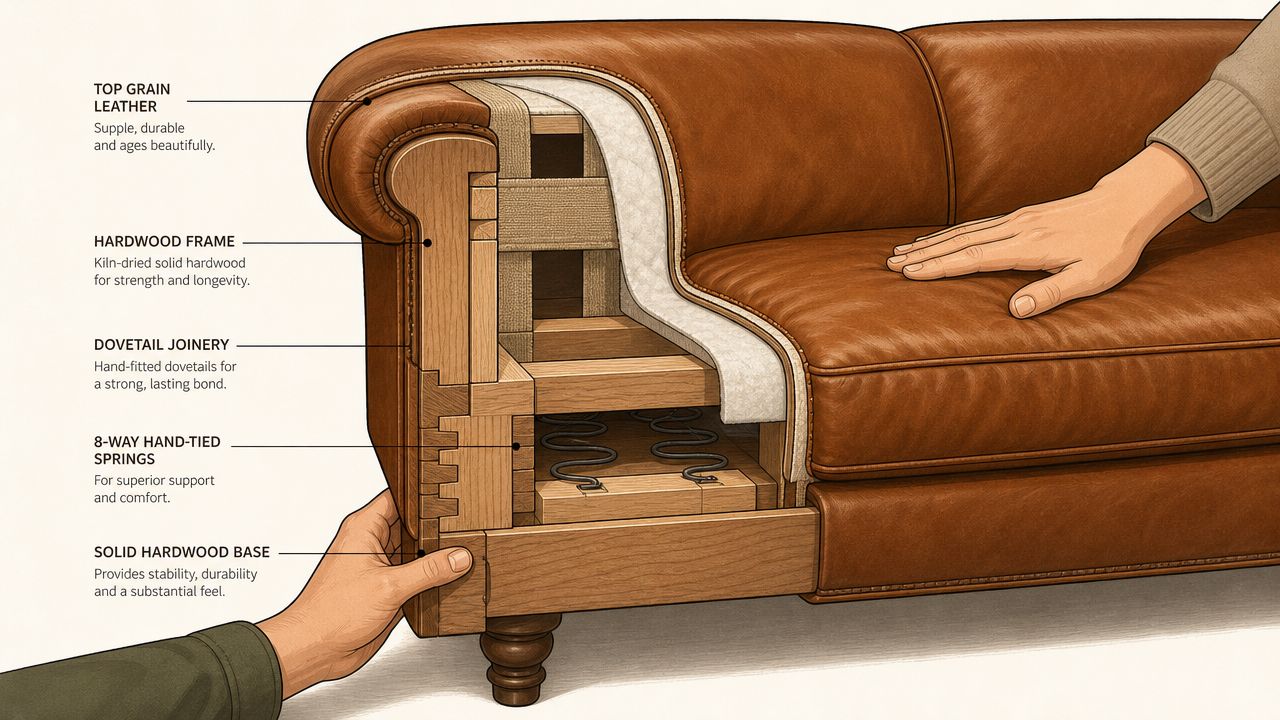
That's why solid hardwood matters so much. Solid cherry, oak, maple, and walnut bring a different kind of confidence to furniture. There's weight to them. There's resistance when pressure hits the arms or back. The piece doesn't feel flimsy when it's moved across the floor or used hard by a busy household.
What the frame should feel like
Good construction can often be felt before it's fully understood. A sofa with a solid hardwood frame usually sits with more authority. The base feels planted. The arms don't wobble. The back doesn't shift when someone leans into it.
That physical stability matters in seating, but it also shows up in Amish-made dining sets and bedroom pieces. A solid maple or solid oak case piece has density and calm. Drawers track with a smoother, more settled feel. Tabletops carry the kind of visual depth that only real grain can deliver.
For buyers who want to recognize construction clues, this overview of wood joints in furniture helps connect visible craftsmanship to long-term performance.
Joinery that holds for the long term
The strongest pieces don't rely on surface appearance. They rely on joinery. According to this guide to quality wood furniture construction, high-quality wood furniture construction is verified by the presence of mortise-and-tenon joints and dovetail joints, which create virtually unbreakable connections superior to standard glue or screw methods.
That language matters because these joints aren't decorative jargon. They solve real problems.
- Mortise-and-tenon joints lock structural members together in a way that resists racking and loosening.
- Dovetail joints help drawers stay tight and square through repeated opening and closing.
- Solid hardwood rails and posts support upholstery tension without the frame twisting out of shape.
A leather seat can only wear beautifully if the frame beneath it stays true.
For homeowners shopping solid wood furniture Ohio families can live with for years, the hardwood standard isn't a niche preference. It's the backbone of the investment. It's also why Amish-made dining sets and Mavin bedroom furniture continue to stand out. Their appeal comes from what the hand feels at the edge of a tabletop, what the eye sees in the grain, and what the structure keeps doing long after trends have moved on.
When buyers test furniture in a showroom, the hidden build should be treated as seriously as the visible style. Good leather needs a serious frame under it. Otherwise, the furniture starts aging before the leather ever gets the chance to develop character.
A Buyer's Guide to Leather Grades and Types
Leather can confuse even careful shoppers because the terms sound similar while the results feel very different. The easiest way to sort it out is to pay attention to touch, surface character, and the kind of aging a household wants.
Top-grain leather usually feels smooth, substantial, and slightly warm to the hand. It tends to show more natural variation than heavily corrected surfaces, and it often develops character with use instead of just looking worn. Performance leathers can add practical protection for active homes while still maintaining a refined, upscale look.
What premium leather should tell the hand
A quality hide shouldn't feel paper-thin or overly slick. It should have body. It should flex rather than wrinkle in a brittle way. Premium hides also carry measurable standards. According to this summary of premium American-made leather specifications, they include a minimum thickness of 1.8–2.2 mm, pH neutrality of 6.5–7.0, and zero VOC emissions under 10 ppb, which helps prevent cracking or odor retention.
That matters for everyday living. A living room in Columbus sees heat in winter, humidity in summer, and constant seat use all year. Leather that holds moisture balance and resists off-gassing is easier to live with and more pleasant over time.
For buyers comparing surface types, this explainer on the difference between top-grain and full-grain leather gives useful context before a showroom visit.
Leather Grade Comparison
| Leather Type | Characteristics | Best For | Vinson's Recommendation |
|---|---|---|---|
| Top-grain leather | Smooth, refined surface with a buttery hand and natural variation | Main living areas, sectionals, everyday family seating | A strong fit for Custom leather sectionals Columbus homeowners want to use daily |
| Full-grain leather | More natural markings and a more organic appearance | Buyers who want visible character and a less uniform look | Worth considering when texture and patina matter more than a highly polished surface |
| Performance leather | Designed for easier day-to-day care while keeping a soft, tailored feel | Active households, frequent entertaining, shared family rooms | A practical choice for homes that need resilience without losing sophistication |
| Split leather | Often less substantial in feel and typically used where lower durability is acceptable | Secondary applications rather than high-demand seating areas | Better approached carefully when the goal is heirloom use |
A quick hand test helps. Press the seat, run fingers across the arm, and look for natural depth rather than an overly uniform finish. In a bench-made piece, the leather should feel like part of the structure, not a decorative skin stretched over something ordinary.
Smith Brothers furniture Easton shoppers often notice this first through touch. The difference is rarely abstract. It's in the softness, the density, and the way the leather responds when someone sits down.
Experience Unrivaled Comfort and Engineering
Comfort isn't only about cushions. It's also about mechanism quality, balance, and the way a moving chair behaves after repeated use. A well-engineered motion piece feels controlled from the first inch of movement to the last.
That's especially important in sectionals, recliners, swivel chairs, rockers, and gliders. These pieces ask more of the frame and more of the internal hardware than a stationary sofa does. When the engineering is right, the motion feels smooth and quiet. When it isn't, the furniture starts to announce itself with stiffness, drift, or uneven support.
Why motion quality changes daily use
A premium power recliner should move with a settled, deliberate rhythm. The footrest should rise without jerkiness. The back should support the body through the motion rather than dropping away from it. A swivel chair should return with composure, not with a loose, spinning feel.
For households considering sectionals with power features, this guide to types of power reclining seating helps translate showroom terminology into practical decisions.
Motion furniture also changes how a room works. A leather sectional with reclining seats can anchor a family room without looking bulky when the proportions are right. A swivel accent chair makes conversation easier and keeps sightlines flexible. A rocker or glider adds a gentle, balanced movement that many people end up using far more than expected.
Good motion furniture doesn't call attention to the mechanism. It lets the person notice comfort instead.
What to test before bringing it home
The sit-test matters more here than in almost any other category. Buyers should take their time and check how the furniture behaves in real use.
- Recline fully. The body should feel supported at the lower back, shoulders, and legs.
- Shift positions. The seat shouldn't create pressure points when someone moves from upright conversation to relaxed lounging.
- Test the controls. Power features should feel intuitive and consistent.
- Listen closely. Premium motion should operate with minimal sound, allowing the mechanism to fade into the background.
- Check the landing. When returning upright, the chair or sectional should settle smoothly rather than snap forward.
For leather furniture made in USA, strong motion engineering can be one of the clearest differences between a piece that merely looks good on the floor and one that still delivers comfort years later. The hardware matters. The frame matters. The tailoring around those moving parts matters just as much.
Tailor Your Furniture Your Way at Vinson
A “Made in USA” label does not help much if the piece still fits your room poorly, blocks a walkway, or shows a leather color that looked better under showroom lights than it does at home. Good custom ordering closes that gap. It turns broad labels and sample swatches into decisions you can test against your actual space.
At Easton Town Center, the stronger buying approach starts with the room itself. Measure the wall. Note where daylight hits. Pay attention to how people really move through the space on a normal evening. A sectional is not just a shape on paper. It sets traffic flow, changes how open the room feels, and determines whether the seat you use every day feels inviting or slightly off every time you sit down.
Customization works best when it starts with the room
The in-store design process helps buyers make those choices with something firmer than guesswork. Complimentary consultations give you a place to compare scale, layout, finish, and upholstery before an order is placed. That matters because a leather sofa can feel very different in a home with warm afternoon sun than it does under showroom lighting, and a wood finish that looks rich beside one sample may fight the tone of your flooring once it is in the room.
The custom order process gives shoppers a clearer path from measurements and samples to a piece that perfectly fits the house. It is especially useful when you want to choose among leather options, wood finishes, and configuration changes without losing sight of construction quality.
How to make a custom order more precise
The useful question is not, “Can I change the color?” The better question is, “What changes will improve daily use without hiding weak construction or vague sourcing?” That distinction matters. Some retailers talk about options because options sound impressive. The smarter showroom conversation asks where the leather comes from, how the frame is built, and whether the version being ordered keeps the same standard as the floor sample.
Digital visualizers can help here. They work like a dress rehearsal for the room. You can compare a warmer brown against a cooler tone, test whether a sectional corner crowds an entry path, or see if a darker leather adds depth or absorbs too much light.
A careful custom order often includes:
- Configuration choices that fit real traffic patterns, not just the empty outline of a room
- Finish selection that respects nearby wood tones instead of competing with them
- Leather choices based on feel, grain, and expected wear in your household
- Coordination across rooms so bedroom, dining, and living pieces relate naturally without looking copied
Vinson Fine Furniture includes an in-store design studio, complimentary consultations, and a custom order program that helps shoppers sort through those decisions in person. That is where the “Made in USA” conversation becomes more useful. You can ask whether the piece is built here, assembled here, or finished here, then compare those answers with what you can see and feel on the floor.
After the order is placed, care still matters. Buyers who want to protect the surface over time can use these effective leather furniture cleaning tips to keep the leather clean without overworking it.
Investing in Value and a Lifetime of Use
A low price can hide an expensive mistake.
Real value in leather furniture shows up after years of daily use, when cushions still support well, the frame stays quiet, and the leather looks lived in rather than worn out. That is the part the "Made in USA" label can blur if you do not slow down and ask what was made here, what was only assembled here, and what quality standards back up the claim.
A well-built piece feels honest in the room. The hide has texture and depth under your hand. The arms do not wobble when you lean on them. The seat returns support instead of sinking and staying there. Good furniture behaves like a house with a sound foundation. You may not stare at the structure every day, but you feel the difference every time you use it.
Value is measured in years of satisfaction
The better question is not the number on the tag. The better question is what that number buys.
For leather seating, that means looking past color and style and checking the parts that carry the load: the hardwood frame, the joinery, the suspension, the cushion construction, and the grade of leather wrapping it all. A handsome sofa built on a weak frame is like a solid wood door hung on cheap hinges. It may look right on day one and feel wrong soon after.
Long-term value also includes care. Buyers who want to protect the surface over time can use these effective leather furniture cleaning tips for regular upkeep that keeps the leather clean without overworking the finish.
The best furniture purchases become more satisfying as the home grows around them.
Smart savings without lowering standards
Saving money and buying well can happen at the same time, but only when the lower price does not come from hidden compromises. Clearance pieces, floor samples, and policy protections can make a stronger piece more attainable, especially if you confirm that the construction and leather specifications match what you expect.
That is where showroom knowledge matters. Ask whether the floor model and the ordered version share the same frame, leather category, suspension, and cushion build. Ask whether "Made in USA" refers to full domestic manufacturing or domestic assembly using imported materials. Retailers do not always volunteer that distinction, yet it shapes how much confidence you should place in the label.
For Central Ohio shoppers, that kind of careful buying can lead to solid wood dining furniture, custom leather sectionals, and motion seating that fit the home without giving up the traits that make furniture worth keeping. White-Glove Delivery matters here too. Careful placement and setup help protect corners, legs, leather surfaces, and moving parts at the moment the piece enters the house.
Vinson Fine Furniture gives shoppers a place to make those comparisons in person. You can test motion, study leather by touch, inspect wood construction up close, and ask the questions that separate a piece built to last from one that only looks convincing on the showroom floor.