Amish Made Dining Table: Quality & Lasting Value

A lot of homeowners start looking for a new dining table only after the old one has already failed them. It rocks when someone leans on it. The finish shows every spill. The corners are chipped, the top is scratched, and it no longer feels right for the home around it.
That moment matters because a dining table does more than fill a room. It holds school projects, weeknight dinners, holiday meals, and long conversations after the plates are cleared. If you're choosing a piece for a Central Ohio home you plan to stay in, it makes sense to look beyond short-term convenience and toward something permanent.
An amish made dining table fits that decision differently than mass-market furniture. It isn't built to survive a move or two. It's built to become part of the house and, often, part of the family story. The value isn't only in how it looks on delivery day. The value is in how it holds up year after year.
Your Guide to Choosing a Lifelong Dining Table
It's easy to spot a poor dining table. You can feel it the moment you sit down.
The top flexes. The legs loosen. The finish looks tired much sooner than expected. What confuses buyers is the next step. They know they want something better, but they aren't always sure what "better" means.
Start with three questions.
- How hard will this table work? If your table handles daily meals, homework, entertaining, and holiday hosting, you need structure, not just style.
- How long do you want to own it? If the honest answer is "for decades," that changes what materials and construction make sense.
- Will your needs change? Families grow, guests come over, homes evolve. A table should adapt without feeling temporary.
A lifelong table usually has four traits.
- Solid hardwood construction instead of particleboard or veneers.
- Joinery that stays tight through daily use and seasonal changes.
- A shape and finish you won't tire of after trends shift.
- Customization options so the table fits your room and routine.
If you're sorting through those choices for the first time, it helps to begin with a grounded overview of solid wood dining tables. Once you understand how materials and build quality affect real-world use, the category gets much easier to manage.
The right dining table shouldn't ask you to compromise between daily practicality and long-term beauty. It should do both.
The Soul of Amish Craftsmanship What It Really Means
"Amish-made" gets used as a label, but it means more than rustic styling or a farmhouse look. It points to a way of building furniture that puts material quality, handwork, and longevity ahead of volume.

Built in woodworking communities with long memory
Amish woodworkers are concentrated in Pennsylvania, Indiana, and Ohio, where skills are often passed through generations rather than treated as a short production job. In a global furniture market that generated $1.3 trillion in 2020, Amish-made furniture remains a distinct niche focused on handcrafting, solid American hardwoods, and avoiding particle board entirely, as noted in this overview of Amish tables and American hardwood construction.
That origin matters because it shapes the result. Smaller workshops tend to build with accountability. The person selecting the wood, shaping the parts, and finishing the table is much closer to the final product than in a high-volume factory.
No two pieces are exactly alike
This is one of the first places buyers get confused. They hear "custom" and assume it means decorative extras. In Amish furniture, customization often starts earlier.
It can mean:
- Selecting the wood species for the look and wear profile you want
- Choosing the stain or finish that fits your room
- Adjusting the size or base style so the table fits the way you live
- Accepting natural variation in grain, color, and figure as part of the beauty
That last point is important. A solid-wood table isn't supposed to look printed or perfectly uniform. Grain movement, mineral streaks, and subtle color shifts are part of what make the piece feel authentic rather than manufactured.
Practical rule: If every board looks identical, you're usually not looking at the kind of character people buy solid hardwood for in the first place.
For readers who want to compare makers and understand where handcrafted domestic furniture fits in the broader market, this guide to American made furniture brands is a useful next step.
Built to Last The Engineering of an Heirloom Table
Craftsmanship sounds good in theory. Engineering is what proves it.
A serious dining table has to survive repeated force from all directions. People lean on edges. Children drag plates across the top. Chairs bump into the apron. Central Ohio homes go through dry winters and humid summers. If a table isn't built for movement and stress, it loosens over time.

Why mortise-and-tenon matters
The phrase sounds technical, but the concept is simple. One piece of wood is shaped to fit precisely into another, creating a mechanical lock instead of relying mostly on screws or nails.
That changes how the table behaves over time.
Mass-produced furniture often depends on fasteners that can loosen as the wood shifts and daily use creates tiny movements at the joints. Amish-made tables commonly use mortise-and-tenon joinery with solid hardwood construction and 1-inch thick tabletops, which is why this construction approach is associated with furniture that can last 50+ years, compared with 10-15 years for conventionally built tables, according to this explanation of Amish dining table joinery and longevity.
If you're visual, think of it this way. A screw grips at a few points. A mortise-and-tenon joint spreads force across shaped wood surfaces that were designed to hold together.
Thickness and material are part of the structure
A thick solid top doesn't just look substantial. It adds stability and gives the table more mass to resist flexing.
Many buyers accidentally compare unlike products. Two tables may look similar online. One may use solid hardwood through the top and base. Another may use a thinner top, veneer, or lighter internal construction. The photos won't tell you much. The weight, the feel of the edge, and the way the base meets the apron tell you a lot.
What to inspect in person
If you're evaluating an amish made dining table, check these details closely:
- Under the top: Look for clean joinery and substantial support, not thin parts hidden by finish.
- At the legs or base: Push gently from the side. A quality table should feel planted.
- Along the edge: Solid wood has depth and authenticity that printed surfaces can't imitate.
- Across the full length: Longer tables need smart support so they don't sag or feel unstable.
For a closer look at the woodworking principles behind durable furniture, this breakdown of wood joints helps connect what you see in the showroom to how the piece will perform at home.
A durable dining table isn't "heavy-duty" because it feels bulky. It's durable because every connection has been designed to stay sound under normal family life.
Choosing Your Forever Table Wood Types and Finishes
Once you've decided to buy solid wood, the next question is usually harder. Which wood should you choose?
Many first-time buyers often feel stuck. They like the idea of hardwood, but they aren't sure how oak differs from cherry, or whether walnut is better than maple for a busy household. The easiest way to think about it is this: wood choice affects appearance, character, and everyday wear.

How to read wood choices correctly
Amish dining tables are commonly offered in hardwoods such as brown maple, quartersawn white oak, cherry, and walnut, chosen for strength and beauty. These woods support the classic, heirloom quality people want from a long-term piece, and cherry has been noted as a consistent favorite among buyers in this article on hardwoods used in Amish furniture.
A wood species isn't just a color. It also shapes the mood of the room.
- Oak feels grounded and traditional.
- Quartersawn white oak brings more pattern and visual texture.
- Cherry reads warmer and more refined.
- Maple looks cleaner and quieter.
- Walnut has a darker, more polished presence.
Solid Hardwood Comparison for Your Dining Table
| Wood Type | Key Characteristics | Best For |
|---|---|---|
| Oak | Visible grain, classic look, takes stain well | Family dining rooms, mission and traditional spaces |
| Quartersawn White Oak | Distinctive grain figure, premium character, timeless presence | Craftsman interiors, statement tables, heirloom styling |
| Cherry | Smooth grain, warm tone, classic appeal, popular with buyers | Formal dining rooms, transitional homes, elegant everyday use |
| Maple | Fine, subtle grain, clean appearance, strong everyday look | Contemporary rooms, lighter palettes, high-use households |
| Walnut | Naturally dark tone, rich grain, sophisticated look | Statement pieces, upscale interiors, rooms needing warmth and depth |
Finishes are not just cosmetic
A good finish does two jobs. It sets the tone of the piece and it protects the wood beneath.
Samples are especially important. The same stain can look different on cherry than it does on oak because the grain structure absorbs color differently. A light finish on maple can feel fresh and modern. A darker stain on oak can feel more traditional and architectural.
When buyers visit a showroom, I encourage them to compare wood and stain together, not separately.
- Natural finishes let the species speak for itself.
- Medium stains add warmth without hiding grain.
- Dark finishes create more drama and formality.
- Distressed options soften the look and mask everyday wear visually.
For a more detailed guide to species, performance, and style fit, see choosing the right hardwood for longevity and style.
Don't choose wood only with your eyes. Choose it with your household in mind. The right species should suit your room on a quiet Tuesday, not just during a staged holiday photo.
Designing Your Perfect Fit Styles Sizing and Customization
A Columbus homeowner buys a dining table that looks perfect under showroom lighting, then gets it home and finds that chairs catch the wall, the base blocks knees, and holiday guests feel squeezed. That usually is not a quality problem. It is a fit problem.
Fit decides whether a table serves your house for decades or becomes an expensive compromise. For a piece meant to last a generation or more, size and configuration matter just as much as craftsmanship.
Understanding the main table styles
Style is not only about appearance. It changes how the table works.
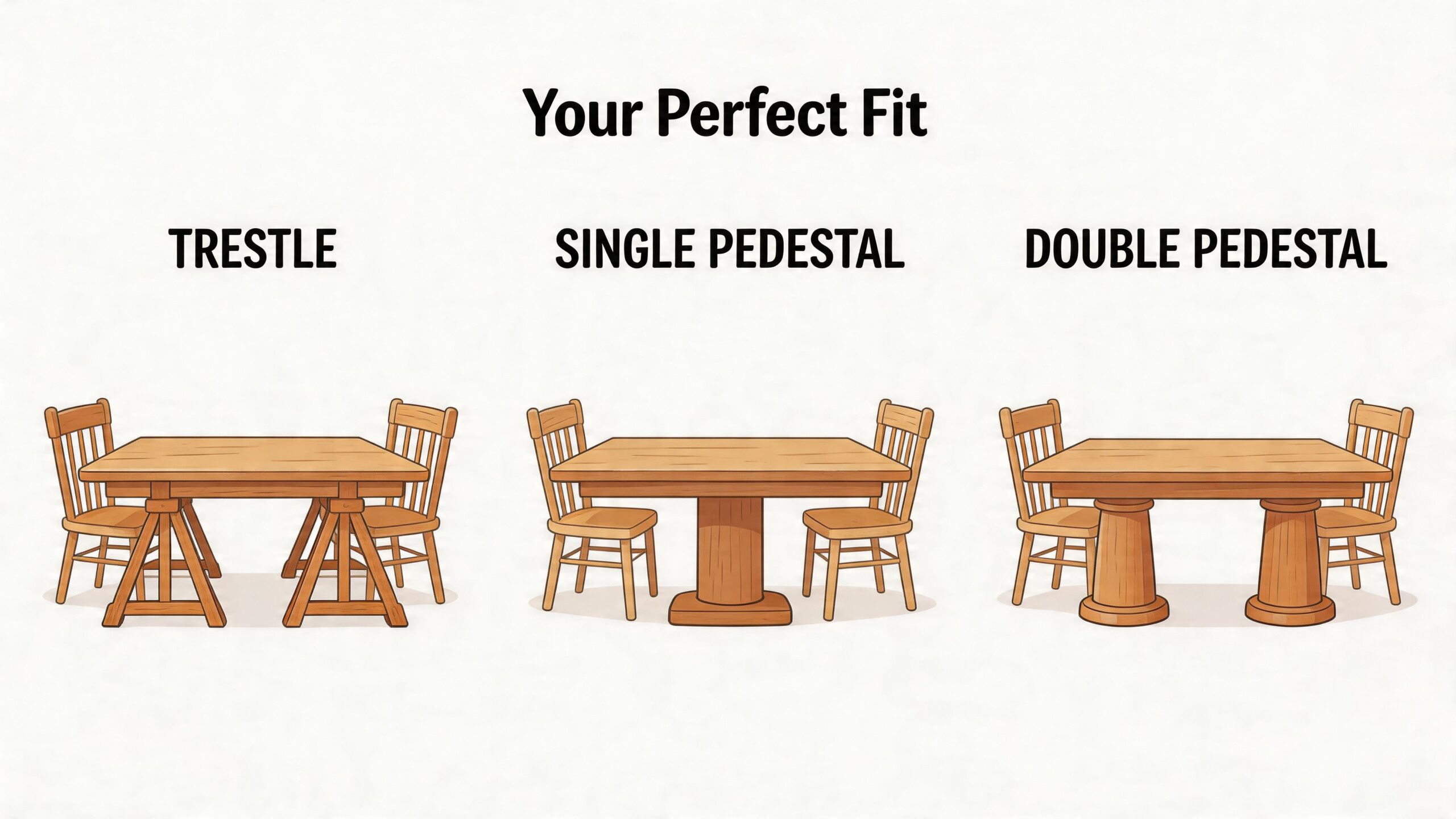
Trestle tables place support near the center, which usually gives diners better legroom and makes it easier to shift chairs as needed. They also carry visual weight well in longer rooms.
Single pedestal tables suit round tops and smaller dining areas because there are no corner legs competing with chair placement. If your room has tighter walkways, that freedom can make daily use much easier.
Double pedestal tables often fit larger tops and more formal spaces. The design brings balance, but it also asks for enough room so the base does not feel crowded.
Leg tables are familiar for a reason. They are straightforward, adaptable, and often a good match for casual or transitional spaces. The tradeoff is simple: corner legs define exactly where seats can go.
A good way to compare these styles is to picture parking spaces in a garage. Two layouts may hold the same number of cars on paper, but one is far easier to use every day. Dining tables work the same way.
Leaves solve a real household problem
Many households do not need a large table every day. They need one table that can grow when the guest list does.
Extension leaves are often the difference between a room that feels open most of the year and a room that stays overcrowded just to prepare for a few gatherings. As noted earlier, Amish builders are especially strong in this area because extension systems are usually designed as part of the table, not added as an afterthought.
That matters financially too. One well-sized expandable table often costs less over time than buying a too-small everyday table, then adding a second surface or replacing it when your needs change.
Customization turns a good table into the right table
Small specification changes have a large effect on comfort and longevity of use. A table that is a few inches too wide can tighten traffic flow every single day. A base chosen without thinking about chair count can limit seating for as long as you own the piece.
For buyers comparing custom kitchen and dining tables, focus on whether you can adjust the details that affect daily life, not just choose from a few preset stains.
Look closely at options such as:
- Overall dimensions, so the table fits the room and leaves comfortable walking space
- Shape, based on how your household eats and entertains
- Base design, which affects legroom, chair placement, and visual weight
- Edge profile, which can make the top feel more formal, softer, or more substantial
- Number and type of leaves, so expansion matches real hosting needs
- Finish coordination, especially if the table sits near flooring, cabinetry, or existing case goods
A practical path is to work with a retailer that offers finish samples, clear specification choices, room-planning help, and a way to confirm scale before ordering. Vinson Fine Furniture offers customizable dining collections, which is useful for buyers trying to match a table to a specific Columbus home rather than forcing the room to adapt to a standard size.
The goal is simple. Buy once, size carefully, and avoid paying later for a table that never quite worked.
Investing in Quality Understanding Value and Price
A Columbus homeowner may look at a $700 dining table and a $3,200 Amish-made table and wonder how the higher number could possibly be the practical choice. That question makes sense. The answer becomes clearer when you treat the table like a long-term household asset rather than a short-term purchase.
A dining table gets used in a way many other furniture pieces do not. It handles daily meals, homework, holiday gatherings, elbows, spills, moving days, and years of chair movement across the floor. Price matters, but lifespan matters just as much.
Initial price versus total cost of ownership
The clearest comparison is total cost over time.
A lower-priced mass-market table can look economical at checkout, but many of those tables are built from veneers, particleboard, or lighter construction that wears out sooner under real family use. An Amish table usually starts higher, often in the $2,000-$5,000 range, because the buyer is paying for solid hardwood, more labor, and joinery meant for decades of use.
A simple example helps. If a Columbus family buys a $600 table and replaces it every 8 years, they spend $1,800 over 24 years, and that assumes the replacement cost never rises. A single $3,000 Amish table over those same 24 years creates a different calculation, especially if it is still structurally sound, still attractive, and still worth something on the secondary market.
According to this discussion of Amish table pricing and resale value, solid wood furniture retains 70-80% of its resale value after 10 years, while particleboard alternatives retain 20-30%. That gap helps explain why one table behaves more like a lasting household good and the other behaves more like a consumable item.
Why higher quality often costs less over the long run
The ultimate expense with cheaper furniture is repetition.
One table develops wobble. The finish starts to break down. A leg loosens after a move. The size or construction no longer feels worth repairing, so the household buys again. Each replacement restarts the spending cycle.
An heirloom table changes that pattern. You are paying more upfront to avoid paying again for the same function a few years later. In financial terms, the purchase price is only one number. Repairability, resale value, and expected service life belong in the equation too.
That is why many experienced buyers stop asking, "What does it cost today?" and start asking, "What will this cost me over twenty years?"
How to judge value without slipping into bargain thinking
Good value does not mean choosing the cheapest option. It means matching what you pay to what you get over time.
Use a few practical questions:
- Is the table solid hardwood throughout, or are lower-cost materials used in key areas?
- How is the base joined to the top, and can those connections handle years of movement and use?
- Can the table be refinished or repaired if life leaves marks?
- Will the dimensions and expansion options still work if your household changes over time?
- Does the retailer offer price matching or a clearance section for floor models? Those can reduce cost without pushing you toward lower-quality construction.
That last point matters. Saving money on a well-built table is smart. Saving money by stepping down to a short-lived table often is not.
For many Columbus homeowners, the strongest value comes from buying once, buying correctly, and letting the table earn its price over decades of daily use.
Bringing Your Table Home The Vinson Experience
A good buying process should reduce risk, not add pressure.
For many Columbus homeowners, a dining table is one of the larger furniture purchases they will make for daily use. The retailer's process matters because it affects whether you end up with a table that fits your room, your household, and your budget over the long term. If the table is an heirloom investment, the purchase process should feel more like careful planning than fast checkout.
Seeing the table in person helps. Photos can show color and style, but they rarely show scale, surface character, or how a base affects legroom. A reputable retailer should give you a chance to compare wood species, finishes, edge profiles, and table shapes side by side so you can judge them with your own eyes and hands.
What to look for from a retailer
Good guidance is practical, specific, and patient. You want a sales process that answers real household questions, not one that only repeats product features.
Look for a retailer that can help with:
- Room planning by discussing dimensions, traffic paths, and how many people you need to seat on ordinary days and holidays
- Finish comparison so you can see how a stain or clear coat works with your flooring, cabinets, and nearby furniture
- Chair coordination to make sure seat height, style, and spacing work with the table you choose
- Configuration decisions such as extensions, base styles, and shape options that affect daily comfort
A useful showroom works like a fitting room for furniture. It lets you test proportions before you commit money and wait time to a custom-built piece.
Payment and delivery matter more than many buyers expect
A strong retailer should also offer clear financing options for buyers who want to spread out the cost of a better table instead of stepping down to lower-grade construction. That can make a long-life purchase easier to manage while still keeping the focus on total value over time.
Delivery deserves the same scrutiny. Solid wood tables are heavy, often assembled in multiple components, and easy to damage if handled carelessly. Look for white-glove in-home delivery that includes placement, assembly, and packaging removal. That level of service protects both the table and your home, and it removes one more chance for an expensive mistake.
If Vinson Fine Furniture is one of the retailers you are considering, use the same standard. Ask how the table can be viewed, how decisions are documented, what delivery includes, and who to call if something needs attention after it arrives.
The right retailer should make the final steps feel orderly and well explained, because a table built to last for decades deserves a purchase process that supports that same long view.
Caring for Your Solid Wood Investment
A solid wood table doesn't need complicated care, but it does need consistent care. Most problems come from neglect or from using the wrong products.
Daily care that works
For regular cleaning, use a soft cloth and keep the approach simple. Dust and light residue should come off easily without soaking the surface.
Good habits include:
- Wipe spills promptly so moisture doesn't sit on the finish
- Use coasters and placemats during normal daily use
- Set hot dishes on trivets rather than directly on the top
- Clean gently instead of scrubbing with harsh chemicals
Avoid abrasive pads, strong household cleaners, and anything that leaves heavy residue. Those products can dull the finish over time.
Wood responds to the room around it
Solid wood is stable, but it's still a natural material. That means your home's indoor conditions matter.
Try to keep the table in a reasonably consistent environment. Don't place it directly beside strong heat sources or in intense direct sun for long periods. If your home feels extremely dry in winter and much more humid in summer, a stable indoor climate will help the table age more gracefully.
What about minor marks
Small surface scratches are part of real life. They don't usually mean the table is failing.
In many cases:
- Light marks can be minimized with proper touch-up guidance
- Surface wear often looks less noticeable on character-rich woods and hand-finished surfaces
- Professional refinishing remains an option on solid wood in a way it often isn't on lower-grade furniture
That's one of the hidden advantages of owning real hardwood. Time doesn't automatically ruin it. Time can be maintained, corrected, and lived with.
Your Amish Furniture Questions Answered
How long does a custom Amish dining table order usually take?
Lead times vary by maker, wood choice, finish, and season. Custom furniture isn't usually pulled from a warehouse shelf. It is generally built to order.
The best approach is to ask for current expectations at the time you shop, especially if you're planning around a move, renovation, or holiday hosting schedule.
Can a design team help match a new table to my existing chairs or buffet?
Yes, and this is one of the most useful services a buyer can ask for.
Bring photos, rough room measurements, and if possible, a sample of wood tone or fabric from the surrounding space. A good consultant can help you decide whether to match closely, contrast intentionally, or blend the new table with what you already own so the room feels collected rather than forced.
Is Amish furniture only traditional or rustic?
No. That idea lingers because many people first encountered Amish furniture in mission or farmhouse styles.
In practice, Amish makers build a wide range of looks. You can find tables with clean lines, contemporary proportions, simpler bases, darker finishes, and more transitional silhouettes. The construction tradition is the constant. The style can be much broader than buyers expect.
Is an amish made dining table too formal for daily family life?
Usually the opposite. A well-chosen Amish table often suits daily use especially well because the design starts with sturdy materials and practical construction.
The trick is choosing the right wood, finish, base, and edge profile for your household. A family with young children may want a forgiving grain pattern and a more relaxed finish. A quieter household may lean toward a smoother, darker, more tailored statement piece.
Should I buy the table first or the chairs first?
In most rooms, start with the table. It establishes scale, wood tone, and the visual center of the dining space.
After that, chairs become easier to evaluate. You can judge seat height, visual proportion, and whether you want a fully matched set or a more mixed look with host chairs, upholstered seats, or contrasting finishes.
What should I bring to a showroom visit?
A little preparation helps a lot.
- Room measurements including nearby walkways and wall clearances
- Photos of the space from more than one angle
- Inspiration images if you know the style direction you prefer
- Notes on daily use such as family size, entertaining habits, and whether you need leaves
That information turns a browsing trip into a productive design conversation.
If you're weighing an heirloom purchase and want to compare solid wood options in person, Vinson Fine Furniture offers a practical next step. At Easton Town Center, you can review custom dining sets, explore the In-Store Design Studio, use the Custom Order Program with 3D visualizers, ask about the Clearance Gallery, and discuss Flexible Financing and White-Glove In-Home Delivery with a consultant who can help you choose a table built for long-term living.