Square Dining Table With Leaves – Your Perfect Fit

You may be living with this tension right now. On most days, your dining table only needs to handle breakfast, homework, a laptop, or dinner for a small household. Then a birthday, holiday, or last-minute gathering arrives, and suddenly the room needs to do much more.
That is where a square dining table with leaves earns its place. It stays compact when your home needs breathing room, then opens up when people matter more than floor space.
For many Columbus homeowners, that balance is not a luxury. It is the difference between a dining area that feels calm every day and one that always feels crowded. I have found that the best tables are not beautiful when styled for a showroom. They are the ones that still make sense on an ordinary Tuesday and a full house on Saturday.
The Enduring Appeal of Flexible Dining
A square table has a social quality that people understand the moment they sit down. Everyone faces one another. Conversation feels balanced. No one ends up stranded at the far end the way they sometimes do at a long rectangular table.
That shape works especially well for daily life. It fits naturally into breakfast areas, open-concept homes, and multipurpose dining rooms where the table may also hold mail, school projects, or a work bag by late afternoon.
Why this shape keeps returning
The appeal is not new. The drop-leaf mechanism emerged in late 16th-century England and changed dining table design by letting households keep a table compact in multi-purpose rooms, then expand it when needed, long before dedicated dining rooms became common (history of table leaves).
That history matters because it explains why the form still feels so relevant. Homes change, but the problem remains familiar. Few households want a large table occupying the room every day just to prepare for a handful of larger occasions each year.
A square dining table with leaves answers that problem cleanly. It gives you a centered, proportional footprint for daily use and extra capacity when guests arrive.
The modern version of an old idea
Today, the best examples do more than expand. They preserve the visual balance of the room.
A well-designed square table with leaves can help a space do several jobs without looking temporary or overfurnished. In practical terms, that means:
- Daily comfort: A compact square footprint is easier to walk around and easier to pair with nearby cabinetry or a kitchen island.
- Better conversation: Four people seated around a square table usually feel equally included.
- Occasional reach: A leaf system lets the same table stretch for guests instead of forcing you to buy for your biggest event.
- Long-term flexibility: If you move, renovate, or rework your layout, an extendable table is more forgiving than a fixed-size piece.
A dining table should fit your life at its quietest, not just at its busiest.
Why investment-minded homeowners choose them
People often assume flexibility means compromise. In lower-quality furniture, that can be true. The leaf feels like an add-on, the seams are clumsy, or the table becomes less stable once extended.
A better table does the opposite. The extension is part of the design from the beginning. The top proportions stay attractive in both positions. The joinery and base are planned so the table looks intentional whether closed or open.
That is why this category has endured. It solves an underlying household problem without asking you to live with a piece that feels purely utilitarian. When chosen well, a square dining table with leaves can read as architectural, welcoming, and subtly formal all at once.
Where confusion usually starts
Most buyers do not struggle with the concept. They struggle with the details.
They wonder whether the square size will feel too small, whether the leaves will be awkward to use, whether the expanded table will interrupt traffic flow, and whether the mechanism will still work smoothly years from now. Those are the right questions, because the right table is not just the one that opens. It is the one you will still enjoy opening years later.
Sizing Your Space and Seating Capacity
The most common mistake is measuring only the table. The room around the table matters just as much.
Many retailers emphasize expanded seating but skip the layout trade-offs. Homeowners need to account for traffic flow and chair clearance when leaves are in use, especially in Columbus-area homes where every bit of floor space matters (guidance on space trade-offs in dining layouts).
Start with the room, not the furniture tag
Walk into your dining area with a tape measure and a notepad. Record the wall-to-wall dimensions, but also note anything that affects movement:
- Door swings
- Heating vents
- Buffets or sideboards
- Walkways into the kitchen or hallway
- Nearby island overhangs or bar stools
These details decide whether a table feels effortless or cramped.
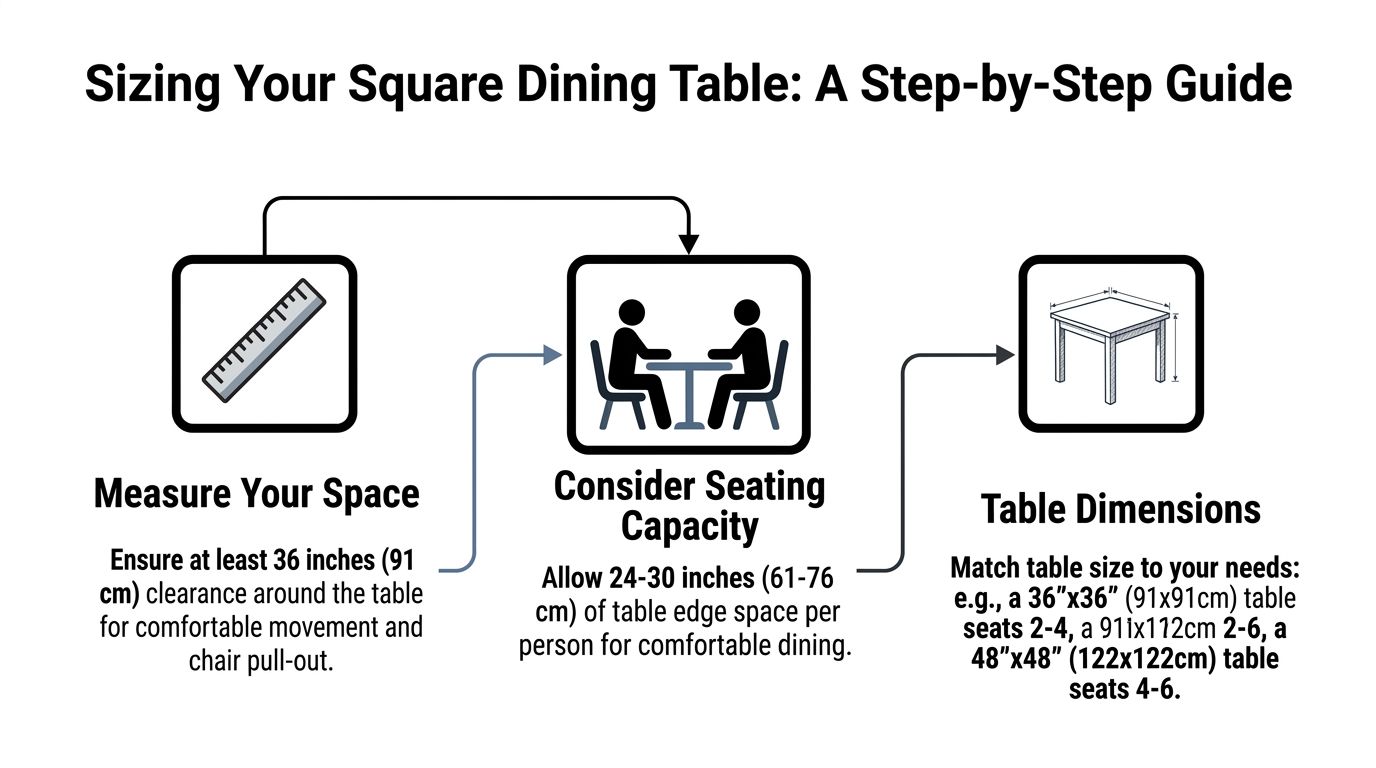
A good working rule is to leave at least 36 inches of clearance around the table for movement and chair pull-out. For seating, allow 24 to 30 inches of edge space per person. As a general visual benchmark, a 36" x 36" table seats 2 to 4, while a 48" x 48" table seats 4 to 6.
A simple way to map the footprint
Use painter’s tape on the floor. Mark the table closed first. Then mark it again at full extension.
That second outline is the one many people forget. It tells you what happens on holidays, not just on ordinary days.
Here is the easiest planning sequence:
- Measure the room. Use the usable area, not just the full room size.
- Mark the closed table. This shows how the table lives most of the year.
- Add chair zone. Pull chairs back far enough to reflect real use.
- Mark the expanded version. Include every leaf you expect to use.
- Walk the traffic path. Move through the room as you normally would.
If the route from the kitchen to the table feels pinched when the leaves are in, the issue is not the table. The issue is the expanded footprint in your specific room.
What a square table does well
A square shape often performs best in rooms that are also fairly balanced in proportion. It can also work beautifully in open plans where the dining area needs to feel centered rather than stretched.
Homeowners often compare a square extendable table with a fixed rectangle. The square usually wins for daily livability. It occupies less visual territory when closed, and it keeps the room feeling open.
A rectangle may still be the better answer in a long, narrow room. But in many homes, the square table becomes the better compromise because it adapts.
If you host a few larger meals but live with the table every day, choose for daily scale first and occasional extension second.
A practical comparison
| Table condition | Best use | What to check |
|---|---|---|
| Closed square | Everyday meals, homework, laptop use | Can chairs tuck in neatly without crowding walkways? |
| Expanded with one leaf | Casual guests, family dinner | Does the room still allow smooth movement behind seated guests? |
| Expanded with multiple leaves | Holidays, larger gatherings | Do doors, sideboards, or adjacent rooms still function comfortably? |
For a deeper planning walkthrough, this guide to dining room table sizing is useful before you shop in person.
Where people misjudge seating
A table may technically seat a certain number of people, but comfort depends on chair width, table legs, base design, and whether guests can enter and leave their seat without asking everyone else to scoot in.
That is why I encourage homeowners to think in two versions:
- Comfort seating: The number you will use most often.
- Maximum seating: The number you can use for special occasions.
The right square dining table with leaves handles both gracefully. It should not feel undersized closed or overextended open. If it does, the proportions are off for your home.
Understanding Leaf Types and Mechanisms
Most confusion around extension tables comes from one question. “How does the table open, and will I enjoy using it?”
That question matters. If the mechanism is awkward, heavy, or fussy, many owners stop using the leaves. A flexible table only has value if the transition feels easy.
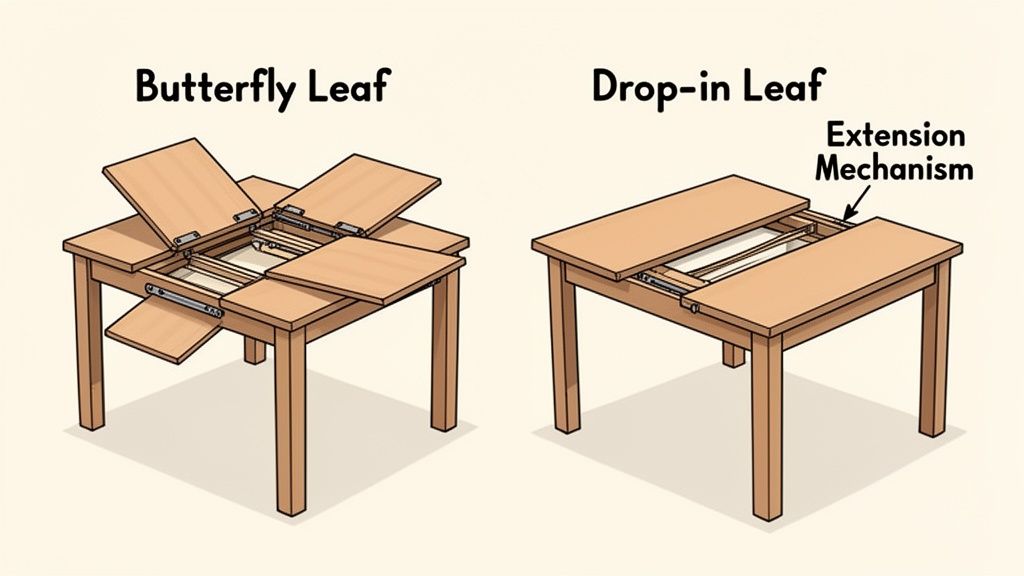
Butterfly leaf versus drop-in leaf
The two most common systems create very different ownership experiences.
| Mechanism | How it works | Best for | Trade-off |
|---|---|---|---|
| Butterfly leaf | The leaf folds and stores inside the table | Homeowners who want quick one-person setup | More mechanical complexity |
| Drop-in leaf | The table opens and a separate leaf is inserted | Buyers who want a simpler structure | You need a place to store the leaf |
A butterfly leaf is often the easiest choice for busy households. The leaf is already inside the table, folded beneath the top. You separate the table halves, unfold the leaf, and close the top again.
A drop-in leaf asks a bit more of you. You open the table, lift the separate insert into position, then align and secure it. Some people prefer this because the construction can feel straightforward and the table may have fewer moving parts hidden inside.
What modern engineering changes
A strong butterfly system is not just convenient. It is engineered for repeated use.
Modern butterfly leaf mechanisms use patented folding frames with nylon-coated steel glides, allow one-person operation in under a minute, and are built to meet ANSI/BIFMA standards, supporting over 300 lbs without sagging (butterfly leaf table engineering details).
That combination of speed, strength, and smooth movement is what separates a true furniture-grade extension system from a frustrating one.
For a closer look at styles built around this approach, browse these butterfly leaf tables.
What to inspect in person
Do not stop at “it opens.” Watch and feel how it opens.
When you test a square dining table with leaves, check these points:
- Glide action: The halves should separate smoothly, without jerking or grinding.
- Leaf alignment: Once open, the seam should look deliberate and sit flush.
- Lockup feel: The table should feel planted after the leaf is in place.
- Base stability: Push lightly at the corners. The table should not wobble.
- Edge continuity: Grain, finish, and apron details should still look cohesive when extended.
Which system lasts longer
There is no universal winner without looking at build quality. A poor butterfly mechanism will age badly. A poorly fitted drop-in system will also become frustrating over time.
The better question is this: does the mechanism match your habits?
Choose a butterfly leaf if you want fast setup and expect to use the extension often. Choose a drop-in leaf if you do not mind handling the insert and prefer a simpler operating concept.
The best mechanism is the one your household will use without hesitation.
One more point buyers overlook
A beautiful top can distract from weak hardware beneath it. Ask how the glides are built, how the leaf is supported, and whether the table feels just as confident when open as when closed.
That is the mark of a table designed for decades of real use rather than occasional showroom drama.
Choosing Materials for Lasting Beauty and Durability
A square dining table with leaves asks more of its materials than a fixed table does. The top has to look refined, but it also has to stay stable as seasons change, the mechanism moves, and the table shifts between compact and expanded forms.
This is why material selection matters so much. The extension system can only perform as well as the table built around it.

Why solid wood remains the benchmark
Solid hardwood offers two advantages that investment-minded buyers appreciate immediately. It has physical strength, and it also gets better looking with age.
Compared with MDF and particleboard, solid hardwoods outperform by over 40% in load-bearing capacity, and lower-grade composites can warp during the humidity swings common in Central Ohio, which can cause leaf misalignment (solid wood versus composite performance).
That matters in a practical sense. A table with a moving top depends on precision. If the material shifts poorly, the leaf stops fitting cleanly, seams become uneven, and the table starts feeling temperamental.
How wood changes the character of the room
Different hardwoods bring different visual personalities.
- White oak: Crisp grain, strong presence, excellent for homes that lean architectural or modern farmhouse.
- Maple: Smooth, fine grain and a cleaner visual texture. Good for transitional spaces.
- Cherry: Warmer tone and a more traditional elegance that deepens with age.
- Walnut: Rich color and a more formal, refined appearance.
Beyond species, the cut matters too. Quartersawn wood often offers a more disciplined grain pattern and greater visual calm, which many homeowners appreciate on larger tops or extension leaves where matching matters.
What heirloom quality means
“Heirloom” gets used loosely. In dining furniture, it should mean the piece can be used, maintained, and repaired over time, rather than discarded when one area shows wear.
That usually points buyers toward:
- Solid-wood construction
- Thoughtful joinery
- A finish that can age gracefully
- A top that can tolerate real family life
- Replaceable or serviceable hardware where possible
This is also where Amish-made furniture and other North American solid-wood makers often stand apart. The attention goes beyond appearance. You see it in the thickness of the top, the fit of the aprons, and the confidence of the base.
A quick material comparison
| Material | Strength | Aging potential | Best fit |
|---|---|---|---|
| Solid hardwood | Excellent | Develops character, can often be refinished | Long-term ownership |
| Veneer over quality core | Good when well made | Can look refined, but depends on build quality | Style-conscious buyers seeking stability |
| MDF or particleboard | Lower | More vulnerable to swelling and wear | Shorter-term use |
If you want help sorting species, finishes, and long-term maintenance, this guide to choosing the right hardwood for longevity and style is a useful place to start.
A dining table should gain character from family life, not lose function because of it.
The feel test still matters
Look closely, but also touch the table. Run your hand along the edge. Open the leaf. Sit down and notice whether the wood feels substantial and settled.
A table meant to last has a certain calm to it. The surface feels grounded, the seams feel intentional, and the structure does not ask for your trust. It earns it.
Designing Your Custom Dining Set at Vinson
Buying a dining table becomes much easier when someone helps you solve the underlying problem instead of just showing you finishes. The underlying problem is rarely “Which one is prettiest?” It is usually a combination of room size, family habits, entertaining style, preferred wood tone, and how long you expect the table to serve your home.
That is why a design process matters.
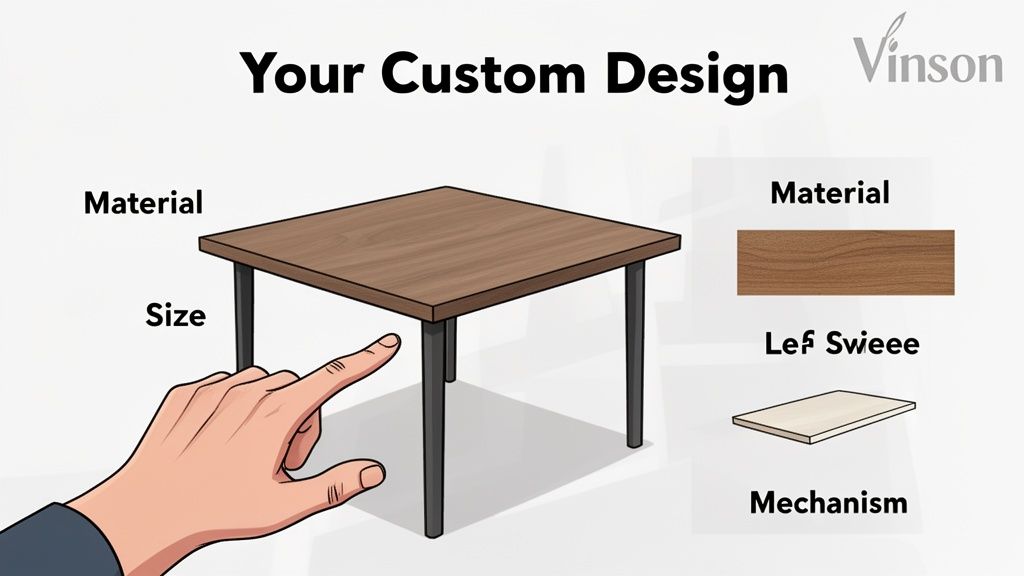
What a good consultation should uncover
A thoughtful designer will ask questions most shoppers do not get asked online:
- How many people use the table on an ordinary weeknight?
- How often do you extend it?
- Does the room also function as a passageway?
- Do you prefer a cleaner top or a more expressive grain?
- Would you rather store a separate leaf or keep the mechanism inside the table?
Those questions save people from expensive mismatches.
Most retailers focus on appearance, but investment-minded buyers also need answers about long-term durability, maintenance, potential repairs, and comparative longevity of leaf systems, which is a gap many competitors leave unaddressed (why durability guidance matters in extension table buying).
How customization changes the outcome
The strongest custom process does not begin with endless options. It begins with narrowing the right ones.
In a well-run showroom consultation, the choices become manageable:
| Decision area | Why it matters |
|---|---|
| Table size | Determines how the piece lives daily |
| Leaf configuration | Affects convenience and future flexibility |
| Wood species | Shapes durability, grain, and aging |
| Finish tone | Connects the table to flooring, cabinetry, and light |
| Chair pairing | Changes comfort, spacing, and visual balance |
A Custom Order Program is valuable because it lets buyers tailor more than dimensions. You can often choose wood species, stain, leg style, chair silhouette, and the extension configuration that makes the most sense for your household.
Digital tools help here. A 3D visualizer lets you compare options before the table is built, which reduces guesswork and gives homeowners a more realistic sense of proportion and finish.
If you want to see how a custom process begins, this overview on getting started with custom order lays out the basics clearly.
Why the set matters as much as the table
People sometimes custom-order the table and treat the chairs as an afterthought. That usually shows.
The best dining rooms feel cohesive because the seating supports the table physically and visually. Chair width affects how many people can dine comfortably. Upholstery changes the mood of the room. Leg shape and finish can make the entire set feel either heavy or refined.
A good designer helps you balance all of that so the room does not feel assembled in parts.
The right custom dining set should look as if it always belonged in your home.
The Easton showroom advantage
For Columbus homeowners, the showroom experience matters because a dining table is not fully understood on a screen. You need to see how the finish reacts to light, how the extension moves, and whether the chair feels supportive over the course of a meal.
That is where an in-store design studio becomes useful. You can compare woods side by side, test mechanisms, discuss layout challenges, and build a solution that suits the way your home works.
Investing Smartly and Bringing Your Table Home
A dining table is one of the few pieces in a home that handles both daily wear and milestone moments. It needs to justify its place financially, functionally, and emotionally.
That is why the buying experience matters almost as much as the construction.
Why an extendable table is a practical investment
A single table leaf typically adds 2 feet of length and seats 2 to 4 more guests. In the United States, extendable tables account for 40 to 50% of mid-to-high-end sales, and properly maintained solid-wood pieces can retain up to 80% of their value (investment value of extendable solid-wood tables).
Those numbers help explain why so many homeowners choose this category. One well-made table can cover everyday use, entertaining, and future moves or renovations without becoming obsolete.
What smart value looks like
Good value is not the lowest number on a tag. Good value means the table fits your room, performs smoothly, and still feels right years from now.
For many buyers, that value comes from a few practical advantages:
- Customization: The ability to choose the right finish, wood, and configuration instead of settling.
- Price protection: A Low Price Guarantee can remove hesitation when you are buying a premium piece.
- Clearance opportunities: A well-curated Clearance Gallery can offer savings up to 70% on select premium furniture.
- Flexible financing: Payment options through Synchrony HOME can make a long-term purchase easier to time with a move or renovation.
Delivery matters more than people expect
A solid-wood extension table is not the kind of purchase you want dropped at the curb. Setup affects how the piece begins its life in your home.
Professional placement and assembly help protect the finish, ensure the table sits level, and save you from wrestling with heavy components or packaging. If you want to know what that process includes, this explanation of white-glove delivery service is worth reading before purchase.
A few care habits that protect the investment
In Central Ohio, seasonal humidity swings are real. A few simple habits help preserve both the top and the leaf fit over time:
- Use placemats and trivets: Heat and moisture are hard on finishes.
- Clean gently: A soft cloth works better than harsh sprays.
- Keep the table out of prolonged direct sun: Uneven light exposure can change tone over time.
- Operate the leaf occasionally: Even if you rarely host, moving the mechanism from time to time helps you notice issues early.
- Address wobble promptly: A small adjustment now is better than strain over time.
A good square dining table with leaves should feel like one of the most settled purchases in your home. It serves a practical purpose, adapts gracefully, and supports the rituals that make a house feel lived in.
If you are looking for a Furniture store Columbus Ohio homeowners trust for Custom dining sets, Solid wood furniture Ohio families can live with for decades, and a personalized showroom experience at Easton, Vinson Fine Furniture is worth the visit. Their complimentary In-Store Design Studio helps you compare sizes, woods, finishes, and leaf configurations in person. Through the Custom Order Program, you can personalize dining furniture with 3D visualizers, while the Low Price Guarantee offers a 110% refund of the difference if you find a lower local authorized price within 30 days. Shoppers looking for immediate value can also explore the Clearance Gallery for savings up to 70%, and flexible financing through Synchrony HOME makes timing easier. When your table is ready, White-Glove In-Home Delivery completes the experience with careful placement and assembly. If you are already visiting Easton for home furnishings, or even researching Best mattresses Easton Town Center and Amish-made furniture for a broader home refresh, Vinson offers the kind of long-term guidance that makes a lifetime purchase feel clear and enjoyable.