Solid Wood Dining Chairs Set of 4: A Buyer’s Guide


A dining room often exposes a furniture mistake faster than any other room. A chair that feels acceptable for thirty seconds can become uncomfortable during a long meal, while a loose joint that seems minor in the showroom can become a daily nuisance after repeated use. For an investment-minded homeowner, a solid wood dining chairs set of 4 deserves the same scrutiny as a table, flooring choice, or built-in cabinet.
The right set should feel stable, fit the household's proportions, suit the room's light and traffic, and offer a realistic path to repair. Solid hardwood matters, but species, joinery, moisture control, finish, and serviceability determine whether four chairs remain useful long after the original style feels familiar.
Why a Set of Four Solid Wood Chairs Is a Long-Term Decision
A four-chair set has a predictable household life. One chair sits closest to the kitchen and catches more traffic. Another becomes the preferred seat for homework, coffee, or a quick conversation. The chairs face pasta nights, holiday meals, pets moving underfoot, and the occasional scrape against the floor. A coordinated set needs to handle that ordinary abuse without turning every small mark into a reason for replacement.
The visible finish gets most of the attention, but three less visible variables control the chair's working life:
- Species: Cherry, oak, maple, and walnut bring different grain patterns, hardness characteristics, and visual aging.
- Joinery: The way legs, stretchers, rails, and backs connect determines how well a chair resists racking.
- Finish: A durable finish protects the surface while still allowing future touch-ups or refinishing.
Solid wood gives a quality chair an important advantage. A sound frame can often be sanded, re-glued, refinished, and reupholstered instead of discarded. That doesn't mean every solid wood chair is automatically heirloom quality. Poor proportions, weak joints, inadequate drying, and inaccessible replacement parts can still shorten its useful life.
The lifecycle case for repair
A 2025 peer-reviewed life-cycle assessment examined 25 household and office furniture pieces across five stages, including material acquisition, production, distribution, use, and disposal. Pre-production created the largest environmental effect, averaging 76% of total life-cycle impact, while production averaged 13%, according to the published life-cycle assessment. For a four-chair set, that makes the species, sourcing, drying, machining, and finish decisions more important than buyers may assume.
Research on wood furniture also used a 10-year lifespan benchmark and found that reuse, repair, and refurbishment required significantly less new material than manufacturing replacement chairs, as detailed in the wood furniture circular-use analysis. Applied to four chairs, extending service means preserving four frames rather than creating demand for four replacements.
Practical rule: A chair should be judged by the quality of its next repair, not only by how polished it looks on delivery day.
The useful buying question isn't whether a set looks fashionable now. It's whether the owner can still tighten a joint, renew a finish, replace a glide, or recover a seat after years of use. Moisture control and ergonomic fit provide the measurable checks that separate a convincing showroom impression from a durable household asset.
Choosing the Right Hardwood Species
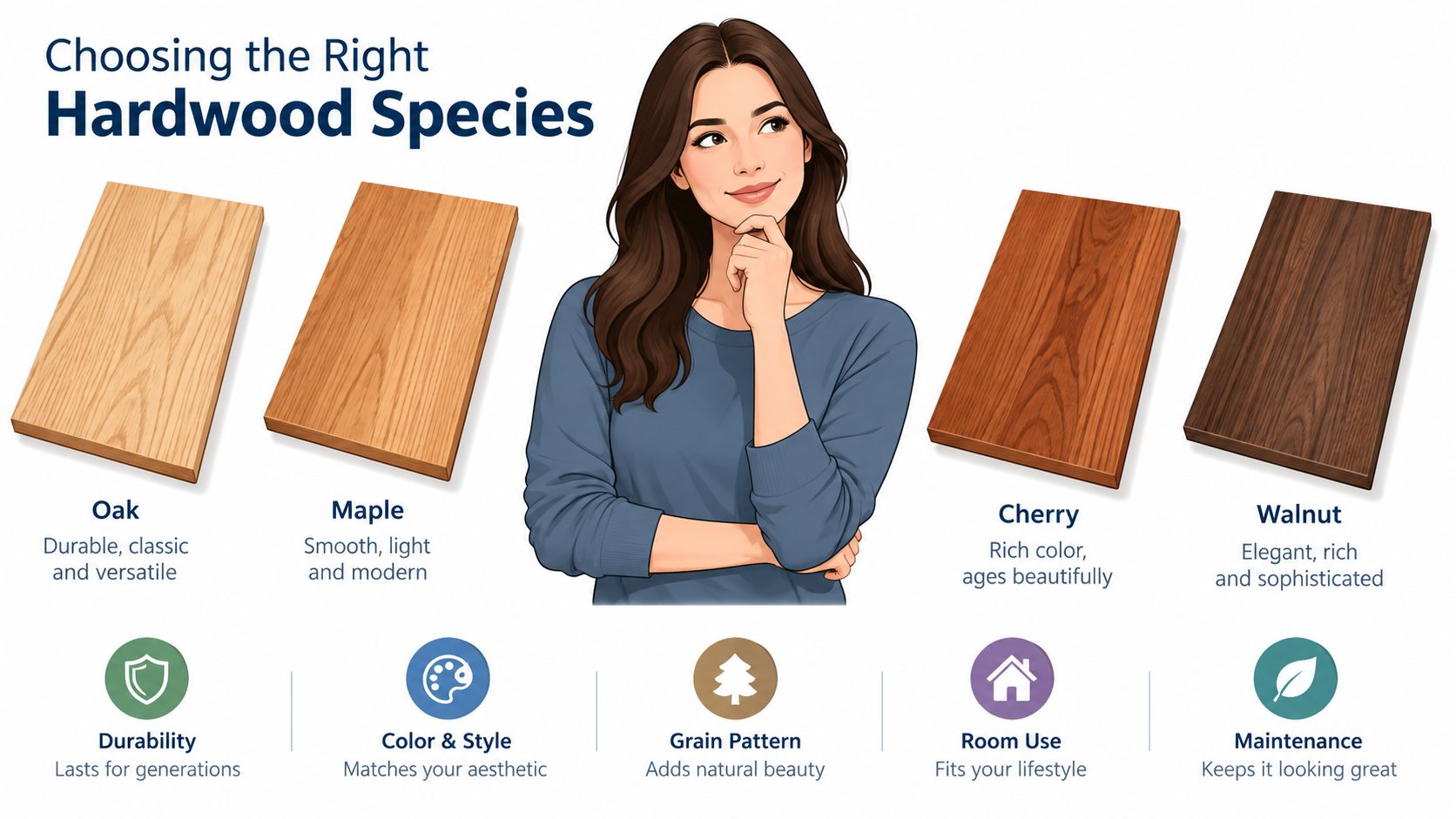
Species selection should begin with the room and the household, not with a color chip. The four hardwoods most relevant to a solid wood dining chairs set of 4 each create a different balance of grain, tone, wear visibility, and design character.
Cherry for a refined, evolving dining room
Cherry has a tight, controlled grain and a warm pinkish-tan starting tone that develops into a deeper, more even patina. It suits homeowners who prefer furniture with quiet detail rather than loud contrast. In a dining room with limited direct sunlight, cherry can provide warmth without demanding a strong decorative theme.
Cherry works particularly well with traditional, transitional, and understated contemporary interiors. Its smooth grain also makes small surface marks less visually aggressive than they may appear on a highly contrasting wood.
Oak for active households
Red oak and white oak are the practical workhorses. Their open grain and pronounced visual texture give a chair a tactile, substantial appearance, while the pattern helps disguise the small abrasions that accumulate around a busy dining table.
Oak is a strong choice for households with children, pets, frequent guests, or a preference for visible craftsmanship. White oak generally reads calmer and more restrained, while red oak brings a warmer, more pronounced grain presence. Either can anchor a room without requiring the chairs and table to look like a matched showroom display.
Maple for crisp lines and painted finishes
Maple has a close grain and a clean appearance. It suits homeowners who want a smooth, disciplined look or a painted finish with sharp coverage. A maple front rail also makes sense where the chair receives frequent contact from legs, shoes, or movement around the table.
Maple's restrained grain supports farmhouse, light contemporary, and painted dining sets. It's the species to consider when the chair's silhouette matters more than dramatic grain movement.
Walnut for visual depth
Walnut brings chocolate-to-cocoa tones and a natural luster that can make four chairs feel like a deliberate architectural element. It's a premium visual choice for a dining room where the chairs need to contribute depth rather than just occupy seats.
Walnut suits buyers who value grain drama and a darker palette. Its richer surface can make dents and sharp marks more noticeable, so it's better for households prepared to accept natural wear as part of the material's character.
For a broader look at how hardwood components support furniture construction, Neasden Hardware hardwood fittings offers useful reference material. Buyers comparing species, grain direction, and finish should also review Vinson's guide to choosing hardwood for longevity and style.
Joinery and Seat Construction That Hold Up
Joinery is the largest durability lever a buyer can inspect directly. Species and finish establish the chair's character, but the connections between legs, rails, stretchers, and back components determine whether the frame stays rigid when someone leans, shifts, or pushes away from the table.
| Joinery Method | Strength Rating | Repairability | Best Use in Chair |
|---|---|---|---|
| Mortise-and-tenon | High | Strong when accessible | Leg-to-rail, stretcher, and back connections |
| Dowel | Moderate to high | Repairable with proper access | Stretchers and aligned frame components |
| Pocket screw | Variable | Possible, but often less durable under movement | Secondary connections and selected applications |
Mortise-and-tenon remains the standard
A mortise-and-tenon joint places one precisely shaped section inside a matching recess. Glue, careful tolerances, and sometimes additional mechanical support create a connection that resists the twisting and racking common to dining chairs.
The important detail isn't the label alone. A poorly fitted mortise-and-tenon joint can still fail, while a carefully executed dowel joint can perform well in the right location. Buyers should ask how the joint is cut, glued, and repaired, rather than accepting a construction term as proof of quality.
Dowel joints use glued hardwood pins to align two bored faces. They can work effectively in stretchers and other properly supported connections, but leg-to-seat corners face more demanding side loads. Pocket-screw construction can be serviceable in selected applications, yet buyers should inspect whether the screws support a well-fitted frame or only pull parts together quickly.
The seat needs equal attention
A chair seat should feel solid under load, without flexing, rattling, or producing a hollow vibration. Edge-glued solid wood seat construction can offer a durable, repairable foundation when the grain direction, fasteners, and moisture control are appropriate.
The showroom test takes less than a minute:
- Grip the front rail and twist. Excessive movement points to racking in the frame.
- Lift the chair by one arm. Watch for joint movement, clicks, or separation between the arm, back, and seat rail.
- Press the seat near each corner. Uneven flex suggests inconsistent support or a loose connection.
- Inspect the stretcher junctions. Daylight gaps and visible movement deserve an explanation before purchase.
The Vinson guide to various wood joints gives buyers useful terminology for discussing construction with a showroom consultant. The goal isn't to reward the most technical-sounding label. It's to find a chair whose frame behaves as one stable structure.
Moisture, Movement, and What to Check in the Showroom
Solid wood continues to exchange moisture with the surrounding air. That movement is normal, but poor manufacturing moisture control can create avoidable stress after delivery. Hardwood intended for interior furniture is typically kiln-dried to 6–8% moisture content in North American furniture production, according to Purdue Extension guidance on wood moisture.
That range is a manufacturing benchmark, not a guarantee. Species, construction, finish, indoor humidity, and acclimation all affect performance. Columbus-area homes also experience heated winter interiors and humid summers, so chair frames need room to move without losing joint integrity.
A practical showroom inspection
A buyer should inspect all four chairs, not only the chair placed closest to the sales floor. The process should include:
- Twist the back gently. A rigid frame should resist lateral movement without creaking.
- Push the rear legs sideways. This exposes looseness at the leg, rail, and stretcher connections.
- Run a hand beneath the seat. The underside should feel consistently finished rather than raw, splintered, or irregular.
- Check the stretcher junctions. Gaps, shifting parts, or fresh-looking adhesive deserve clarification.
- Slide the chair across the floor. Properly seated glides should move evenly without catching or wobbling.
- Ask for construction details. Species, moisture procedures, finish, glue, and repair provisions should be explained clearly.
A chair that rocks while unloaded may experience greater joint stress when occupied. The issue may be an uneven floor, an incorrectly seated glide, or a frame problem, so the showroom should identify the cause rather than dismiss the movement.
Showroom standard: A written specification turns a reassuring conversation into something the buyer can verify later.
After delivery, owners should keep chairs away from direct heat sources, HVAC outlets, and exterior doors. Care instructions for wood surfaces and seasonal movement are also covered in Vinson's guide to caring for wood furniture.
Sizing and Ergonomics for Real Dinners
A chair can be beautifully made and still be wrong for the household. Ergonomic fit affects foot contact, thigh pressure, hip and knee angles, back support, and the ease of standing after a meal. A coordinated set of four should give every diner the same basic level of support, not only the person who tested the display chair.
A published dining-furniture evaluation identifies suitable ranges of approximately 40–45 cm, or 15.7–17.7 inches, for seat height and seat depth, with a seat width of about 45 cm, or 17.7 inches, as described in this dining-furniture ergonomics evaluation.
| Measurement | Target Range | What It Controls |
|---|---|---|
| Seat height | 40–45 cm, or 15.7–17.7 inches | Foot contact, thigh pressure, and ease of standing |
| Seat depth | 40–45 cm, or 15.7–17.7 inches | Thigh support and back contact |
| Seat width | About 45 cm, or 17.7 inches | Hip clearance and lateral comfort |
The seat test matters more than the label
Seat height should be measured from the floor to the compressed seating surface, not merely from the floor to the frame. Shorter users need stable foot contact, while taller users may need adequate thigh support without feeling compressed beneath the knees.
Seat depth deserves equal attention. If the seat is too shallow, the thighs lose support. If it's too deep, the sitter may slide forward or lose contact with the backrest. The correct test is simple: the feet should rest flat, the back should contact the chair naturally, and a comfortable gap should remain behind the knees.
Seat width should be checked across all four chairs, especially when arms, sculpted rails, or upholstered cushions reduce usable space. Buyers should include the household's tallest and shortest daily diners in the sit-test, then remain seated long enough for pressure points to appear.
A dining bench can create a different visual and seating rhythm, particularly in a mixed arrangement. For ideas about combining bench seating with upholstered elements, styling a dining bench at Quote My provides a useful design reference.
Finishes, Fabrics, and Customizing Your Set
Four chairs should read as one composed furniture decision, not four unrelated purchases. That coherence comes from the relationship between wood tone, finish sheen, seat profile, fabric, and the proportions of the dining table.
A durable film finish generally makes sense for households that host frequent meals and want stronger resistance to spills and routine abrasion. An oil or wax finish suits owners who appreciate a softer tactile surface and accept more active maintenance. The right choice depends on the household's cleaning habits and willingness to renew the surface over time.
Upholstery changes the ownership experience
A shaped wood seat can be practical and easy to wipe clean. Upholstery adds cushioning for longer meals and introduces an opportunity to connect the chairs with a rug, drapery, or adjacent living room seating.
Performance fabric is a sensible choice for active households that want comfort without making every spill a crisis. Top-grain leather and performance leathers bring a different tactile character and can connect dining seating visually with a living room that includes premium motion pieces, such as motorized sectionals, reclining seating, swivel chairs, rockers, or gliders.
Custom order rewards careful decisions
The Custom Order Program provides a more coherent path than assembling four chairs from separate catalog choices. For brands such as Smith Brothers of Berne, Mavin, and Canadel, buyers can select fabrics, finishes, dimensions, cushion fills, nailhead patterns, arm profiles, and overall configuration. Digital or 3D visualizers help shoppers review the intended result before production, as described in the custom design consultation information.
The origins are specific. Smith Brothers is made in Indiana, Mavin is Amish-made in Ohio, and Canadel is handcrafted in Quebec, Canada. That gives a North American-crafted project a clear manufacturing story while allowing the set to reflect the room instead of forcing the room to accommodate a fixed model.
Buyers considering upholstery should understand cleaning codes, cushion construction, fabric recovery, and future service before ordering. Vinson's upholstery materials guide provides a practical starting point for that conversation.
Repair, Refinishing, and Getting a Second Decade Out of Them
Delivery isn't the end of ownership. It's the point at which the owner begins protecting the frame, finish, and seat from the wear patterns that develop around a real dining table.
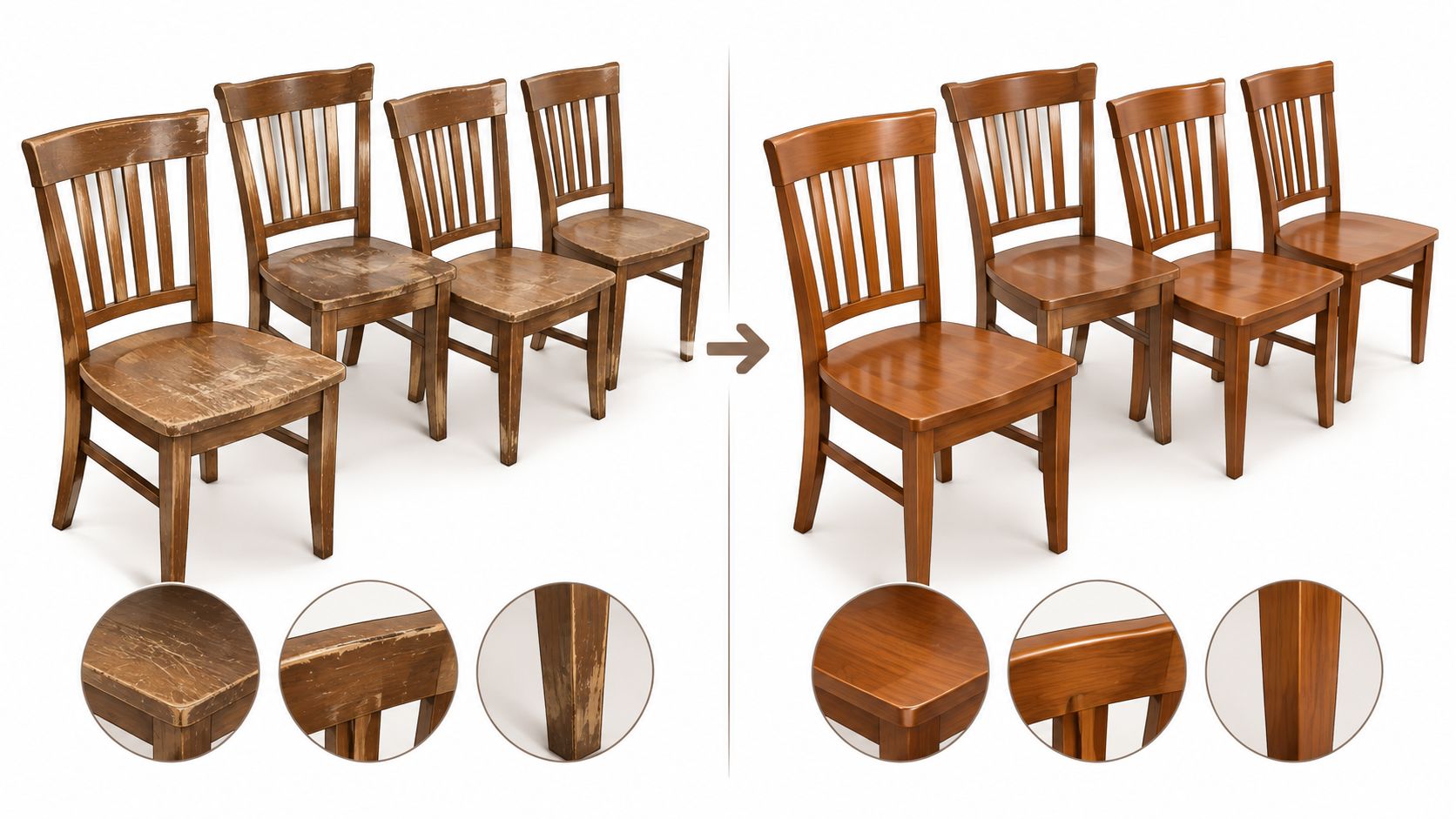
Research on circular wood-furniture use found that reuse, repair, and refurbishment extend product life while reducing the need for new material compared with replacement production. Solid wood is especially suitable for this approach because a sound frame can often accept surface renewal, new upholstery, replacement glides, and joint repair.
A serviceable chair has accessible solutions
Owners should distinguish between routine care and structural work:
- Surface care: Dust with a soft microfiber cloth and clean spills promptly using methods suited to the finish.
- Hardware inspection: Check stretchers, back slats, and glides when a chair begins to wobble or scrape.
- Minor tightening: A qualified repair professional can address loose connections before repeated movement enlarges the joint.
- Seat renewal: Worn fabric, compressed cushioning, and damaged webbing can often be replaced without discarding the hardwood frame.
- Finish renewal: Surface wear can be blended, touched up, or refinished when the underlying wood remains sound.
A split rung or loose mortise-and-tenon connection shouldn't receive improvised treatment that traps dirt or creates a rigid stress point. Hide glue, clamps, replacement parts, and careful alignment belong in the hands of a furniture repair specialist when the joint has significant movement.
Serviceability should influence the original order
A buyer should ask whether the maker can supply replacement glides, seat components, fabric information, finish guidance, and repair support. A chair that can be serviced without destroying the surrounding frame has greater practical value than one that only looks complete when new.
The Vinson furniture repair service offers a useful reference point for owners evaluating what can be repaired rather than replaced. The strongest four-chair purchase is the one that remains useful through changes in fabric, finish, household routines, and personal taste.
Value, Pricing, and Why the Easton Showroom Matters
A solid hardwood set should be evaluated by total ownership value, not only by the initial ticket. A chair that remains structurally sound, comfortable, repairable, and visually relevant can justify its place in a home far better than a lower-priced set that requires premature replacement.
The Easton showroom at 4070 Morse Road in Columbus, Ohio, belongs to a family-owned business serving Central Ohio since 1979, formerly under the name Kitchen Tables & More, according to the company's history. That local continuity matters because a serious furniture purchase benefits from an in-person sit-test, construction questions, finish samples, and service discussions.
Concrete ways to protect the purchase
The showroom experience includes several distinct value paths:
- Low Price Guarantee: Under the stated policy conditions, including the described 30-day period, a qualifying lower price from a local authorized dealer results in a 110% refund of the difference, as detailed in the solid wood furniture value information.
- Clearance Gallery: Selected floor samples, overstocks, and seasonal closeouts offer savings of up to 70%, with availability depending on the individual piece.
- Custom design support: The In-Store Design Studio and Complimentary Design Consultations help coordinate dimensions, finishes, upholstery, and surrounding dining or living room furniture.
- White-Glove Delivery: The service is designed to move selected furniture into the home with careful handling rather than treating a solid hardwood purchase like an unattended shipment.
The Custom Order Program also supports buyers who want a precise result across dining and living spaces. Smith Brothers furniture Easton shoppers can explore Indiana-made upholstery, Mavin bedroom furniture can extend Ohio Amish-made craftsmanship into the bedroom, and Canadel can provide handcrafted Quebec options for a North American-crafted dining project. The same showroom also presents premium living room choices, including top-grain and performance leathers, custom leather sectionals Columbus shoppers can configure, power motion, reclining, swivel, rocker, and glider seating.
A proper visit should include every chair in the set. Buyers should sit long enough to assess back angle and seat pressure, check all joints for movement, compare the four chairs for consistency, and ask how moisture control, finish repair, and replacement components are handled. That is how a Columbus homeowner turns a style preference into a documented investment.
Vinson Fine Furniture offers solid hardwood dining seating, custom fabrics and finishes through its Custom Order Program, an In-Store Design Studio, and practical value options for a four-chair purchase. Homeowners comparing solid wood furniture Ohio options should visit Vinson Fine Furniture at Easton to test the chairs, review construction details, and choose a set designed for long service.