Mattress Comparison Guide: Top Picks for 2026

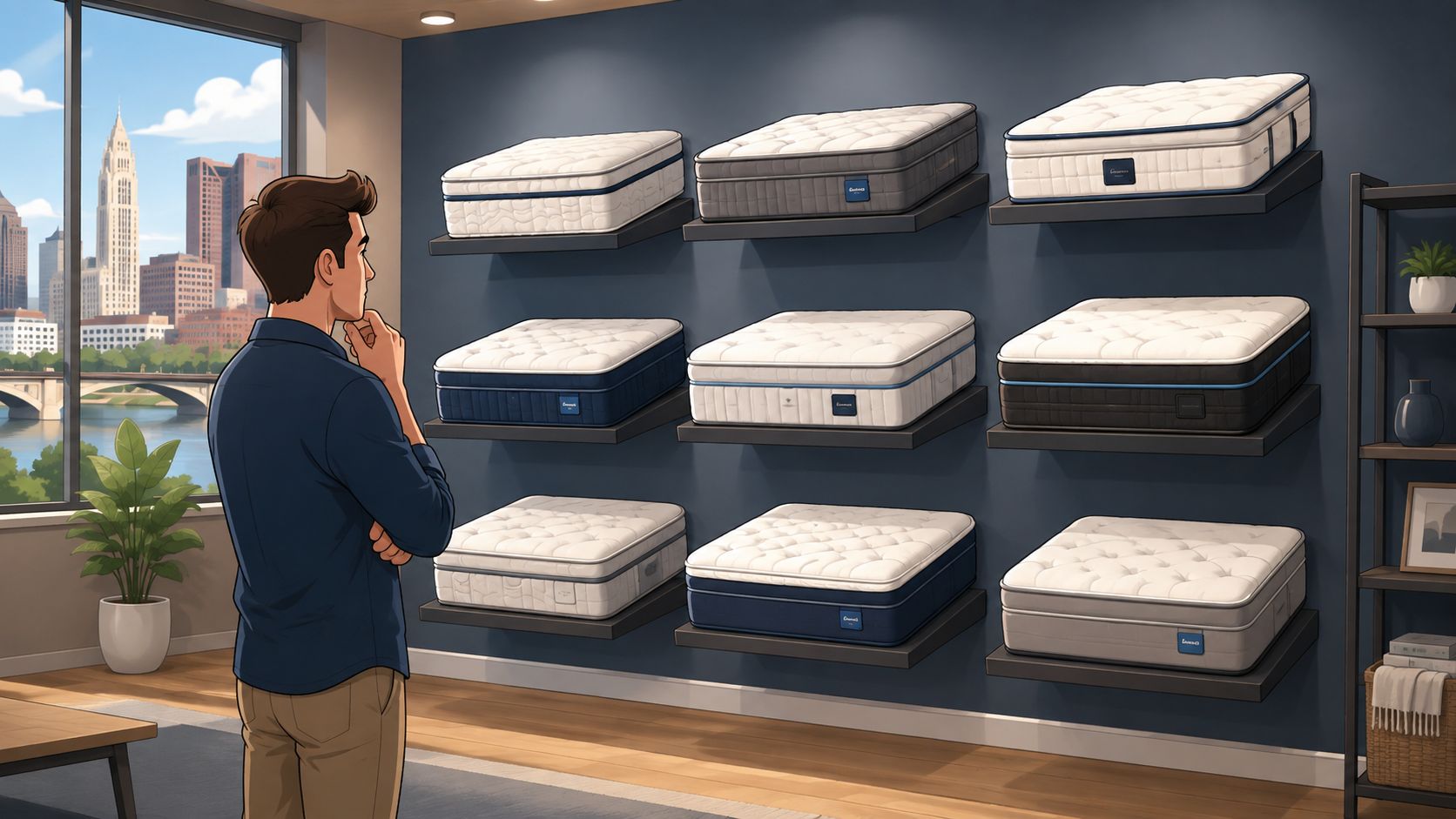
A shopper in Columbus can stand in front of a row of premium mattresses, feel the clock ticking, and still make the wrong call in ten minutes. The trap is obvious, a bed can feel great for a few breaths and still be a poor long-term fit once body weight, sleep position, base support, and trial-night reality enter the picture. A serious mattress comparison guide treats the purchase like a long-term investment, not a showroom mood.
| What matters most | What to compare | Why it changes the answer |
|---|---|---|
| Construction | Foam density, coil system, latex type, full layer stack | Similar firmness can hide very different durability and feel |
| Sleep profile | Side, back, stomach, combination, couples | The same mattress can be right for one sleeper and wrong for another |
| Foundation | Slat spacing, center support, adjustable base fit | The wrong base can create sagging and warranty problems |
| Post-purchase value | Trial nights, warranty terms, clearance, financing | The smartest buy is often the one that survives real sleep, not just a sit-test |
The market is big because the mistake is expensive. One independent industry analysis values the worldwide mattress market at $34.52 billion in 2024, with a forecast rise to $40.7 billion by 2029 and a 3.35% CAGR; it also places the U.S. market at $11.57 billion in 2024 (NapLab mattress sales statistics). That scale is exactly why comparison shopping deserves discipline.
Why a Real Mattress Comparison Matters Before You Buy
A Columbus homeowner can walk into a showroom tired, compare three mattresses in a hurry, and still miss the one detail that matters most. The first impression is rarely the final verdict. A bed that feels plush for ninety seconds can turn into a sore back, a hot night, or a partner-disturbance problem once real sleep starts.
The better way to shop is to treat the mattress as a multi-year decision. Good comparison work separates four jobs that shoppers often mash together. Construction literacy tells the buyer what's inside. Brand positioning narrows the field. Sleeper-type matching filters out models that won't work. Showroom protocol keeps the final decision honest.
The most useful comparison guides today are data-driven, not vibes-driven. One expert testing framework reports over 17,000 data points from 400+ real mattress tests, with an average overall performance score of 8.55 and a range from 6.41 to 9.79 (NapLab how to choose a mattress). That's the right mindset, because mattresses aren't interchangeable just because the tag says “medium” or “firm.”
Practical rule: if the comparison stops at firmness and price, it's incomplete.
That's also why a good mattress comparison guide has to follow the bed past the showroom floor. The strongest choice depends on what happens on the frame at home, what happens after thirty nights, and what happens when the body settles into it over time.
Understanding Mattress Types and Build Quality
The hangtag is marketing. The spec sheet is the truth.
Read the build, not the slogan
A useful comparison starts with the full layer stack, from cover to support core. Foam should be judged by density in lb/ft³, latex should be identified as Dunlop or Talalay with the rubber blend noted, and coils should be checked by type, gauge, count, and edge-support density (Mattress Underground specifications guide). Two mattresses can share the same firmness label and still behave very differently once those numbers change.
Same firmness rating does not mean same feel, same durability, or same value.
That's the basic rule shoppers need to internalize before they trust a showroom impression. Memory foam usually brings deeper contouring and stronger motion isolation. Innerspring models feel more traditional and more responsive. Hybrid designs try to balance contouring with bounce, and latex often gives a livelier, more resilient surface. The trick is not to chase the category, it's to judge whether the build matches the sleeper.
For a plain-language pressure-relief breakdown, a helpful companion resource is the DME Superstore mattress guide. It's useful because it pushes shoppers toward the same idea that matters in a serious showroom, pressure relief is a construction question, not a label.
Know how the common types behave
A hybrid can look like a foam mattress with coils under it, but the structure matters more than the name. A true hybrid should have a support core that changes how the bed responds at the edge, in the center, and under partner movement. A foam mattress with a token coil layer may not deliver the same perimeter stability or durability.
Wirecutter's mattress guide frames the market around foam, innerspring, and hybrid categories, with density thresholds that matter for durability. It recommends at least 3 lb/ft³ for memory foam for people under 200 pounds, and at least 4 lb/ft³ for people over 200 pounds. For non-memory polyfoam, it recommends at least 1.8 lb/ft³ for lighter sleepers and around 2 lb/ft³ or higher for heavier sleepers (Wirecutter mattress guide).
A shopper comparing models the right way should ask a blunt question, does the internal build justify the asking price? If the answer isn't visible on the spec sheet, the mattress probably isn't worth premium money.
For a focused comparison of foam and hybrid construction, Vinson's internal guide on memory foam vs. hybrid mattresses fits neatly into the same decision process.
Tempur-Pedic, Sealy, and Stearns & Foster Compared
These three lines sit in different lanes. Treating them like substitutes is how shoppers end up paying for the wrong trade-off.
Different value tiers, different sleep priorities
Tempur-Pedic is the contouring-first choice. It's the line for sleepers who want deep pressure relief and strong motion isolation, especially couples who notice every shift in the night. Sealy is the broad-line workhorse, with a range that covers more shoppers and more budgets while keeping the focus on reliable support. Stearns & Foster leans into craftsmanship, a more traditional feel, and a refined hybrid build that appeals to buyers who want luxury without losing bounce.
| Brand | Signature Construction | Best For | Typical Price Band |
|---|---|---|---|
| Tempur-Pedic | Adaptive contouring foam with strong motion control | Pressure-sensitive sleepers and couples | Premium |
| Sealy | Broad range of support-forward constructions | Shoppers who want dependable value across tiers | Entry through premium |
| Stearns & Foster | Craftsmanship-leaning hybrid with upgraded materials | Buyers who want a traditional feel with modern support | Premium |
The decision is not which brand sounds better. It's which compromise the shopper is willing to live with for years. Tempur-Pedic asks for patience in exchange for a more enveloping feel. Sealy asks the buyer to prioritize practical support and range. Stearns & Foster asks for a bigger commitment in exchange for a more polished, customized experience.
The trade-off that matters most
A buyer who wants to feel “held” should stay with the contouring-first option. A buyer who wants something more conventional should not force a deep-foam feel just because the word premium sounds persuasive. A buyer who wants upscale craftsmanship and a more classic mattress structure should focus on the hybrid-leaning luxury tier.
A fuller brand review for the craftsmanship side is available in Vinson's Stearns & Foster mattress review. It's the right kind of internal read when the buyer is deciding between texture, support, and long-term comfort rather than just comparing names.
Matching Firmness and Support to Your Sleep Style
Firmness is not a personality trait. It's a match between body position, body weight, and how much support the spine needs to stay neutral.
Start with position, then adjust for weight
Side sleepers usually need enough cushioning to let the shoulder and hip settle without pressure spikes. Back sleepers usually do better when the lumbar area stays supported without being shoved forward. Stomach sleepers need the most restraint, because too much sink turns the midsection into a hinge.
Combination sleepers need a mattress that changes gears without trapping them. Couples need to care about motion transfer and edge stability, because one person's comfort can easily become the other person's sleep problem. The most common comfort-and-spine sweet spot is medium-firm, especially when the goal is balanced support rather than a dramatic sink.
Body weight changes the equation. Lighter sleepers can sit deeper on firmer hybrids than they expect, because they don't compress the comfort layers as much. Heavier sleepers need higher-density foam and reinforced coils, or the bed can develop a hammock effect that looks like comfort at first and turns into misalignment later.
Consumer rule: the best mattress is the one where the spine feels aligned, not flexed or twisted, after enough time to settle in.
Consumer Reports also says shoppers should spend at least 10 minutes on each promising model in-store and specifically test motion isolation by lying on the bed with a sleep partner (Consumer Reports mattress buying guide). That advice is simple because the body gives away the answer quickly when the mattress is wrong.
A quick match-up by sleeper profile
- Side sleeper: Look for pressure relief first, then enough edge support to keep the bed usable across the full surface.
- Back sleeper: Prioritize support that keeps the lower back stable without hard pushback.
- Stomach sleeper: Choose a firmer, more controlled surface that resists midsection sag.
- Couple: Put motion isolation and perimeter stability ahead of flashy softness.
- Combination sleeper: Pick responsiveness over deep sink, or turning over will feel like work.
For a more targeted shopping path, Vinson's internal guide on how to choose the right mattress for your sleeping style can help narrow the field before the showroom visit.
The Foundation Problem Most Guides Skip
A mattress can be excellent and still fail on the wrong base. That's not a mattress defect, it's a setup mistake.
The frame underneath changes the outcome
Foam mattresses generally need slat gaps of about three inches or less. Many hybrids tolerate about three to four inches depending on the brand, but the buyer should never assume that without checking the mattress's support requirements. Queen-or-larger frames also need a real center rail with legs, or the middle of the mattress can start to sag under normal use.
That matters because unsupported sleep looks like a mattress problem before anyone realizes it's a foundation problem. The symptoms are familiar, premature softening, strange motion transfer, a dip in the middle, and warranty friction when the manufacturer asks what the bed is sitting on. Adjustable bases add another layer, because profile height and foam density affect how a mattress bends and recovers.
What a mismatch usually creates
- Sagging between wide slats, especially under foam models that need tighter spacing.
- Warranty disputes when the base doesn't meet the mattress maker's support rules.
- Motion transfer that seems like a defect, but is really the frame flexing under load.
- Fast comfort loss, because the support core is working harder than it was designed to.
This is the section most shoppers skip, and it's the one that saves the most money. A good mattress on a bad base is still a bad sleep system.
For a clear explanation of support systems, Vinson's internal guide on why you really do need a box spring for your bed belongs in the decision process before delivery is scheduled.
How to Test Mattresses in the Showroom
A mattress test should be boring, methodical, and a little ruthless. Anything less is just a comfort demo.
Run the same drill on every bed
Start with loose clothing and the actual sleep position. A side sleeper lies on the side. A back sleeper lies on the back. A stomach sleeper does not fake it by sitting upright and guessing. The body needs enough time to settle, because the surface can feel different after a few minutes than it does on first contact.
The PMC review on mattress evaluation found that, in one controlled study, pain appeared in all body regions after 10 minutes of lying supine and increased with longer time on the mattress, with the head region showing the highest pain scores and the lower back the second-highest (PMC mattress evaluation review). That's the warning sign hidden inside the quick sit-test, a short test can miss the very discomfort that shows up after the body stops fighting the surface.
Use the full showroom checklist
- Lie down for a full ten minutes: Short testing rewards first impressions, not real comfort.
- Test with a partner if relevant: Movement should stay on one side of the bed.
- Sit on the edge: The perimeter should hold shape without collapsing.
- Check the spine from the side: The body should look neutral, not bowed or twisted.
- Pause before deciding: A rushed yes is usually a later return.
The motion test matters as much as the comfort test. Consumer-level shoppers often ignore partner disturbance until after delivery, then realize that the bed feels different at 2 a.m. than it did under showroom lights. The edge test matters too, because usable surface area is part of the value.
A practical comparison guide for quality checks is available in Vinson's internal article on how to tell if a mattress is good quality. It fits the same sit-test protocol and keeps the focus on what matters once the body lies down.
Trial, Warranty, Financing, and the Low Price Guarantee
A mattress purchase doesn't end at checkout. The comparison starts when the first week of sleep begins.
Use the trial window like a decision tool
The first 30 nights should be treated as a tracking period, not a waiting period. Record whether the bed feels too firm, too soft, too hot, or too unstable along the edges. If the same problem repeats after the body has had time to adjust, that's not a “maybe later” signal, it's a mismatch.
Warranties deserve the same blunt reading. Proration means the coverage changes over time, and coverage can be voided by improper support, misuse, or other setup problems. That's why foundation compatibility keeps showing up again, because the warranty isn't just about the mattress, it's about how the mattress is used.
Vinson's Low Price Guarantee refunds 110% of the difference within 30 days against a local authorized dealer, and the Clearance Gallery offers savings up to 70% on floor samples and overstocks. Flexible financing is available through the Synchrony HOME Credit Card, with no-interest plans for qualified buyers. Those three levers turn a premium purchase into a more controlled one, because the shopper can protect value without chasing the lowest sticker.
The smartest value play is often a clearance premium model, backed by a price guarantee as insurance.
That approach works because it combines a lower acquisition cost with a cleaner fallback if the market price shifts. It's a sharper strategy than chasing the cheapest option in the room and hoping comfort magically improves later.
Choosing the Right Mattress and Next Steps at Easton
There isn't one winner here. There are good matches, and there are bad compromises.

Three clean match-ups
A budget-conscious couple should start with a support-forward Sealy hybrid and focus on motion isolation, edge stability, and a base that won't flex under shared use. The lower-risk move is to use the trial period aggressively and insist on a proper frame from day one.
A side sleeper who's pressure-sensitive should put Tempur-Pedic at the top of the list. The advantage is contouring and motion control, but the buyer still needs to confirm that the spine stays level during a ten-minute lie-down and that the home base supports the mattress correctly.
A craftsmanship-oriented shopper who wants a more traditional luxury feel should look hardest at Stearns & Foster. The value levers are the upgraded construction, the trial period, and the ability to compare premium feel against price before deciding whether the surface justifies the spend.
For shoppers who want a decision without guesswork, the Easton Town Center showroom is the right place to slow down and do the sit-test properly. Vinson Fine Furniture offers a complimentary design consultation, a clear comparison process, and delivery support after the mattress and base are matched correctly. Pair the mattress with the right foundation before White-Glove Delivery, so the first night tells the truth.
Visit Vinson Fine Furniture at Easton Town Center and use the showroom sit-test to compare pressure relief, motion isolation, and edge support side by side. Bring your sleep style, your base measurements, and your questions, then book a complimentary design consultation so the mattress, foundation, and delivery plan all line up before the first night home.