Coffee Tables Amish: Prices, Sizes and Solid Wood Guide


A coffee table is a long-term purchase, so start with the room's footprint and the table's construction before weighing price tags. Wood responds to seasonal humidity changes, and the top, finish, and joinery all affect how well a table suits your home over time.
In a Central Ohio living room, check that the shape works with the seating and leaves enough space for reclining furniture. At the Easton showroom, a sit-test can help you judge reach and knee clearance in person.
What an Amish Coffee Table Costs in 2026
Before comparing prices, ask the showroom to write down the table's dimensions, wood species, finish, included features, delivery charges, taxes, and any customization costs. A written quote makes it easier to compare configurations and understand what you are paying for.
What shapes the price
A smaller standard table in a familiar hardwood is a practical starting point for a restrained budget. A wider or deeper top uses more material, while drawers, a specialized base, and more involved joinery can add to the cost. Finish choices and customization can affect the quote as well.
A higher price alone does not confirm premium joinery or custom workmanship. Check the specifications and ask how the table is built before treating the price as evidence of quality.
Budget rule: Compare written specifications before comparing totals. A lower price for a smaller top or a different finish may reflect a different configuration, not a like-for-like saving.
Get the quote in writing
Ask whether the quoted price covers the selected dimensions, hardwood, finish, and hardware. Confirm delivery charges and applicable taxes, and get any customization costs included before paying a deposit. Stock availability and made-to-order production are different purchasing situations, so confirm which applies to the table you are considering.
Vinson's published information does not establish fixed coffee-table prices. A written showroom quote gives you a clear basis for setting your budget and comparing options.
Sizes and Shapes That Fit Your Living Room
A 28-inch-deep coffee table gives a sectional more surface area, but it also takes up more floor space. Measure the clear area between seats, doors, and walking routes before choosing a top. Vinson's guide to distance between a couch and coffee table offers a practical starting point for checking that spacing.
Match the shape to the seating
Coffee table shapes and typical dimensions
| Shape | Height | Best fit |
|---|---|---|
| Rectangular, medium | Near the sofa's seat height | Conventional sofas and narrow seating arrangements |
| Rectangular, large | Checked against seat and knee height | Long sofas or sectionals |
| Round | Comfortable for seated reach | Small seating groups and tight traffic |
| Square | Coordinated with surrounding seats | Sectional corners and square layouts |
| Deep rectangular, 28-inch depth | Confirm the selected model's height | Sectionals where guests need reach |
For a sectional, start at 24 inches deep and test the reach from each seat. Choose a shallower top if it crowds a walkway or makes the chaise difficult to use. A round table suits compact rooms because it has no projecting corners; a larger rectangle can bring the surface within reach of more seats.
- Measure occupied seating. Account for knees, feet, and where people sit.
- Open moving furniture. Extend recliners and check their full travel path.
- Check sightlines. Keep the table from obstructing a low fireplace opening or comfortable television viewing.
- Test the route. Walk from the doorway to every seat without turning sideways around the planned footprint.
Mark the top's outline with painter's tape and place a sturdy box inside it to suggest height. Leave the outline in place during normal household routines. Order a custom dimension only when it resolves a specific fit problem.
Amish Coffee Table Styles and Origins
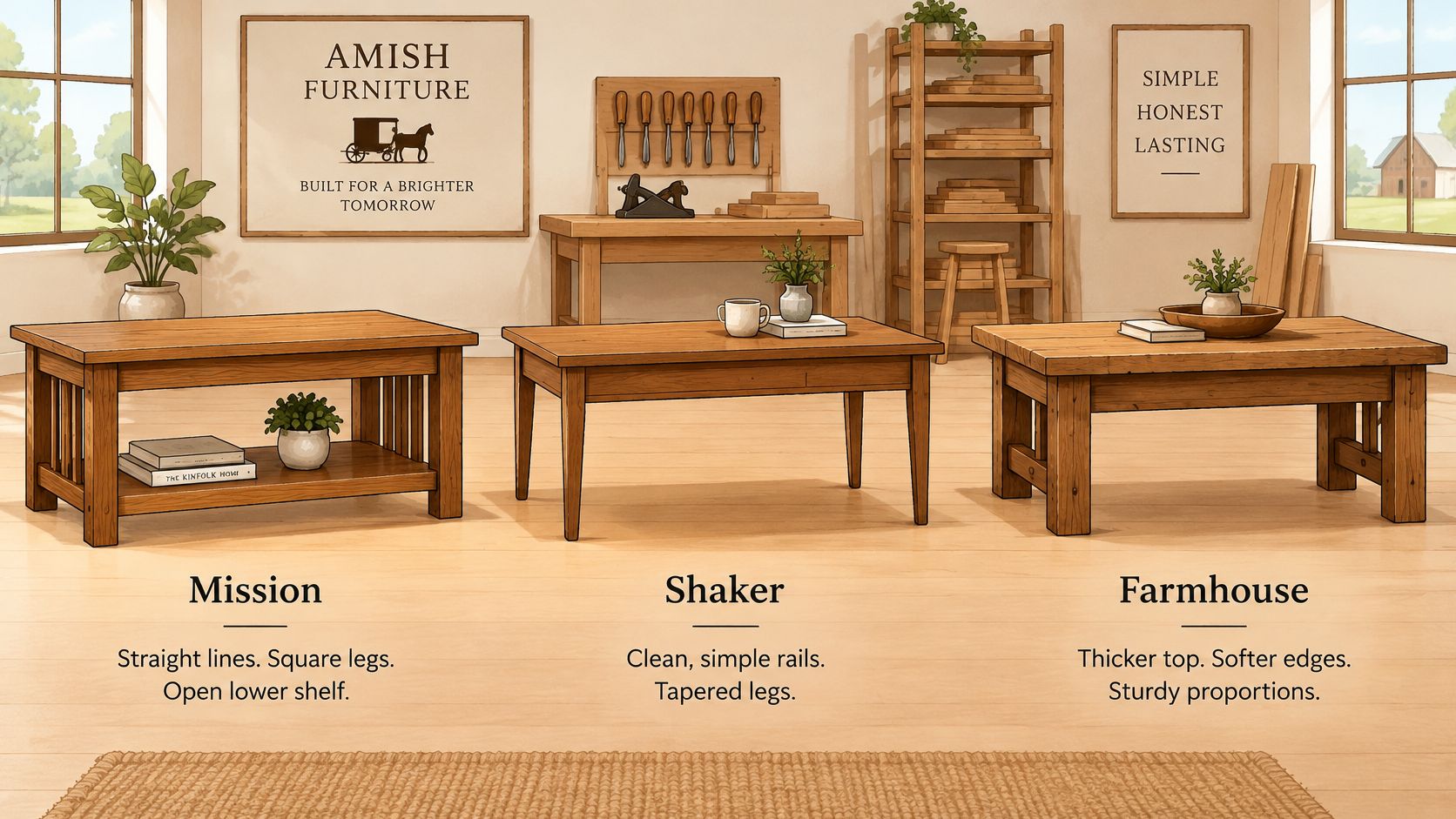
Three common style families give an Amish coffee table its visual character: Mission, Shaker, and farmhouse. Style helps narrow the choice, but it does not identify the maker or show how the table is built.
Choose the visual language first
Mission designs favor straight lines and a substantial frame, making them a natural fit for craftsman rooms and interiors with a grounded, architectural feel.
Shaker styling is quieter, with clean edges and restrained detailing. It suits minimal rooms where the wood surface and proportions take precedence. Farmhouse designs feel more informal; a distressed finish can shape that look, but it does not indicate construction quality.
Use photographs to decide which style belongs in your room. Then check the specifications for the details that affect daily use, including the finish and the table's construction. A sit-test at the Easton showroom can help confirm that the style feels right alongside your seating.
Regional roots still matter
Amish furniture history traces woodworking traditions through Pennsylvania, Ohio, and Indiana. National attention to Amish furniture grew as collectors and dealers recognized its folk-art and handcraft traditions.
For today's buyer, the maker's location is more useful than a broad label. Mavin is Amish-made in Ohio. Smith Brothers of Berne is made in Indiana and serves the upholstery side of a coordinated room. Canadel is handcrafted in Quebec, Canada, so it belongs to North American craftsmanship, not an American-made category.
Solid Hardwoods and Joinery That Last Decades
Cherry, oak, maple, and walnut offer different visual results and different responses to everyday wear. Species selection should begin with the household's tolerance for dents, visible grain, and color change, rather than with a promise that any hardwood is damage-proof.
Hardness primarily informs resistance to indentation. It doesn't determine whether a finish will scratch, whether a joint will loosen, or whether a top will accommodate seasonal movement.
Solid hardwood species for coffee tables
| Species | Grain and color | Best fit |
|---|---|---|
| Black walnut | Straight to wavy grain, deep chocolate brown | Warm, refined tops with a rich look |
| Black cherry | Fine grain, red-brown that deepens with age | Heirloom pieces that darken over time |
| Red oak | Open, pronounced grain, warm tan | Busy family rooms and expressive surfaces |
| White oak | Prominent grain, grayish tan, potential ray flecks | Classic Mission and craftsman looks |
| Hard maple | Pale, fine, even grain | Bright, smooth tops intended for daily use |
Walnut's darker surface can establish contrast against light upholstery. Cherry rewards a buyer who welcomes developing color rather than expecting a permanent match to the original sample. Oak makes the grain part of the design, while maple offers a quieter surface.
Inspect the base, not just the top
Apron-to-leg connections should use mortise-and-tenon, pinned mortise-and-tenon, or properly engineered corner blocks. End-grain screws alone shouldn't carry the responsibility for a frequently moved table.
With the seller's permission, apply gentle opposing pressure at diagonal corners. A stable base shouldn't visibly rack or click at its connections. Vinson's explanation of wood joints helps buyers recognize the construction vocabulary before visiting the showroom.
A thick top can look substantial while sitting on an inadequately braced base. The underside deserves the same attention as the finished surface.
Allow the top to move
The USDA Forest Products Laboratory reports that hardwood lumber for furniture, cabinets, and millwork is typically kiln-dried to approximately 6–8% moisture content. Drying is essential, but it doesn't make wood dimensionally inert.
In a heated Columbus home, winter conditions can draw moisture out of a top and cause contraction. Humid summer conditions can cause expansion across the grain. A properly designed attachment accommodates that movement rather than forcing the top to remain fixed.
Elongated fastener holes, figure-eight clips, or another suitable movement-tolerant system can keep the top secure without rigidly restraining it. Placement away from radiators, HVAC outlets, and exterior doors reduces abrupt exposure changes.
Before ordering, obtain the species of each component, top thickness, kiln-drying and acclimation practices, and attachment method. A clear answer about movement management is more useful than a general claim of heirloom quality.
Finishes and Year-Round Care for Central Ohio Homes
A finish determines both the surface's appearance and its repair path. A warm, easily renewed surface may suit one household better than a harder film that requires professional repair after serious damage.
Coffee table finishes compared
| Finish | Look | Repairability | Protection |
|---|---|---|---|
| Oil | Natural, matte, warm | Local renewal is often straightforward | Moderate |
| Oil-varnish blend | Soft sheen, often warm amber | Spot repair may be possible | Moderate to high |
| Lacquer | Clear, satin to gloss | Deep damage may require refinishing | High with appropriate care |
| Catalyzed varnish | Clear protective film in different sheens | Professional refinishing often needed | Strong, formulation-dependent |
| Water-based | Clear, often lighter in tone | Deep damage may require refinishing | Good, with lower solvent emissions |
The actual coating formulation matters more than a broad category name. “Water-based” describes the carrier, not a universal durability rating, and a catalyzed coating isn't immune to heat, standing water, or abrasion.
Select the repair path deliberately
Oil and oil-varnish finishes can be attractive where future local repair matters. The trade-off is that a household may need to renew the surface and respond promptly to moisture.
Film finishes generally offer a more protective barrier. However, a deep gouge through a catalyzed film can be harder to blend invisibly than wear on an oil-finished surface. Ask for the exact finish name, approved cleaner, curing instructions, and repair procedure.
Practical distinction: A finish that tolerates everyday use and a finish that repairs easily aren't necessarily the same finish.
Keep care simple and consistent
A reliable routine should protect the coating without adding unnecessary products. Vinson's wood furniture care guide provides a useful reference alongside the maker's finish-specific instructions.
- Remove grit gently. Use a clean, soft cloth and avoid dragging abrasive dust across the surface.
- Separate heat and moisture. Place coasters beneath drinks and protective mats beneath warm serving pieces.
- Blot spills promptly. Don't leave moisture beneath trays, cups, or folded textiles.
- Control exposure. Avoid direct sunlight and concentrated heat from vents or fireplaces.
Indoor air quality also deserves a purchasing question. Colorado State University Extension advises asking about formaldehyde content in furniture and improving ventilation, an especially relevant consideration after renovations or for sensitive households.
Stable indoor conditions protect the whole table, not just its finish. The strongest-looking coating on a sample board won't compensate for unsuitable placement or a care routine the household won't maintain.
How to Verify an Amish-Made Table
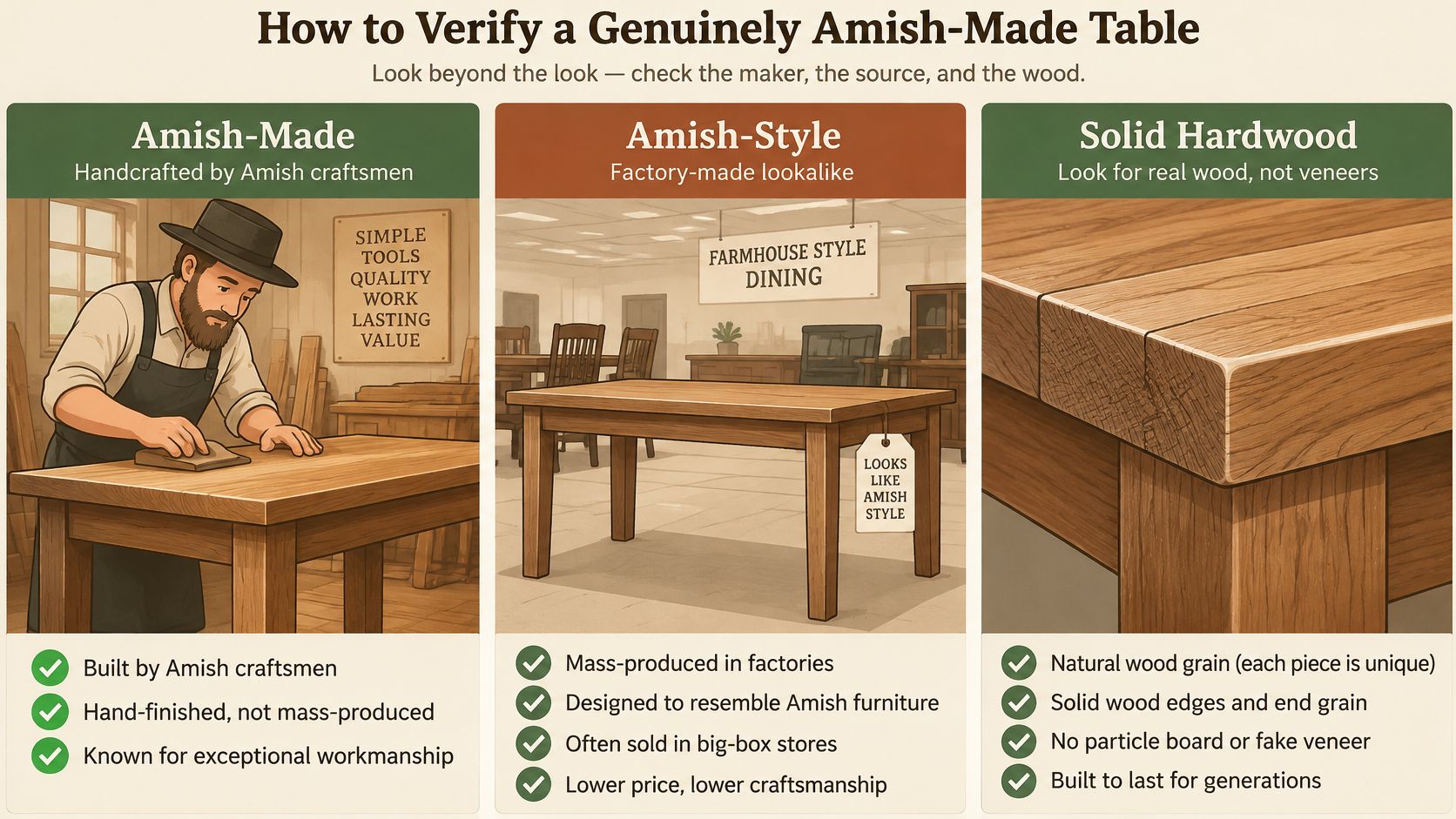
Start with traceable details: who built the table, where it was made, and what materials and construction the seller can document. Amish heritage furniture information can help frame questions about a maker's background, but a style description alone does not establish who built a particular piece.
Request traceable answers
- Identify the builder and location. Ask for the maker's name or workshop location.
- Identify every wood component. Confirm the species used for the top, legs, aprons, drawer fronts and sides, panels, and trim.
- Inspect concealed surfaces. Check the underside and drawer interiors for construction details that polished photographs may not show.
- Ask about the joints. Visible pins or tenons can support an explanation of how the table was assembled, but appearance alone does not establish who made it.
- Get written specifications. Record the wood species, top thickness, finish system, and maintenance requirements.
- Clarify customization. Ask which dimensions, species, finishes, and hardware can be changed.
- Request warranty and testing documents. Distinguish documented performance claims from a seller's assurance.
Vinson's published Hardwood Standard states that the company sells and promotes solid hardwood furniture, excluding engineered wood, MDF, laminate, and particle board. That policy describes materials. For an individual table, ask for its maker and construction details as well.
Treat certification as a document, not a phrase
The verification framework associated with USDA Forest Service guidance includes questions about stability, load, and durability. If a seller cites a testing standard or certification, ask for the supporting documents and confirm what was tested and by whom.
A missing test certificate does not, by itself, establish that a workshop-built table is poorly made. It does mean you should weigh documented testing separately from warranty terms, construction details, and the maker's claims.
Vinson's heritage Amish furniture information provides a starting point for a showroom conversation. Bring your questions, then inspect the table's details and confirm that its footprint suits your room before comparing price tags.
Customizing Your Table Through the Custom Order Program
A custom table should solve a fit problem, not merely offer a different stain. The process resembles tailoring a suit: useful measurements come before production, and attractive materials can't rescue incorrect proportions.
Vinson's Custom Order Program information describes fabrics, finishes, dimensions, and 3D visualizers across Smith Brothers, Canadel, and Mavin. Available changes remain product-specific, so a program-wide option shouldn't be assumed available on every coffee table.
Turn the room plan into a specification
For a table, the useful questions concern top length and depth, base style, edge profile, species, and finish. A walnut top with a maple base may be worth exploring, but mixed-species construction and finish compatibility need confirmation before becoming part of the order.
Visualizers help compare supported combinations. They don't replace physical samples, and screen color shouldn't serve as final approval for a finish expected to coordinate with existing furniture.
The In-Store Design Studio and Complimentary Design Consultations at Easton Town Center give the selection process a practical setting. A consultant can evaluate a table beside upholstery samples and review whether the proposed footprint suits the sofa and rug.
- Coordinate the room. Top-grain and performance leathers, fabrics, and hardwood finishes should be reviewed together.
- Test moving furniture. Power-motion sectionals and reclining seating need operating clearance; swivel chairs, accent chairs, rockers, and gliders need their own movement space.
- Keep categories accurate. Smith Brothers furniture at Easton supports seating decisions, while Mavin bedroom furniture and Amish-made dining sets can inform a coordinated whole-home palette.
Approve the details before production
Vinson's guide to getting started with a custom order supports a measured approach rather than a rushed selection. Searches such as “solid wood furniture Ohio” or “custom leather sectionals Columbus” become more useful once tied to actual room requirements.
The final order should state dimensions, materials, finish, hardware, price, estimated production timing, and change or cancellation terms. Made-to-order lead times can affect a renovation schedule, so the written estimate should guide planning rather than an assumed arrival date.
Confirm the Fit at the Easton Showroom
The next step is a sit-test at Easton Town Center. A coffee table should feel comfortable at knee height, remain within practical reach, and leave the surrounding seating usable.
Vinson is family-owned, formerly Kitchen Tables & More, and serves Central Ohio with a focus on North American craftsmanship. The showroom visit should confirm scale, finish coordination, and the construction details behind the proposed order.
Compare value and delivery terms
Vinson's published value and consultation information describes a Low Price Guarantee refunding 110% of the difference for qualifying lower prices at local authorized dealers within 30 days, plus Clearance Gallery savings up to 70% on selected floor samples, overstocks, and seasonal closeouts.
Its White-Glove Delivery service includes inspection, room-of-choice placement, assembly or light installation, packaging removal, and a final walkthrough. Flexible financing through the Synchrony HOME Credit Card is also available, subject to applicable terms.
- Bring measurements. Include doorways, seating dimensions, and the taped footprint.
- Bring references. Room photographs and existing finish samples help establish context.
- Bring questions. Request the itemized quote, production estimate, warranty, and delivery scope.
Vinson Fine Furniture offers solid-hardwood selections, customization support, and complimentary design guidance for a coffee table intended to stay through future room changes. A visit to Vinson Fine Furniture lets Columbus homeowners check store hours, explore available clearance selections, and plan an Easton showroom sit-test with measurements and finish samples in hand.