Salvaged Wood Sideboard Buyer’s Guide for 2026


The first clue is usually tactile. A homeowner runs a hand across a weathered top, feels the ridges in the grain, and wonders whether the marks are honest age or a warning that the piece will start shifting as soon as the seasons change. That question matters with a salvaged wood sideboard, because the best ones carry history in the surface and discipline in the structure.
A sideboard is a long, low storage piece built for serving, display, and dining-room organization, with drawers and cabinets as its usual working parts. Reclaimed lumber is wood recovered from earlier use, often from barns, factories, warehouses, boxcars, coal mines, or wine barrels, then given a second life in furniture. Put the two together and you get a piece that can feel rustic, formal, and highly practical at the same time, if the maker has handled the wood correctly.
What a Salvaged Wood Sideboard Really Is
The smartest way to understand this furniture is to separate the shape from the material. The sideboard is the form, a dining-room cabinet that grew out of earlier serving tables and settled into a long, low silhouette with storage below and a working surface above, as described in reference histories of the category. Salvaged wood is the material story, lumber pulled from an earlier life and reused instead of milled fresh.
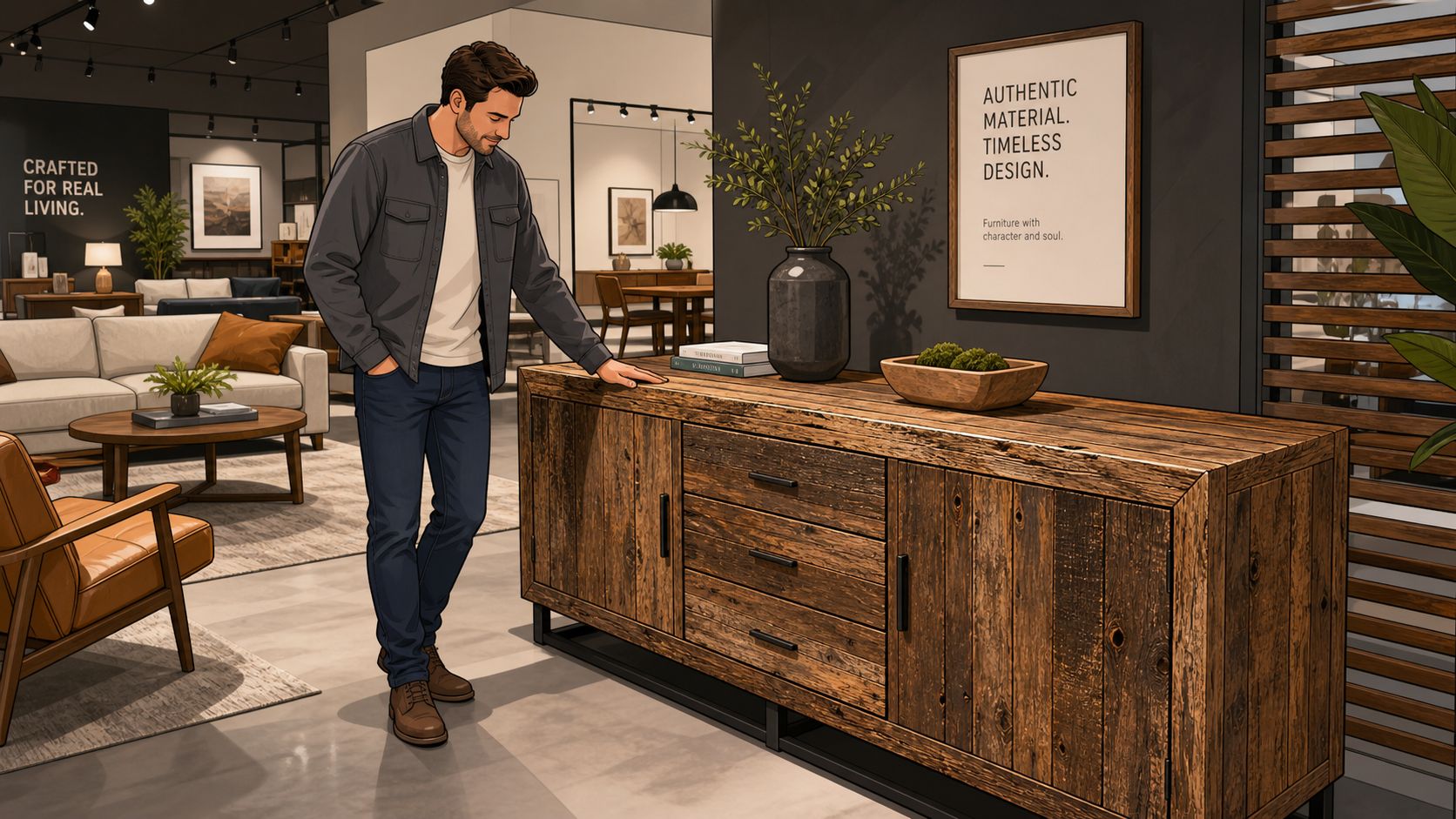
That combination is why these pieces read differently from ordinary storage cabinets. The grain usually looks more varied, the wear can be visible, and the boards often carry provenance from old structures rather than anonymous stock. A homeowner shopping for one should think of it as a hybrid, part heritage furniture form, part reuse-driven material record.
Where the wood usually comes from
Reclaimed stock commonly enters the market through salvage stores, local salvage yards, specialty lumber suppliers, and online marketplaces. That sourcing path matters because it affects both appearance and trust. A board from a documented barn beam tells a clearer story than a board with no origin at all, even if both can be attractive.
Practical rule: character is only valuable when the structure underneath it is sound.
For a first-time buyer, the key is to stop judging the piece only by color and distress marks. A salvaged wood sideboard should still behave like a furniture cabinet, with doors that close cleanly, drawers that glide, and a top that stays flat enough to live with. Vinson Fine Furniture's buffet and server collection is a useful place to compare those forms side by side, because the shopper can separate style from build quality before making a decision.
How to Judge the Wood Before You Buy
Start with the end grain. That edge tells a more honest story than the top face, because it can reveal rot, splits, insect damage, and the depth of weathering that sanding won't remove. Experienced woodworkers also look for embedded grit, since old boards often carry dirt deep into the fibers and that grit can chew through tools, dull blades, and interfere with finish adhesion.
What stable reclaimed wood should look like
A serious buyer should ask whether the boards were re-milled, acclimated, and moisture-matched before assembly. In furniture work, kiln-dried hardwoods are commonly targeted to about 6% to 8% moisture content for interior equilibrium, while reclaimed lumber that never gets reconditioned can keep shrinking, swelling, or cupping after the piece is built. A moisture meter is worth asking about because material above 20% moisture content is prone to warping and cracking as it dries. Woodcraft's salvaged wood guidance calls that out plainly.
A maker who works carefully should also be able to describe how the boards were cleaned and stabilized. That usually means metal detection, fastener removal, and some amount of finish testing before topcoating. Without that prep, stain blotching, adhesion failure, and hidden contamination can show up later in the room, not on the showroom floor.
Buyer's check: if the seller can't explain how the wood was cleaned, dried, and fitted, the patina may be doing more work than the joinery.
The quick inspection list
- Check the end grain: Look for rot, insect trails, and splits that continue past the surface.
- Ask about moisture: Stable indoor furniture should be conditioned before assembly, not after delivery.
- Look for sound joinery: Strong panels, allowances for movement, and well-fitted doors matter more than distress marks.
- Inspect for hidden debris: Nails, screws, and grit can damage both the piece and the finish.
- Ask how much material was removed: Weathered stock often needs deeper cleanup than it first appears.
A practical rule from reclaimed-wood makers is that weathered faces often need about 1/8 to 1/4 inch per side removed to get past damaged fibers. That means a sideboard that looks thick and substantial on the outside still needs careful milling on the inside. This reclaimed-wood reality check is useful precisely because it reminds buyers that old boards are not automatically ready boards.
Pricing and Value Compared to Other Sideboards
Price makes sense only after the wood and the work are understood. A salvaged wood sideboard can cost more or less than a new cabinet depending on what went into it, because the visible age of the wood is only one part of the value equation. Species, provenance, joinery, and hand-finishing all shape the final number, and each of those factors changes how the piece will wear over time.
What drives value
A documented board from an old barn or warehouse usually has more story and often more labor behind it than an unmarked piece of scrap stock. Furniture built from older-growth timber can also feel denser and more substantial, but that only helps if the boards were screened for defects. The value comes from the combination of material character and careful construction.
| Attribute | Salvaged Wood Sideboard | New Solid Hardwood | Engineered Wood/MDF |
|---|---|---|---|
| Visual character | Distinct grain, age marks, provenance | Clean, consistent, more uniform | Usually uniform, less tactile depth |
| Dimensional behavior | Depends heavily on reconditioning and joinery | More predictable when properly built | Can be less forgiving around moisture |
| Repairability | Strong when built from real boards and serviceable parts | Typically repairable and refinishable | Limited repair once damaged |
| Long-term feel | Can be heirloom-worthy if crafted well | Strong long-term value when made from solid cherry, oak, maple, or walnut | Shorter horizon for serious investment buyers |
That table matters because it frames the purchase around lifespan, not just first impressions. A homeowner shopping for solid wood furniture Ohio should think in terms of repairability and movement, not surface style. The best long-term value still comes from solid hardwood construction, especially cherry, oak, maple, or walnut, because those materials stay in the serviceable furniture category rather than sliding into disposable construction.
A value lens that avoids shortcuts
The important distinction is simple. A sideboard made from salvaged boards can be a treasure, but only if the structure is as disciplined as the surface is interesting. If the maker cut corners on drying, cleanup, or joinery, the price is carrying more risk than value.
For buyers comparing options, this guide to solid wood versus engineered wood is worth reviewing because it clarifies why material choice matters for a piece expected to live in a dining room for years. Local shoppers also have practical ways to stretch a budget without sacrificing quality, including Low Price Guarantee offers and Clearance Gallery savings, which keep premium furniture within reach when the right piece appears.
Sizing Styles and Configuration Choices
A sideboard can look perfect and still fail the room if it lands too heavy, too tall, or too shallow for the wall it needs to serve. That's why size and configuration deserve the same attention as grain and finish. The best piece supports traffic flow, gives the eye a place to rest, and still leaves room for drawers to open without bumping chairs, radiators, or door swings.
Choose the footprint first
The most reliable way to shop is to measure the wall, then mark the usable zone with painter's tape. That quickly shows whether the room wants a broad, low buffet or a slimmer cabinet that reads more like a console. In a dining room, the piece should feel anchored, not crowded, and in an entryway it should leave a clear path for movement.
Match storage to how the room works
- Drawer-heavy layouts: Best for flatware, linens, chargers, and small serving tools.
- Cabinet-door layouts: Better for larger serving pieces, baskets, and mixed storage.
- Open shelving: Useful when display matters, but it asks for visual discipline.
- Closed storage: Keeps the room calmer and usually reads more formal.
Base style changes the entire mood. A plinth base feels grounded and architectural. Tapered legs make the piece lighter, which helps in smaller rooms or tighter entryways. The same salvaged boards can feel traditional, mid-century, industrial, or modern farmhouse depending on how the base and hardware are handled.
See the silhouette in person
A salvaged finish can read warmer or rougher than it does online, and that changes how the room feels around it. A showroom visit helps the buyer judge scale, sheen, and edge detail in real light, where the weight of the wood and the spacing of the doors are easier to read. This configuration guide can help shoppers think about the piece as a real object, not just a photo.
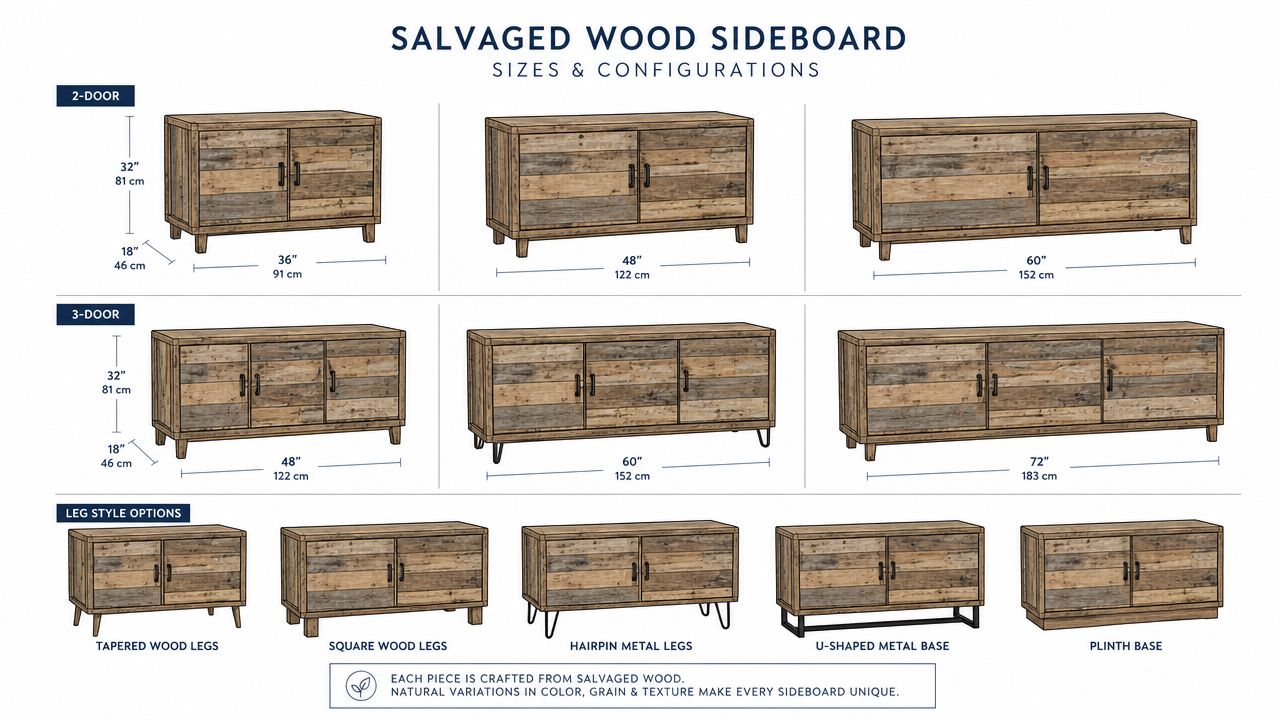
A simple rule helps here. The more visual texture the wood has, the more important surrounding restraint becomes. Lighter chairs, quieter hardware, and simpler accessories keep the sideboard from swallowing the room.
Care and Maintenance That Protects the Patina
A well-made sideboard should age gracefully, not drift into cracks and misaligned doors. That takes a stable home environment as much as it takes a good finish. Reclaimed boards already had one life cycle before they reached the showroom, so they deserve steadier conditions than a typical mass-produced cabinet.
Keep the room stable
Humidity swings are hard on mixed-age wood. If the home runs too dry, boards can tighten and separate. If it runs too damp, they can swell and press against each other. The kiln-dried benchmark of 6% to 8% moisture content only means something if the house itself stays reasonably conditioned.
Cleaning should stay simple. Use a soft cloth, avoid soaking the surface, and wipe spills as soon as they happen. Harsh all-purpose cleaners can dull the finish faster than most owners expect, especially on reclaimed surfaces with varied grain density.
Wax, oil, or film finish
The finish choice changes how the sideboard ages.
- Wax and oil: Softer visual feel, easier local touch-ups, but more sensitive to spills and abrasion.
- Film finishes: Better barrier protection, more uniform sheen, and usually stronger for active households.
- Mixed-age reclaimed stock: Needs finish compatibility testing so the topcoat bonds evenly across boards of different ages.
Old boards don't forgive sloppy prep. The finish only looks good when the sanding, sealing, and curing steps were handled with equal care.
The warning signs are easy to spot once the owner knows what to watch for. Finish cracking, new gaps between boards, sticking doors, and drawers that suddenly feel out of square all point to movement, not just cosmetic wear. That's the time to contact the maker rather than covering the symptoms with more polish.
A useful visual reference for layered, lived-in interiors can also help with styling and care choices. That Blanket Co's photo blankets resource offers a useful example of how soft materials and natural textures are presented in calm, usable rooms, which is helpful when the sideboard sits among textiles and other warm finishes. This wood-furniture care guide is also worth keeping nearby for routine maintenance.
Styling Ideas for Every Room in the Home
A salvaged piece carries enough visual weight to anchor a room, which is why styling should be selective, not crowded. The goal is to let the grain do some of the talking while the surrounding objects support the composition. Too many small objects turn a strong cabinet into clutter; a few deliberate pieces let the wood breathe.
Three room-by-room approaches
In a modern farmhouse dining room, the sideboard works best beside linen-upholstered chairs, a simple runner, and matte black hardware. The reclaimed top brings warmth, while the textiles soften the structure and keep the room from feeling overly rustic. A tray for serving pieces can sit centered on top, but it should leave enough blank space to show the grain.
In a transitional entryway, the same piece can feel more polished. A round mirror above it, ceramic lamps on either side, and a small stack of design books create a balanced landing spot for keys, mail, and a single bowl. If the room already has strong flooring or trim, the sideboard should echo those tones instead of competing with them.
In a minimalist living room, the sideboard can function as a low media console. A neutral palette, one large artwork, and very little else let the patina carry the room's warmth. The trick is contrast, not competition, so the roughness of the wood stands out against smooth walls and clean-lined seating.
Styling rules that keep the look intentional
- Balance the weight: Pair heavy reclaimed wood with lighter fabrics, glass, or pale upholstery.
- Layer texture carefully: Use linen, ceramic, woven baskets, or a single tray instead of many small accents.
- Leave empty space: Negative space makes old grain look richer, not bare.
- Use light with restraint: Lamps should illuminate the surface without creating visual noise.
For homeowners drawn to a calmer, more gathered feel, these cozy decor ideas offer a useful texture and lighting reference. The same principle applies here, because a sideboard looks best when the room around it has some softness to absorb its visual weight.
Buying Local and Customizing at Vinson Fine Furniture
Local buying changes the experience because the buyer can see the finish, feel the weight, and test the scale in person instead of guessing from a listing. At Easton Town Center, a family-owned showroom like Vinson Fine Furniture gives Columbus and Central Ohio homeowners a place to compare real materials, ask questions, and make decisions with a design consultant rather than a product page. That matters most for people who treat furniture as a long-term investment.
What local service adds
The In-Store Design Studio and complimentary design consultations help buyers coordinate finish, size, and room layout before a purchase is locked in. That is especially useful when a sideboard needs to work with existing dining chairs, nearby flooring, or a tricky wall span. The Custom Order Program also lets shoppers tailor details through brands like Canadel, Mavin, and Smith Brothers, which is the kind of flexibility that turns a nice piece into the right piece.
For shoppers who value craftsmanship and local support, ethical shopping for craftsmanship is a relevant mindset. It's a reminder that where a piece comes from matters almost as much as how it looks in the room.
Practical purchase advantages
- Low Price Guarantee: If a lower authorized local price is found within 30 days, the difference is refunded at 110%.
- Clearance Gallery: Floor samples, overstocks, and closeouts can offer savings up to 70%.
- White-Glove Delivery: Multi-point inspection, assembly, and packaging removal reduce the risk of a rough first day at home.
- Solid hardwood focus: The standard stays centered on cherry, oak, maple, or walnut, never on engineered substitutes.
Vinson Fine Furniture is a family-owned business formerly known as Kitchen Tables & More, serving Central Ohio with a focus on Ohio, USA, and Canada manufacturing and Amish-made craftsmanship in solid hardwood. For a buyer comparing a salvaged look against a fully customized dining or storage piece, the custom order starting point can help clarify what's possible before making the trip.
Your Decision Checklist and Common Questions
The cleanest way to buy a salvaged sideboard is to treat it like a structural purchase, not just a style choice. The surface matters, but the joinery, moisture behavior, and finish prep matter more over time. A good piece should feel steady when the doors close, sound dense when knuckles tap the top, and look intentional rather than over-distressed.
Quick checklist
- Check the wood history: Ask where the lumber came from and whether it was documented or repurposed.
- Inspect movement risk: Look for re-milled, acclimated boards with moisture matched for interior use.
- Review the finish: Confirm that old coatings, grit, and contamination were addressed before topcoating.
- Test the fit: Doors, drawers, and panels should move cleanly without binding.
- Measure the room: Scale should fit the wall, the traffic path, and the furniture already in the space.
- Choose for lifespan: Solid hardwood construction stays the most trustworthy path for long-term value.
Common questions
Are salvaged wood sideboards safe for dining and storage use?
They can be, but only when old finishes, contamination, and hidden fasteners are handled properly. A buyer should ask how the wood was cleaned, whether finish compatibility was tested, and whether the piece was built for indoor cabinetry use.
Why does reclaimed wood vary so much from piece to piece?
Because each board has its own past. One plank may come from an old beam with dense grain, while another may carry more wear, more patching, or more cleanup work.
How long should a well-made reclaimed sideboard last?
There isn't a universal number to promise, but a properly built piece can become a long-service heirloom when the wood is stabilized, the joinery allows for movement, and the finish is maintained carefully.
How do custom orders usually work?
A buyer selects the form, chooses the details, and then confirms the finish, size, and hardware before production. A good showroom makes that process easier by helping the customer visualize the final piece in the room first.
A salvaged wood sideboard works best when the story on the surface matches the craftsmanship underneath it. Visit Vinson Fine Furniture to compare solid hardwood storage pieces, explore customization with design help, and see how a well-built sideboard can bring lasting weight, warmth, and usefulness into the home.