
Adjustable Bed Frames: A Buyer’s Guide


You can tell a couple is due for a real sleep upgrade the moment the pillows start piling higher every night. One person wants to read upright because reflux flares after dinner, the other is tired of being jolted awake by snoring, and both are trying to make a flat mattress do a job it was never built for. Adjustable bed frames fix that problem at the source by moving the mattress, not by adding more cushions and hoping for the best.
The category isn't niche anymore. Grand View Research estimated the global adjustable bed frames market at USD 4,376.4 million in 2024 and projected USD 8,614.4 million by 2033. That's a mainstream residential purchase now, not a medical oddity tucked away in a hospital catalog.
What an Adjustable Bed Frame Does in Your Bedroom
An adjustable base changes the bed to fit the night. One sleeper raises the head to read, another lifts the legs to reduce pressure on tired lower backs, and a couple can settle into different positions without rebuilding a pillow stack every evening. The bed stops being a fixed platform and starts doing part of the comfort work.
That shift shows up in who buys these bases. Grand View Research reported that residential buyers accounted for 67.10% of the market, which fits what happens in real homes, not just care settings. The same report showed North America held 35.69% of the global market in 2024, so this is already a familiar category in bedrooms like the ones around Columbus and Easton Town Center.
The nightly use case is usually more ordinary than people expect
A buyer usually wants a better bedtime setup, not a dramatic medical solution. The reasons are familiar, reading in bed, easier breathing, quieter sleep with a partner, or a more comfortable position after a long day on your feet. That is why the strongest case for an adjustable base is not a list of features. It is the way one bed can support two different sleep styles without turning the room into a pile of extra pillows.
If a mattress only feels right when pillows are propping someone upright, the bedroom is already asking for an adjustable base.
That is also why this category belongs in normal home shopping. The market share data points to a product that has moved into everyday residential furniture decisions. Buyers are comparing comfort, clearance, space, and long-term value, which is exactly how a showroom consultant should frame the choice. A good setup also needs the rest of the bed to cooperate, so if a base is replacing a traditional support setup, read why you really do need a box spring for your bed before assuming every bedroom layer should stay the same.
How Adjustable Frames Work Under the Mattress
A good adjustable base starts with the part nobody sees. Under the mattress, it uses a steel support system with hinge points and lift sections that let the head and legs move while the center stays stable. The frame does not change the whole room. It changes the sleeping surface, which is what matters in a bedroom with limited clearance, a heavier mattress, or a setup that has to work every night without fuss.
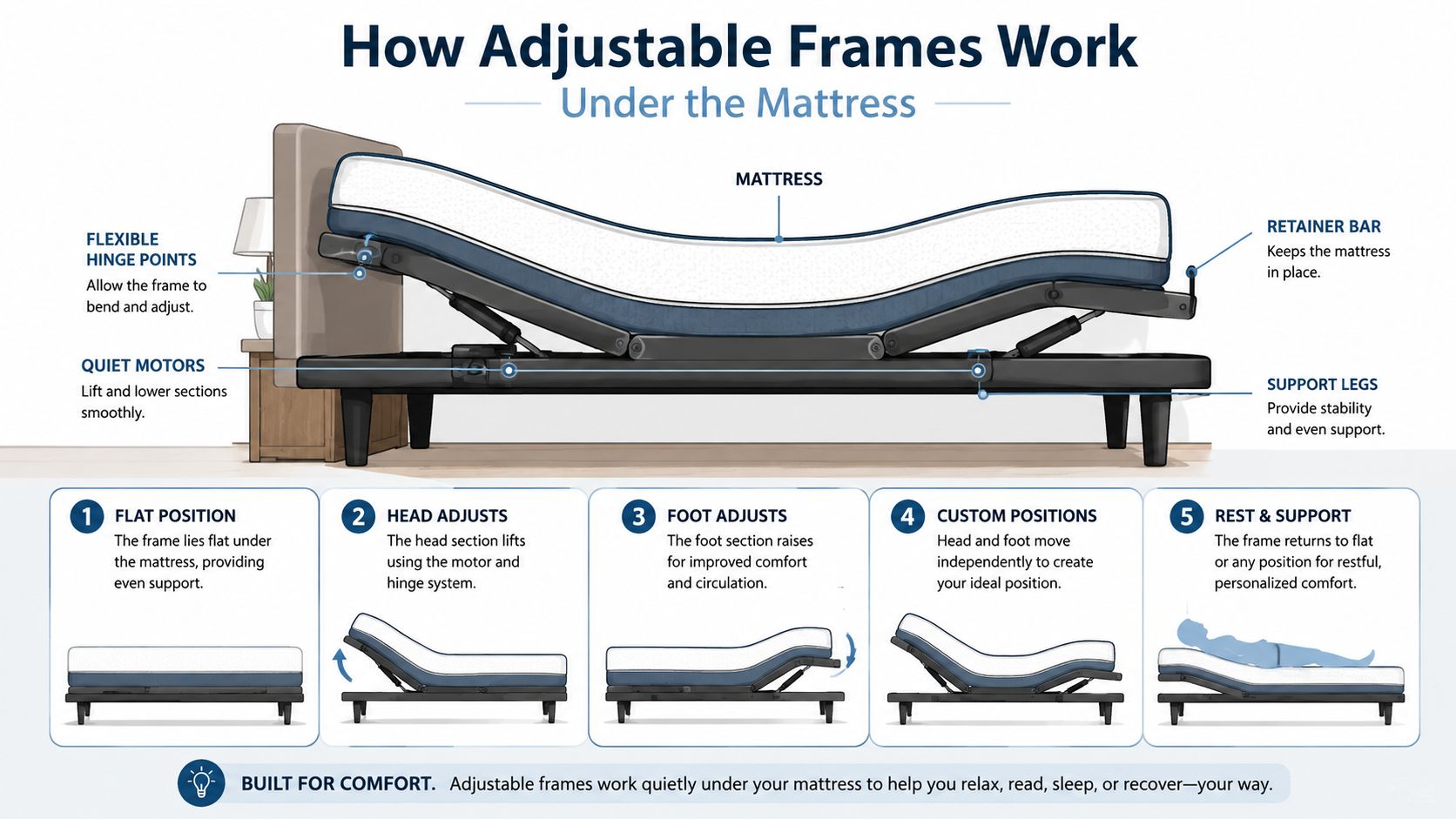
A residential technical manual lists a 52.5° backrest and 45° legrest articulation range, along with 110V/60Hz power input and an 800 lb maximum supported load (technical manual). Those numbers matter because they show how much movement the frame can deliver and how much weight the structure is built to carry. If the mattress is dense or resistant to bending, the frame has to do more work, and the support system has to hold its shape without strain.
The mechanism itself has a few parts worth checking before anyone talks about remotes or presets.
- Lift motors: These drive the motion under the mattress. Paired motors usually give the frame a more controlled feel.
- Load-bearing chassis: A steel frame keeps the base steady when it is raised, lowered, or held at an angle.
- Hinge points: These are the bend locations. If they are weak, the mattress and base fight each other.
- Power input: Standard household power keeps the setup straightforward, but the base still needs a nearby outlet.
A frame that moves smoothly is doing its job. A frame that jerks, strains, or looks overworked is a problem waiting to show up once a dense hybrid or memory-foam mattress is placed on top. That is also why support decisions should be made before the bed is purchased, not after. If the bedroom still uses a traditional foundation layer, read why you really do need a box spring for your bed so the support system under the mattress makes sense instead of working against the base.
A base with a clean articulation range is one thing. A base that holds position without creaking, wobbling, or fighting the mattress is the one worth buying.
That is the same logic behind a high-low bed for care facilities. The purpose is different, but the mechanical lesson is the same. The frame has to move the mattress platform in a controlled way, support the load, and keep the user comfortable without making the structure feel flimsy.
Key Features Worth Comparing Before You Buy
A buyer gets more value by comparing the specifications that change nightly comfort than by chasing novelty features. Start with how far the base moves, then check whether it can carry the mattress and sleepers without strain.
Market research on adjustable bed bases places the category in steady growth, with powered units leading the field and queen-size setups staying central to residential buyers. Those patterns match what a showroom sees every day. Home buyers usually want a base that moves cleanly, supports real weight, and fits the room without forcing the rest of the bedroom setup to work around it.
The features that change the experience
| Feature | What it changes at night | Who should care |
|---|---|---|
| Articulation range | How high the head and feet can lift | Anyone who reads, watches TV, or needs stronger positioning |
| Motor count | How smoothly and independently the base moves | Couples and heavier mattress owners |
| Weight capacity | Whether the frame handles sleepers plus mattress safely | Nearly every buyer should check this first |
| Remote style | How easy it is to adjust without fumbling in the dark | Older buyers and anyone who changes positions often |
| Presets | Fast access to common positions like Zero Gravity, TV, and Anti-Snore | Shoppers who want convenience more than customization |
| Smart extras | Lighting, snore detection, app control, and similar add-ons | Buyers willing to pay for comfort and convenience layers |
What matters and what doesn't
The presets people use most are the ones worth paying for. Zero Gravity and Anti-Snore solve common comfort problems quickly, while TV mode raises the head enough to avoid piling up pillows. Smart extras can be useful, but they should sit behind the basics, not replace them.
Weight capacity needs a hard look. Industry buying guides note that many bases support a wide range of total load, including sleepers and mattress, and the number matters once a dense mattress and two adults are involved. A weak frame feels fine in the store, then starts to show its limits once nightly use, movement, and mattress weight all land on it.
The support system under the bed matters just as much as the remote in your hand. If your setup still depends on a traditional foundation layer, read why you really do need a box spring for your bed so the base, mattress, and support pieces work together instead of fighting each other.
That same practical mindset applies to a high-low bed for care facilities. The use case is different, but the lesson is the same. The frame has to move smoothly, hold position, and support the load without feeling flimsy.
For shoppers comparing premium and mid-tier bases, the question is simple. Does the higher price buy quieter movement, stronger support, or a layout that fits the household? If it does not, the upgrade is mostly cosmetic.
Split Options and Sizing for Solo Sleepers and Couples
The biggest regret usually comes from picking the wrong layout. A single-unit base moves as one piece, so both sleepers get the same position. A full-split base gives each side independent control. A split-head model splits the upper section while keeping the lower section shared.
Consumer Reports identifies those three core constructions, single unit, full split, and split head. That is the decision point. The layout changes how the bed works in daily life, not just how it looks in a showroom.
Which layout fits which household
- Single unit: Best for solo sleepers, guest rooms, or anyone who wants one clean adjustment for the whole bed.
- Full split: Best for couples with different bedtimes, different elevation needs, or very different comfort preferences.
- Split-head: Best for couples who want independent head positions but do not need separate lower-leg movement.
Queen still draws a lot of attention in this category. Market research from Grand View Research and Mordor Intelligence both point to queen configurations as a major choice for buyers, which makes sense because queen fits many rooms and sleep setups without forcing the bedroom to work around the bed (Grand View Research, Mordor Intelligence). That is why so many households start there. It is familiar, practical, and usually easier to fit into a real bedroom.
Size is a decision, not just a measurement
Twin XL is a common starting point for split systems. King often shows up as two Twin XL bases when separate control matters. California King can work in longer rooms, but the bedroom still has to handle the footprint without making it hard to walk around the bed.
The right size also depends on how the bed gets used at night. A king-size adjustable setup is often discussed as a pair of coordinated bases, which is why couples should think about motion independence before they get distracted by finishes or styling details (Vinson couples guide). If one person rises early and the other reads late, the split choice is not a luxury. It is the difference between a bed that supports both people and one that turns sleep into a nightly compromise.
Will Your Current Bed Frame and Bedroom Work
Many buyers make their first expensive mistake here. An adjustable base does not just need room, it needs the right kind of room. A low-clearance frame, a solid center support, or a fixed platform deck can stop the mechanism from moving cleanly and can wear the lift system down over time.
Clearance is the first thing I check. Adjustable bases generally need about 3 to 5 inches of open space so the mechanism can move freely. The frame also needs to leave enough room for the base height and the mattress stack, because a setup that fits on paper can still feel cramped once it is in the bedroom.
A quick bedroom audit pays off
- Check under-bed space: If the frame is boxed in underneath, the base may not articulate properly.
- Inspect slats and supports: Solid center supports can obstruct movement.
- Measure wall and doorway clearance: Moving a heavy base through tight spaces gets difficult fast.
- Look at outlet placement: The bed needs reliable power without awkward extension setups.
- Think about ceiling height: Raised positions feel different in a room with a low ceiling.
A showroom-quality decision starts with a tape measure, not a remote.
The practical takeaway is blunt. A decorative bed frame that looks good with a flat mattress may be the wrong shell for an adjustable base. If the current furniture is too closed-in, replacing the frame usually makes more sense than forcing a mismatch that fights the mechanism and complicates the room.
For shoppers who want to translate that into a real-room plan, a bed-size guide can help with dimensions before the purchase is placed, including a clear look at king-size bed frame measurements and room fit(Vinson king frame guide). The goal is not to guess. It is to confirm that the base can move, the room can host it, and nobody is stuck rearranging the bedroom after delivery.
Mattress Compatibility and Pairing Rules
The mattress is half the equation, and the wrong one can make an excellent base feel disappointing. Flexible foam and many hybrid designs move more naturally with an articulating frame, while stiffer builds can crease, hump, or fight the hinge points. That strain shows up in comfort first, then in wear.
The issue is flex behavior. A mattress that bends cleanly at the base's articulation points keeps the sleeping surface supportive. A mattress that resists movement turns the adjustable frame into a compromise, especially at the head and leg sections.
General pairing rules by mattress type
| Mattress type | Typical fit on adjustable bases | Main risk |
|---|---|---|
| Memory foam | Usually a strong match because it flexes readily | Heat and height, depending on construction |
| Latex | Often works well if the build is pliable | Stiffness in thicker or denser models |
| Hybrid | Can pair well if the coil system is designed to bend | Edge rigidity and hinge stress |
| Innerspring | Often the weakest match | Creasing, reduced flex, possible support issues |
A thicker mattress can also change the whole feel of the setup. Put a tall mattress on a tall base and the bed may sit higher than intended. Put a low-profile mattress on a tall base and the proportions can feel awkward, even when the mechanics work.
Bottom line: The mattress should flex with the base, not against it. If the mattress feels stubborn in the store, it'll feel stubborn at home.
The safest move is to treat the mattress and base as a pair, not as separate purchases. That's especially true when the existing mattress is already mid-life and showing body impressions. A coordinated replacement often makes more sense than forcing an old mattress to serve a new mechanism.
For buyers narrowing the mattress side of the equation, a focused selection guide helps separate flexible comfort builds from rigid ones (Vinson mattress guide). The conversation should be about fit, flex, and longevity, not just feel on the first night.
What to Expect to Spend and What You Get for It
An adjustable base should be judged as a long-cycle purchase, not a quick accessory. The best value comes from choosing a frame that still feels solid and current when the mattress on top has already moved through a big part of its life. A buying guide says adjustable beds tend to last 10 to 20 years, while the mattress on top usually lasts 7 to 10 years. That gap matters, because a good base can outlast one or even two mattresses.
The premium question is not whether a buyer can spend more. It is what the extra money buys. In practice, higher tiers usually bring stronger motors, quieter movement, split configurations, more useful presets, and better electronics. If those upgrades do not match how the household sleeps, the price jump is wasted.
How to think about the price ladder
- Entry level: Best for single sleepers or guest rooms that need basic positioning without extra bells.
- Mid-tier: Usually the sweet spot for most households, because it balances quiet operation, stronger support, and useful presets.
- Premium: Worth considering when the household wants split control, massage, lighting, app functions, or the quietest operation available.
Mordor Intelligence's market outlook shows the category continuing to expand, which usually means more feature layering and more spread between basic and premium pricing over time. Buyers should assume that shiny extras add cost, not just convenience.
The delivery experience matters just as much as the hardware. White-glove setup removes the headaches that often follow a boxed purchase, especially for a heavier split system. For shoppers who want a concrete reference point on hands-on assembly, TLC Moving & Storage furniture assembly shows the kind of work involved when a large bed system has to be put together in a home (TLC Moving & Storage furniture assembly).
Vinson Fine Furniture's model adds a local, in-home advantage here, because the base can be delivered, placed, assembled, and cleared away without turning the bedroom into a weekend project. That is the practical side of buying through a showroom instead of leaving the whole process to a box and a tracking number.
A strong base should still feel solid after years of use, and the mattress should be the part that changes sooner. That is the value test. Buyers who spend a little more for durability usually spend less over the life of the bed than buyers who replace an underbuilt frame too early.
A practical health guide can also help buyers think through the comfort side of raised sleep without turning the purchase into a diagnosis checklist. A useful place to start is this guide to how adjustable bases can help with common sleep concerns. The right mindset is simple, use the base to support a better position, and do not expect it to do more than the body can feel.
Honest Answers to the Questions Buyers Hesitate to Ask
The skeptical questions are usually the right ones. Anti-snore and Zero Gravity settings do help many sleepers by raising the head and easing upper-body pressure, but they're not miracle cures. Motors are quieter than a harsh mechanical buzz, yet they're not silent. Warranty language can also be more specific than shoppers expect, especially around electronics, weight limits, and misuse.
A practical health guide can help buyers think through the comfort side of improved sleep without turning the purchase into a diagnosis checklist (Vinson health guide). The right mindset is simple, use the base to support a better position, not to promise more than the body can feel.
Questions worth asking before the sale
- How much noise does the motor make? Quiet matters at night, especially for light sleepers and shared rooms.
- What does the warranty cover? Electronics, moving parts, weight limits, and normal wear are not the same thing.
- Who needs the premium tier? Usually couples, frequent readers, and anyone who values quieter motion or split control.
- What happens if the base needs service? That's where local delivery and setup can save a lot of frustration.
What to measure before visiting the showroom
The smart pre-visit checklist is short. Measure doorway width, ceiling clearance, outlet location, and the current bed frame's under-bed space. If a partner will share the bed, bring their preferences into the conversation, because a split configuration that looks unnecessary on paper can become essential at night.
Vinson's Easton Town Center showroom gives buyers a place to test the fit in person, compare comfort positions, and use a complimentary design consultation to pressure-test the setup before anything is ordered. The In-Store Design Studio, Low Price Guarantee, and Clearance Gallery all matter here, because adjustable bases are easiest to buy well when the household can see the differences and not just read about them.
One last rule is worth keeping. If the bed has to solve a real sleep problem, the buyer should test it like one. Bring the pillow height, bring the questions, and sit through the positions that matter. That's how a purchase becomes a good long-term decision instead of an expensive guess.
Visit Vinson Fine Furniture at Easton Town Center to compare adjustable bed frames in person, test the positions that matter, and get clear guidance on clearance, mattress pairing, and setup. The showroom team can walk through delivery, assembly, and value options so the final choice fits both the bedroom and the way the household sleeps.